
Yes, an online hot yoga certification can be legitimate, but only if it is a full 200-hour course from a Yoga Alliance registered school, led by an E-RYT 500 trainer, with live teaching practice and real feedback. A short online add-on is not a full hot yoga certification. Check those four things before you pay.
Is Online Hot Yoga Certification Legit? The Short Answer
Most people searching for an online hot yoga certification have already found a cheap course. They like the price. But they worry a studio will laugh at the certificate. That worry is fair, because quality varies a lot between online programs.
Here is the honest version. A hot yoga certification earned online carries the same registration as an in-person one, as long as the school meets the same standard. So the format is not the problem. The program behind it is.
That means your job is not to choose between "online" and "in person". Instead, your job is to check whether the course you are looking at is a real 200-hour training or a short workshop dressed up as one.
What Yoga Alliance Actually Requires for Online Training
Yoga Alliance is the registry most studios look for on a CV. Its Standards for Registered Yoga Schools allow a 200-hour course to run fully in person, fully online, or as a mix of both. However, a few rules apply to every format.
- 30 live hours minimum. At least 15% of the program must be synchronous, which means teacher and trainees online at the same time.
- An E-RYT 500 lead trainer. Every lead trainer on a new 200-hour program must hold the E-RYT 500 credential.
- 150 of 200 hours taught by the lead trainers themselves, not by assistants.
- Four set study areas with minimum hours in each, plus a practicum where you actually teach.
You can read the full rules in the Yoga Alliance standards for registered schools. If a course cannot tell you how it meets those 30 live hours, treat that as your first warning sign.
Most Online Hot Yoga Courses Are Add-Ons, Not a Full Hot Yoga Certification
This is the part most search results about hot yoga certification skip. When you search for an online hot yoga course, many of the programs you find run between 15 and 60 hours. Several of them also state, often in small print, that you need an existing 200-hour certificate before you may teach their sequence.
Those courses are not scams. They are continuing education for teachers who already hold a 200-hour qualification. For a beginner, though, they lead to a dead end, because no studio will hire you on a 20-hour certificate alone.
| Course type | Typical hours | Who it suits | Can you teach after it? |
|---|---|---|---|
| Online hot yoga add-on | 15 to 60 | Teachers who already hold 200 hours | Only with a prior 200-hour certificate |
| Full online 200-hour course | 200 | Self-motivated learners with a home practice | Yes, if registered and the live hours are met |
| Hybrid 200-hour course | 200 (theory online, practicum in person) | Most career changers | Yes, with hands-on practicum completed |
Why the Difference Matters for Your Hot Yoga Certification
Picture two students. Both paid for an online hot yoga certification in the same month. The first finished a 20-hour sequence course in a weekend. The second spent ten weeks on a 200-hour program with live sessions and a practicum.
Six months later, only the second student is teaching. The first student is not less talented. She simply bought a top-up course when she needed a foundation, and nobody told her the difference before she paid.
So before anything else, ask one question: is this a 200-hour hot yoga certification, or is it an add-on? The answer usually sits on the course page under "prerequisites" or "who is this for".
What a Real 200-Hour Hot Yoga Certification Should Cover
A full hot yoga certification follows the same core curriculum whether you study on a laptop or in a hot room. Yoga Alliance sets minimum hours for each area, and a good school publishes how its timetable maps to them.
- Techniques, Training and Practice (75 hours). For hot yoga, this means all 26 postures and 2 breathing exercises, from the opening Pranayama breathing to the final Kapalabhati breath.
- Anatomy and Physiology (30 hours). Joints, muscles, the breath, and how the body responds to heat.
- Yoga Humanities (30 hours). History, philosophy and teaching ethics, including the lineage of the sequence you will teach.
- Professional Essentials (50 hours). Teaching method, class management, business basics and the practicum.
For hot yoga specifically, there is one more piece: the dialogue. In the Original Hot 26&2 method, teachers lead the class with a scripted set of instructions instead of demonstrating. Learning that dialogue word for word takes weeks of practice, and it is the skill studios test first at an audition.
Online study for a hot yoga certification handles the theory and the dialogue well. You can replay a lecture on Ardha Chandrasana five times, then record yourself delivering it. That is often easier than catching every word in a packed training room.
Online vs In Person: What You Can't Learn Through a Screen
Being honest about the limits of an online hot yoga certification is what separates a good school from a sales page. Three things are hard to learn at home, and all three matter in a hot room.
1. Teaching in the Heat
A hot yoga class runs for 90 minutes at around 40°C with about 40% humidity. Your voice, your stamina and your eye on the students all behave differently in that room.
Research shows how demanding the class is: one study from the University of Wisconsin measured an average of 333 calories for women and 460 for men in a 90-minute class, at about 80% of maximum heart rate (Porcari et al. 2014). You need to feel that intensity before you lead it.
2. Seeing Real Bodies
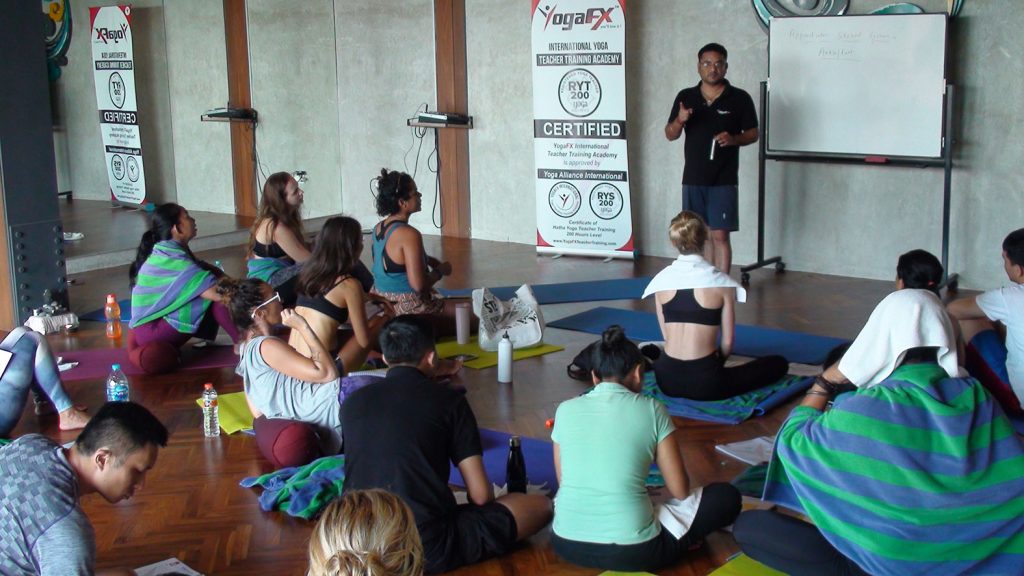
On a webcam, you see one angle of one student. In a studio, you scan 20 bodies at once and spot the knee that is about to lock badly. That skill only grows with live practice and a trainer standing next to you, which is why the best hot yoga certification programs never skip the practicum.
3. Feedback on Your First Class
Your first full class will feel shaky, and that is normal. Instead of finding out on paying students, it is far better to teach it in front of a senior trainer who stops you, corrects you and lets you try again. A good online program gives you live feedback sessions. A great one adds an in-person practicum.
That is why many schools, YogaFX included, prefer a hybrid format. The theory goes online, where you can study at your own pace. Then the heat, the bodies and the feedback happen in person. To see what that looks like week by week, read our online yoga teacher training breakdown.
7 Honest Checks Before You Pay for Any Online Program
Use this list on any hot yoga certification you are comparing, including ours. If a school cannot answer all seven clearly, keep looking.
- Is the school a Yoga Alliance Registered Yoga School? Search its name in the Yoga Alliance directory yourself. Don't rely on a badge image.
- Is it 200 hours, or an add-on? Check the prerequisites. If it needs a prior certificate, it is continuing education.
- Who is the lead trainer? Look for an E-RYT 500 with real teaching hours, not just a brand name.
- How are the 30 live hours delivered? Ask for the live session schedule, not only the video library.
- Will you teach a full class and get feedback? A practicum with corrections is where you become a teacher.
- Can you hear from graduates? Look for named reviews on Google and Yoga Alliance, plus video testimonials from people who now teach.
- Is your money safe? Pay the school directly where you can. Third-party booking platforms can fail, as our guide to looking beyond the booking screen before you pay explains.
Online forums are full of people who skipped checks two and five on their hot yoga certification. As a result, they hold a certificate that no studio will accept. The checks take an hour. Retraining takes months. And once you are qualified, see what the hot yoga instructor salary looks like in practice.
Is a Hot Yoga Certification Worth It? Cost, Time and Career Math
Whether a hot yoga certification is worth it depends on what you want from it. Some students want a teaching career. Others simply want to understand the practice that changed their own life. Both are good reasons, but they lead to different budgets.
The Time Cost
Traditional hot yoga trainings often ask you to leave work for several weeks. That is the hidden cost most people forget: lost income, rent at home, and time away from family. A hybrid course shrinks the time away, because most of the study happens before you travel.
For example, a student from London who studies the theory online for eight weeks only needs about a week away for the Bali intensive. Compare that with a month-long residential course, and the savings on rent, flights and unpaid leave can be larger than the course fee itself.
The Money Cost
Online-only study is the cheapest route to a hot yoga certification. A full hybrid certification with an in-person practicum costs more, because it includes trainers, a venue and live feedback. At YogaFX, the MasterClass is currently US$1,899 at the Early Bird rate (normally US$1,999), with interest-free payment plans from US$250 a month.
To see whether teaching could pay that back, run your own numbers with the free calculator below. It shows likely earnings by city, class count and pay rate.
Why People Stay With the Practice
Many teachers start because the practice helped them first. Research suggests that is more than a feeling. A Harvard-affiliated trial at Massachusetts General Hospital, published in the Journal of Clinical Psychiatry, found that 59% of participants in heated yoga had their depression symptoms drop by half or more over 8 weeks, compared with 6% on a waitlist (Nyer et al. 2023).
A 2025 systematic review of 43 studies and 942 participants also linked the 26-posture practice with gains in flexibility and general well-being (Willmott et al. 2025). These findings describe the practice, not a promise for every student. If you have a health condition, please consult a healthcare professional before starting a hot practice or a training.
The YogaFX Hybrid Path: Study Online, Finish With Mr. Ian Terry in Bali
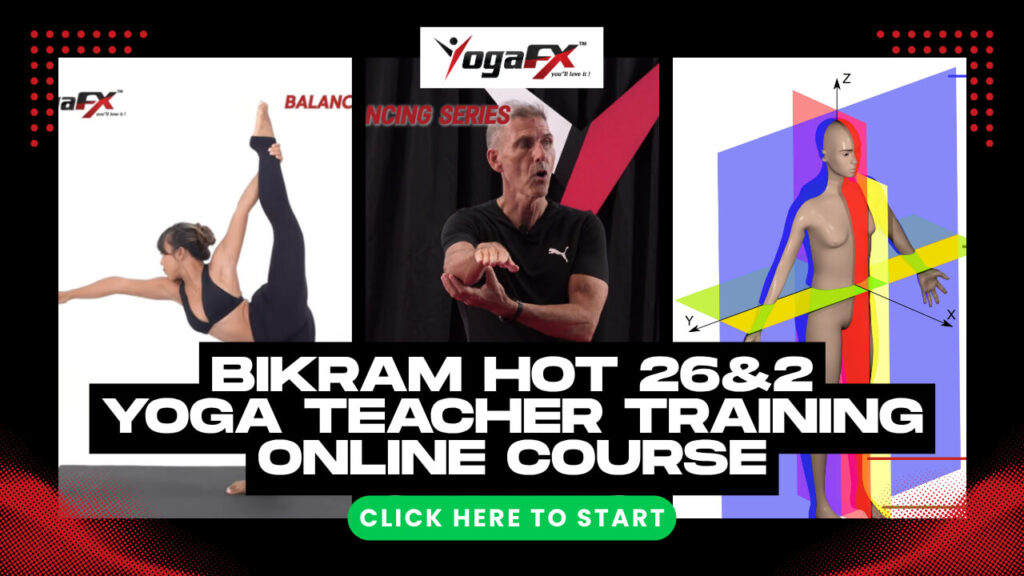
YogaFX built its program around the gaps described above. You start with the hot yoga teacher training online course at home, covering anatomy, philosophy, teaching method and the full standing series dialogue at your own pace.
Then, when you are ready, you join the 6-day Bikram Hot 26&2 Yoga Teacher Training MasterClass in Bali for the practical part. As listed on the course page, your online course fee is credited in full toward the MasterClass, so the online study doubles as your pre-course preparation.
- Dual certification. Your hot yoga certification combines the Yoga Alliance RYT 200-Hour plus the Bikram Hot 26&2 200-Hour International Yoga Certification.
- Lead trainer. Mr. Ian Terry, E-RYT 500, with more than 12,000 teaching hours and 5 years of training (2014 to 2019) with the founder of the method.
- Track record. More than 1,500 graduates from 80+ countries since 2017, and 550+ reviews across Google, Yoga Alliance and YouTube.
- Next batch. Check in Sunday 24 January 2027, check out Friday 29 January 2027, at Soham Wellness Center in Seminyak, Bali.
The idea is simple: learn the words at home, then learn to teach them in the heat with Mr. Ian beside you. That is how a hybrid hot yoga certification protects both your time and your teaching quality. In fact, several YogaFX graduates now compete for Indonesia at international Yogasana championships, and Mr. Ian serves as Master Trainer for the Republic of Indonesia Yogasana Sports Federation.
Who the Online Hot Yoga Certification Route Suits
- Career changers who cannot leave work for a month but can study in the evenings.
- Dedicated students who want to understand the 26 postures deeply, even if teaching comes later.
- Existing teachers from other styles who want a hot yoga certification without repeating a full residential course.
If you are none of these, and you would rather learn everything in one block, an in-person route may suit you better. Either way, the same 200-hour standard applies to your hot yoga certification.
Watch a behind-the-scenes look at the training below to see what the in-person days are like.
For a deeper look at the types of hot yoga certification and the hours each one needs, read this guide to hot yoga certification types. If you want to know how the training days actually feel, this article on what Bikram yoga teacher training is really like covers it day by day.
FAQ
Can you teach yoga with an online certification?
Yes, if your online hot yoga certification is a full 200-hour course from a Yoga Alliance registered school. Yoga Alliance accepts online and hybrid training, provided at least 30 hours are live. Studios still choose who they hire, so a strong practicum and a confident audition class matter as much as the certificate itself.
Can you do yoga teacher training online?
You can. Registered schools may now deliver a 200-hour training fully online, in person, or as a hybrid. For hot yoga, a hybrid route works best for most students, because theory and dialogue suit online study, while teaching in a heated room needs live practice and in-person feedback from a senior trainer.
How long does 200 hour yoga teacher training take?
It depends on the format. Full-time in-person trainings often run three to five weeks. Online courses are self-paced, so most students take a few weeks to a few months. A hybrid course combines both, with online study at home first, then a short in-person intensive for the practical teaching component.
Is yoga teacher training worth it?
For most graduates, yes, even those who never teach full time. A good hot yoga certification deepens your own practice and gives you a recognised qualification for part-time teaching. It is worth it when the course is a registered 200-hour program with live feedback, rather than a short add-on certificate that studios will not accept.
Can I teach yoga without certification?
In most countries there is no law requiring a certificate. In practice, though, almost every studio, gym and insurer asks for a 200-hour qualification. Without one, you will struggle to find work or get liability cover, so certification is the realistic starting point for anyone who wants to teach regularly.
Still have questions? Take the 2-minute quiz to see if you are ready, and Mr. Ian and the YogaFX team will follow up with answers for your situation. Are you ready to become a hot yoga teacher? Take the quiz, or go straight to the online course enrolment page.