
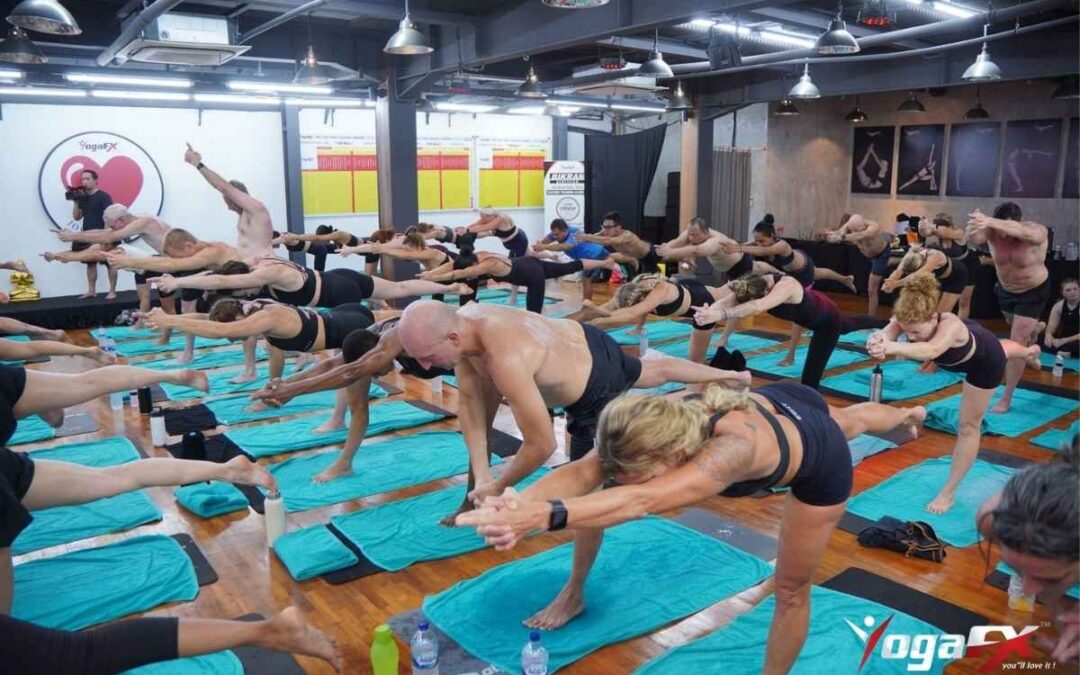
The best hot yoga mental health research so far says heated yoga can cut depression symptoms and lift well-being, but men barely appear in the data. In the two key trials, 79% and 81.5% of volunteers were women. So the results probably apply to men too, yet nobody has measured that directly.
Hot Yoga Mental Health in Men: The Short Answer
If you're a man wondering whether a hot class could help your head as much as your hamstrings, here's the honest picture. Two randomised trials give us the strongest hot yoga mental health evidence we have. Both found real benefits. Neither one was built to answer your question.
That gap matters because men are less likely to ask for help with low mood, so they are also less likely to sign up for a depression study. As a result, the people who joined these trials were mostly women in their late twenties and early thirties.
Here is what the evidence does and does not tell a man reading it today:
- It does show that 8 weeks of heated yoga lowered clinician-rated depression scores far more than waiting did.
- It does show that 6 weeks of hot yoga raised mindfulness, peace of mind and life satisfaction in healthy adults.
- It does not show whether men respond more, less or the same, because too few men took part to compare.
- It does not replace treatment. Hot yoga sits beside professional care, not instead of it.
That's the frame for the rest of this guide. We'll walk through exactly what researchers measured, why men are missing, and how a man can use the practice sensibly while the science catches up.
What Researchers Measured in the Two Key Trials
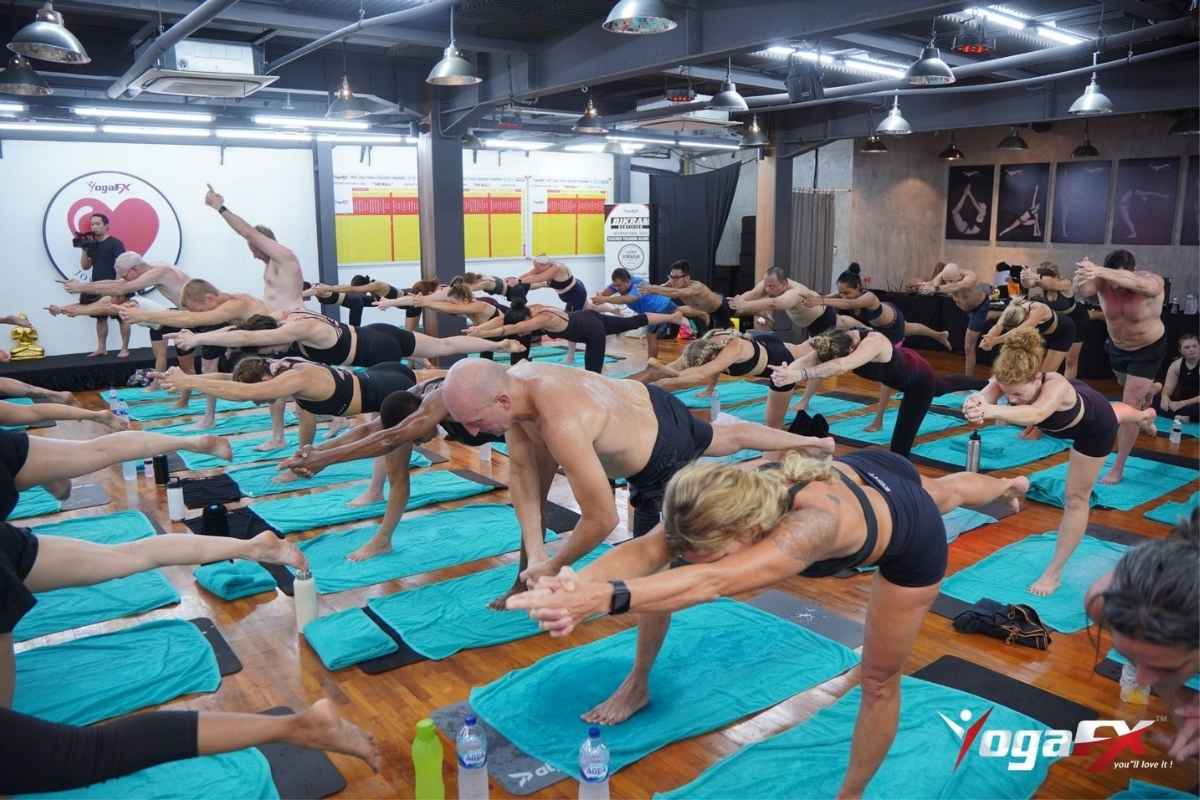
Most headlines about hot yoga mental health benefits come from just two studies. One tested people with depression in Boston. The other tested healthy adults in Cambridge, UK. The table puts them side by side, including the detail most articles skip: who actually took part.
| Study | Who took part | Women in sample | Dose | What they measured | Main result |
|---|---|---|---|---|---|
| Massachusetts General Hospital (Nyer et al. 2023) | 80 adults with moderate to severe depression randomised, 65 analysed | 81.5% | Two 90-minute classes a week at 105°F, 8 weeks | Clinician-rated depression score (IDS-CR) | 59% of the yoga group cut symptoms by half or more, vs 6% on the waitlist |
| Cambridge, UK (Hui et al. 2022) | 290 healthy adults new to yoga | 79% | Up to four 90-minute classes a week at 40°C, 6 weeks | Mindfulness, peace of mind, life satisfaction, general health, moods four times a day | Gains on five of six well-being measures vs a waitlist |
The Boston Depression Trial
Researchers at Massachusetts General Hospital randomised 80 adults with moderate to severe depression. Half were asked to attend two heated classes a week for 8 weeks. The rest waited. A clinician then scored each person's symptoms with the Inventory of Depressive Symptomatology, a standard rating scale.
The result was striking. 59.3% of the yoga group saw their symptoms drop by 50% or more, compared with 6.3% of the waitlist group, according to a summary from MGH Psychiatry News. The effect size was large, and no serious side effects were reported.
Attendance was lower than planned, however. Participants averaged about 10 classes over 8 weeks, not 16. Even so, Harvard Health reported that people who managed roughly one class a week still improved.
The Cambridge Well-Being Trial
The second hot yoga mental health study asked a different question: does hot yoga help people who aren't depressed? Bryant Hui and colleagues gave 290 yoga beginners six weeks of free 90-minute classes in a 40°C room. Participants attended about 17 classes each.
Compared with a waitlist, the hot yoga group gained in mindfulness, peace of mind, life satisfaction, eudaimonic well-being and general health. Flourishing did not change. People who started with the lowest well-being gained the most, which is worth noting for anyone who feels flat right now. You can read the full paper in Psychosocial Intervention.
The Missing Men in Hot Yoga Mental Health Studies
Look again at that women column. Only about one in five volunteers in either trial was a man. The Cambridge authors list this skew as a limitation themselves. So any claim about men's mental health yoga results is, for now, an educated guess built on mostly female data.
81.5%
Women in the MGH trial
Share of the 65 analysed adults with depression who were female.
79%
Women in the Cambridge trial
Share of the 290 healthy beginners who were female.
59%
Halved their symptoms
Heated yoga group in the MGH trial, vs 6% of the waitlist.
22.3 vs 5.6
US suicide rate per 100,000
Men vs women in 2024, about four times higher for men.
Why Men Don't Sign Up
The reason men are missing from hot yoga mental health data is the same reason they're missing from therapy rooms. A 2016 systematic review led by Zac Seidler at the University of Sydney looked at how masculinity shapes help-seeking for depression. Later researchers summarise its finding bluntly: men were about half as likely as women to seek help from a GP for mental health concerns.
A 2020 German study of 12 men treated for depression, published in Frontiers in Psychiatry, explains why. Before treatment, the men held onto ideas of being strong, self-reliant and the provider. So they played down symptoms and tried to fix things alone.
Why It Matters
Silence also has a cost. In 2024 the US suicide rate was 22.3 per 100,000 for men and 5.6 for women, according to the CDC's National Center for Health Statistics. That's roughly four times higher for men.
Hot yoga isn't a crisis tool, and nobody should treat it as one. If you're thinking about suicide, call or text 988 in the US, or your local emergency number, today. But for many men, a structured physical practice can be an easier first door than a waiting room.
Why a Hot Room May Suit Men Who Avoid Talking
Here's where the research on men and the design of a hot class meet. Seidler's later PhD work at the University of Sydney found that men in therapy valued structured, goal-focused treatment and wanted to understand the system they were in. The Original Hot 26&2 class is built almost entirely on structure.
- Same sequence every time. 26 postures and 2 breathing exercises, in the same order, so progress is easy to see.
- No talking required. The teacher speaks a scripted dialogue. You just follow it, with no group sharing.
- A clear physical goal. Locking the knee in Dandayamana Janushirasana or going deeper in Ustrasana gives you a target you can measure.
- A fixed time box. Each class runs 90 minutes in about 40°C and 40% humidity, then it's over.
That doesn't prove hot yoga works better for men. It does suggest why some men who would never book a counsellor will show up to a hot room three times a week. The Frontiers study also found that men valued men-only peer groups, where they could admit weakness without judgment. A shared, sweaty, silent class can play a similar role.
Mr. Ian Terry, E-RYT 500 and founder of YogaFX, teaches the class this way on purpose. Over more than 12,000 teaching hours, he has kept the dialogue, the order and the timing fixed, so every student knows exactly what comes next. For a man who dislikes open-ended conversation, that predictability is often what makes the first class possible.
How Men Can Use Hot Yoga for Mental Health Safely
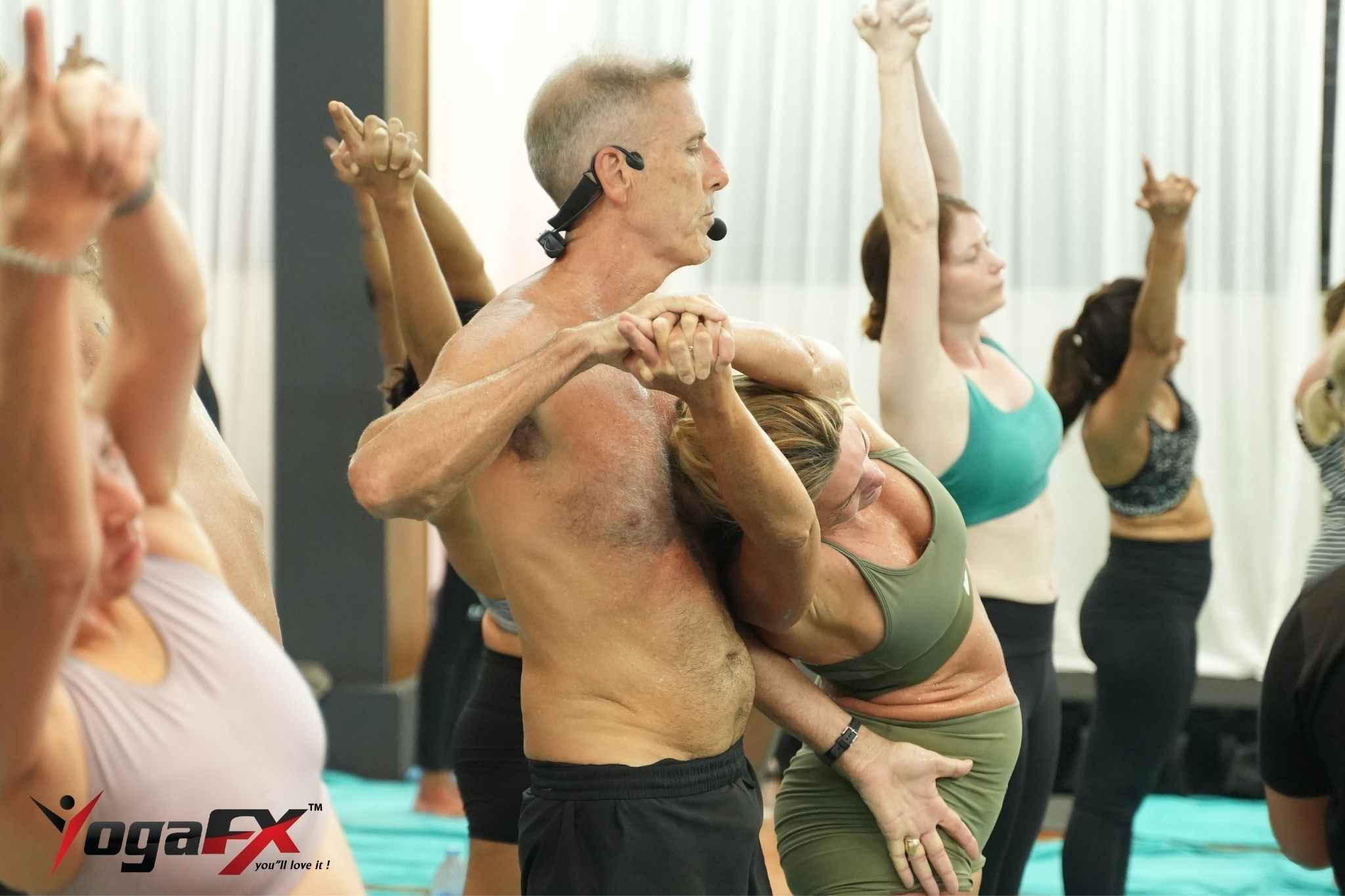
If you want to try hot yoga for mental health, copy the dose researchers actually tested rather than guessing. That is also the safest way to test hot yoga mental health benefits for yourself, because you can compare your results with theirs. This plan follows the MGH and Cambridge protocols as closely as a normal working week allows.
- Check with your doctor first. Do this especially if you have heart problems, high blood pressure, or take medication that affects heat tolerance.
- Book two classes a week for 8 weeks. That was the MGH target. One a week still helped, so don't quit if life gets busy.
- Keep your existing care. Some MGH participants were already taking antidepressants. Yoga was added, not swapped in.
- Track one number. Rate your mood from 1 to 10 after each class. Researchers in Cambridge tracked mood four times a day for the same reason.
- Hydrate and pace yourself. Sit down when you need to. Heat is a stressor, and pushing through dizziness proves nothing.
Expect the first two or three classes to feel rough, but that's normal. Many men are surprised by how hard the heat is, because a 90-minute class is a real workout. A University of Wisconsin study (Porcari et al. 2014) measured an average of 460 calories for men per class at about 80% of maximum heart rate.
When Hot Yoga Is Not Enough
Watch for signs that you need more than a class. These include low mood lasting more than two weeks, losing interest in things you used to enjoy, drinking more to cope, or any thoughts of harming yourself. In any of those cases, please consult a healthcare professional. The hot yoga mental health research supports the practice as an addition to care, never a replacement.
What Our Trainees Say About the Mental Side
Data tells you what happens on average. Trainees tell you what it feels like. These three comments come from video reviews recorded at the end of YogaFX teacher trainings, so each one touches on the hot yoga mental health side of the practice.
"It took me to real depth, mentally, physically. I could not even imagine it would be like that. The third day I felt like I was shining, and the fourth day was much easier."
Jamasb, YouTube review, 2026
"This is not like physical practice, but our emotion, our mental, our heart, our love." (translated)
Arkan, YouTube review, 2023
"I'm going to also use my skills and do research into Bikram yoga and mental health, which is my passion."
Fiona, YouTube review, 2025
Jamasb's description of day two as the hardest and day three as the turning point matches what many trainees report. You can watch his full review below.
The Limits of the Evidence
Our site leans on graded evidence, so it's only fair to grade this body of work too. The hot yoga mental health findings are promising, but they're early. Here's what a careful reader should keep in mind.
- No active control. Both trials compared yoga with waiting, not with a gym class or room-temperature yoga. So we can't separate the heat from the exercise.
- Short follow-up. The trials ran for 6 and 8 weeks, so long-term hot yoga mental health results are thin.
- Small male samples. With about one man in five, neither study could test whether men respond differently.
- Volunteers, not patients off the street. People who sign up for a yoga study may already be open to yoga.
None of this cancels the results. It means the honest headline is "promising, especially for women, and probably for men too." The next useful study would recruit men on purpose, for example through workplaces or sports clubs, and compare heated with unheated classes.
Bikram Yoga Mental Health Research and the 26&2 Sequence
You'll see this topic searched as bikram yoga mental health, too. The MGH team describes its classes as heated yoga in a 105°F room, and Harvard Health notes the style is also called Bikram yoga. Today most studios teach the same sequence as Original Hot 26&2.
For the depression-specific evidence in more depth, see this guide to what the research shows on Bikram yoga for depression. For anxiety, read about the real benefits and honest risks of hot yoga for anxiety.
Learn the Method Online With YogaFX
Some men who feel the hot yoga mental health benefits first-hand decide they want to understand it properly, or even teach it. That's exactly who our hot yoga teacher training online course was built for. You study the 26 postures, the dialogue and the science at home, on your own schedule.
The course is led by Mr. Ian Terry, E-RYT 500, who has more than 12,000 teaching hours. He trained for 5 years, from 2014 to 2019, with the founder of the method. Since 2017, YogaFX has trained more than 1,500 graduates from 80+ countries.
- Start with the postures. Our guide to the 26&2 poses breaks down each one.
- See how online study works. Read the 8-week breakdown of online yoga teacher training.
- Check any course first. Use these 7 honest checks for an online hot yoga certification.
When you're ready for the heat, the next step is the 6-day Bikram Hot 26&2 Yoga Teacher Training MasterClass in Bali. The next batch checks in on Sunday 24 January 2027 at Soham Wellness Center in Seminyak. The Early Bird price is US$1,899 (normally US$1,999), with payment plans from US$250 a month.

FAQ
Is hot yoga good for mental health?
Early research says yes. A Massachusetts General Hospital trial found 59% of people with depression halved their symptoms after 8 weeks of heated yoga, and a Cambridge trial found gains in mindfulness and life satisfaction. Most participants were women, so results for men are likely but not yet measured directly.
Can hot yoga help with depression?
It may help as an addition to care. In the MGH trial, adults with moderate to severe depression who did heated yoga improved far more than a waitlist group, with no serious side effects. It is not a replacement for treatment, so keep working with your doctor or therapist while you practise.
Can hot yoga help with anxiety?
Hot yoga may ease everyday stress. In the Cambridge trial, six weeks of classes raised peace of mind and mindfulness in healthy adults, and moods rose on studio days. Anxiety disorders were not the focus, so anyone with diagnosed anxiety should ask a healthcare professional before starting.
How many hot yoga classes to see a difference?
The MGH trial asked for two classes a week for 8 weeks, and participants averaged about 10 classes in total. Harvard Health reported that people who managed about one class a week still improved. In Cambridge, people attended around 17 classes over six weeks. So aim for two a week, but don't give up if you only manage one.
Who should not do hot yoga?
Talk to your doctor first if you have heart problems, high blood pressure, are pregnant, or take medication that affects heat tolerance. Harvard Health specifically advises people with heart conditions to check before trying it. Anyone in a mental health crisis should seek urgent professional help rather than start a class.
Still have questions? Mr. Ian and the YogaFX team answer them personally. Take the 2-minute quiz to see if you're ready to teach hot yoga, or go straight to the online course enrolment page.