
Hot yoga inflammation research is mostly indirect. Blood tests such as C-reactive protein (CRP) track inflammation, and reviews of yoga in general report mixed CRP results, with clearer signals for other markers. We could not open a hot yoga trial that reports CRP, so treat any claim of proof with caution.
This article is general education, not medical advice. If you have an inflammatory condition, heart disease or a recent abnormal blood test, consult a healthcare professional before any heated class.
Hot Yoga Inflammation in Short: What We Could Verify
Most pages on hot yoga inflammation promise a clean answer. The sources we could open and check give a more careful one. Here is the short version, and every point is explained further down.
- CRP is a blood marker. Your liver makes it in response to inflammation, and the test shows how much inflammation you have, not what is causing it.
- Yoga in general has mixed CRP results. A 2022 review describes some trials with lower CRP and others with no change.
- Other markers look stronger. The same review says the most conclusive data points to IL-1β and IL-6, not CRP.
- Hot yoga is the missing piece. We found no heated-class trial with verified CRP results, so the link is still a hypothesis.
- Context decides a CRP number. Infections, smoking, sleep, weight and even hard exercise before the test can move it.
So the honest summary of hot yoga inflammation research is this: the idea is plausible, the direct proof is thin, and your own doctor is the person who can read your blood results.
What CRP Actually Measures, in Plain Words
Before you can judge any claim about hot yoga inflammation, you need to know what the number means. CRP is the marker most often quoted, so we start there.
What the Test Shows
According to MedlinePlus, a C-reactive protein test measures the level of CRP in a blood sample, and the liver makes CRP in response to inflammation. The CRP test tells your provider how much inflammation is in your body, but not what is causing it or where it is.
The Mayo Clinic says the same thing in other words: the level rises when there is inflammation, and the test doesn't show the cause. It adds that it's possible to have a high hs-CRP level that doesn't affect the heart.
Two Versions of the Test
There are two versions, and mixing them up is a common mistake. A standard CRP test looks for infection or chronic inflammatory disease. A high-sensitivity CRP test, called hs-CRP, picks up much smaller rises and is used to estimate heart disease risk.
The Unit Trap
Labs report CRP in different units. Mayo Clinic quotes milligrams per litre (mg/L), while MedlinePlus quotes milligrams per decilitre (mg/dL). One mg/dL equals 10 mg/L, so a number like 1.0 and a number like 10 can mean the same thing. Always check the unit on your own report before you compare any hot yoga inflammation numbers.
| Test or rule | What it is used for | Number quoted by the source | Source |
|---|---|---|---|
| Standard CRP | Checking for infection or chronic inflammatory disease | 8 to 10 mg/L or higher is considered high, and the range varies by lab | Mayo Clinic |
| Standard CRP, other unit | The same question, written in mg/dL | 0.8 to 1.0 mg/dL or lower is thought to be healthy (about 8 to 10 mg/L after conversion) | MedlinePlus |
| hs-CRP | Estimating heart disease risk | Under 2.0 mg/L is lower risk, and 2.0 mg/L or more is higher risk | Mayo Clinic |
| Repeat testing | Smoothing out day-to-day swings | Risk is usually based on the average of two tests about two weeks apart | Mayo Clinic |
What Moves CRP Besides Yoga
This is where hot yoga inflammation claims often fall apart, so slow down here. A CRP result is a blunt tool, and plenty of everyday things push it around. MedlinePlus lists infections, inflammatory bowel disease, autoimmune disorders, asthma and other lung diseases, smoking, and exposure to polluted air.
It also links higher results to insomnia, depression, obesity and menopausal hormone therapy. Some medicines, including common pain relievers such as ibuprofen and aspirin, can affect the result too. So a change in CRP after a few weeks of classes could come from many places, not only from hot yoga inflammation changes.
What Reviews of Yoga and CRP Report
The best source we could open for hot yoga inflammation questions is a mini-review by Carolina Estevao of King's College London. It appeared in Brain, Behavior, & Immunity - Health in 2022 under the title "The role of yoga in inflammatory markers". It looks at yoga broadly, not at heated rooms.
What the Review Says About CRP and Hot Yoga Inflammation
The abstract describes strong evidence for yoga's effect on circulating cortisol and classical inflammatory markers such as CRP. Read the trial-by-trial discussion, though, and the picture gets more mixed. That difference matters for any claim about hot yoga inflammation.
- Lower CRP: several trials found CRP reductions, for example in people with rheumatoid arthritis and in people with heart failure.
- No change: other trials found none, including a hypertension trial (Wolff, 2015) and a breast cancer trial (Bower, 2014).
- Small numbers: the breast cancer trial had 28 participants, and its authors blamed limited statistical power for the lack of a significant result.
- Stronger signals elsewhere: the review concludes that the most conclusive data points to benefits for IL-1β and IL-6.
The Limits the Review States
The author is open about the weak spots. Studies used different yoga styles and doses, and most were pilot single-arm studies, which means no comparison group. Follow-up was short, and there were limits in how the biomarkers were analysed. None of that is a reason to dismiss yoga. It is a reason not to oversell it.
| What we looked at | What it reported | Why it can't settle hot yoga inflammation |
|---|---|---|
| Estevao 2022, yoga trials and CRP | Some trials found lower CRP (rheumatoid arthritis, heart failure), others found no change (hypertension, breast cancer) | Mixed yoga styles and doses, and mostly pilot single-arm studies |
| Estevao 2022, other markers | The most conclusive data points to IL-1β and IL-6 | These are not CRP, and the review is not about heated rooms |
| Hot yoga trials with CRP results | None that we could open and verify | This is a gap in our search, not proof that no study exists |
| MedlinePlus and Mayo Clinic | CRP rises with inflammation but doesn't show the cause | A CRP change can come from sleep, weight, infection or training load |
Notice the third row. We looked for a hot yoga trial that measured CRP and could open none. Some PubMed pages were blocked to our tools, so a study may exist that we simply couldn't read. If you find one, read the abstract yourself before you repeat its number.
Where Heat Fits In: The Heat Shock Protein Idea
If yoga in general gives mixed CRP results, why do people link hot yoga inflammation to heat at all? The usual answer is a family of cell proteins called heat shock proteins, or HSPs. We covered the studies behind them in our post on heat shock proteins and hot yoga.
The Mechanism in One Paragraph
The course guide we teach from describes it this way. Mild heat stress prompts cells to make HSPs, mainly HSP70 and HSP90. These act as molecular chaperones, meaning they help keep other proteins folded and repair damaged ones. The guide also says HSPs may suppress pro-inflammatory pathways, and that heat exposure may lower markers such as CRP.
Why Hot Yoga Inflammation Is Still a Hypothesis
That chain is a plausible story, and it's a useful teaching model. But each link needs its own evidence in people doing hot yoga, and we could not verify the last link, a lower CRP after heated classes, from a source we could open. So we present it as an idea to test, not a result.
Stress hormones are a neighbouring question. Our post on whether hot yoga increases cortisol covers a study that saw a short rise during class and a calmer stress response after eight weeks. Cortisol and hot yoga inflammation research overlap, but a cortisol result is not a CRP result.
Hot Yoga Inflammation at a Glance
If you only want the figures, here they are in one place. Each card comes from the sources above, and the references sit under the graphic.
5 Things CRP Studies Can and Cannot Tell You
Use these five checks whenever you meet a headline about hot yoga inflammation. They work for any yoga or heat claim, and they are the checks we ask trainees to run.
- A CRP change is not a cause. Both MedlinePlus and Mayo Clinic say the test shows how much inflammation, not why.
- Averages beat single readings. Mayo Clinic bases heart risk on two hs-CRP tests about two weeks apart, so one blood draw proves little.
- Pilot studies are signals. The 2022 review says most studies in the field were pilot single-arm studies. A signal is something to test next, not a result to bank.
- Yoga is not hot yoga. A trial of gentle yoga can't tell you what hot yoga inflammation looks like at 40°C, and the reverse is true as well.
- One marker is not one body. The review found stronger data for other markers than for CRP, so a single number never tells the whole story.
Soreness After Class Is Not Chronic Hot Yoga Inflammation
Many people search for hot yoga inflammation because they feel puffy or sore after class. That's a fair worry, but it is a different question from the one CRP answers. A sore hamstring the next morning is a short-lived effect of effort. A CRP result describes a longer pattern, and the two shouldn't be confused.
Hard Exercise and the Blood Test
Here is a practical point from Mayo Clinic. It says hard exercise, such as intense weight training or a long run before the test, can cause a sudden jump in CRP. A tough 90-minute heated class is hard exercise too. That's our inference, because we found no study that timed CRP after hot yoga. Still, tell your doctor if you trained shortly before a blood draw.
When to Stop and Get Help
Soreness that fades in a day or two is common after a demanding class. Pain, swelling or heat in one joint that does not settle is different, and so are fever, chest pain, fainting or confusion. Those need a medical opinion, not another class. Our post on feeling tired after hot yoga covers the fatigue side of recovery.
Small samples are another reason for care. In our guide to hot yoga and blood pressure, two studies of 42 and 10 people gave results that did not line up neatly. Hot yoga inflammation research has the same problem, which is why we keep repeating the limits.
Questions to Bring to Your Doctor About Inflammation
If you practise alone at home, nobody is watching your face for signs of strain. That makes preparation matter more. Write your questions about hot yoga inflammation down, and bring any blood test results you already have.
- Which inflammation marker, if any, should I track, and how often?
- Is my CRP or hs-CRP result affected by medicine, weight, sleep or recent training?
- Does my condition or medication change how I handle heat and fluid loss?
- Would a cooler or shorter class be a safer first step for me?
- Which symptoms should make me stop class and call you?
A good doctor will welcome the list. It also shows you where your own question sits, which is usually somewhere between curiosity and a real medical concern.
How Online Trainees Should Talk About Hot Yoga Inflammation
If you are studying to teach, this topic is a good test of your judgment. Students will ask about hot yoga inflammation, usually whether heat reduces it. A trustworthy teacher answers with what was measured, says what is still unknown, and then points to the student's doctor.
Follow these four steps before you repeat a claim in class:
- Name the marker. Say CRP, IL-6 or cortisol, not just "inflammation".
- Name the group. Say who took part, how many, and for how long.
- Name the style. Say whether it was yoga in general or a heated class.
- Name the limit. Say what the study couldn't show, then stop there.
Mr. Ian Terry, E-RYT 500, leads the course. He has more than 12,000 teaching hours and trained for five years, from 2014 to 2019, with the founder of the method. We follow the same four steps for every science topic on this site. To see how physiology sits inside a programme, read what the physiology module of a hot yoga teacher training should teach.
What Our Trainees Say About the Course
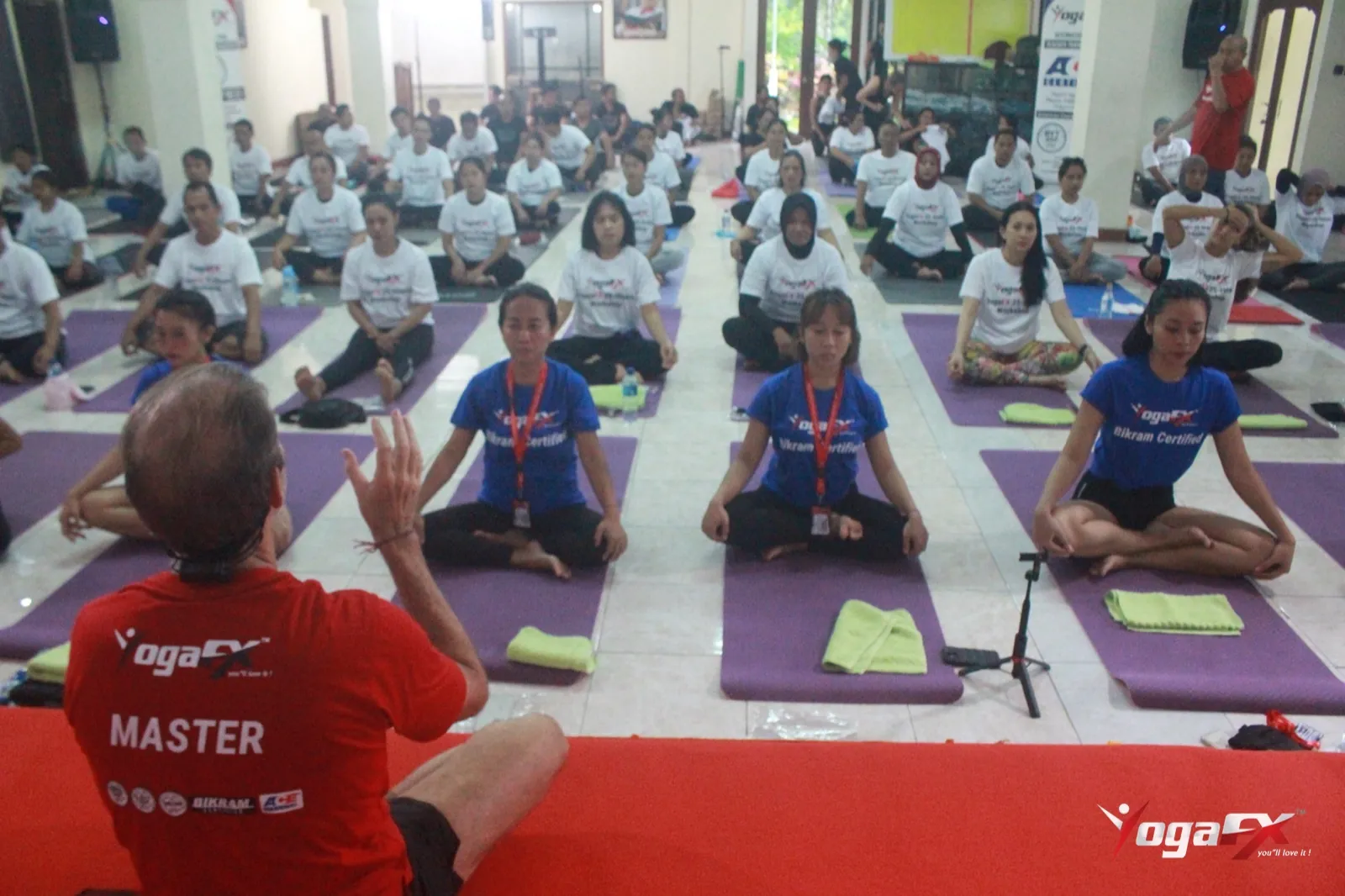
Research is one half of a good teacher. The other half is delivering a class with care. Three graduates of the hybrid course, where theory is studied at home before the practical week in Bali, described the experience in their video reviews on YouTube. None of them is about hot yoga inflammation, but they show what the learning feels like.
"It's been the most challenging mentally physically spiritually I ever experienced and the best thing I've ever done."
Emelie, YouTube review, 2024
"Thank you Mr Ian, you never let us quit, you kept pushing forward."
A trainee in our YouTube review, 2024
"Wishing you health and spirit, a healthy life, and thank you." (translated from Indonesian)
Novi, YouTube review, 2024
These are personal experiences, not evidence about inflammation or health outcomes. You can watch Emelie's full video below and judge the course for yourself.

The Bottom Line on Hot Yoga Inflammation
Here is where the evidence leaves us. Hot yoga inflammation research is still mostly a question, not an answer. CRP is a real and widely used marker. Yoga in general shows mixed CRP results and stronger signals for other markers. Direct CRP data from heated classes is missing from the sources we could open.
So if you enjoy hot yoga, these sources give you no reason to fear it and no reason to expect a lower blood marker. If inflammation is a medical concern for you, the useful next step is a conversation with your doctor, not a hot yoga inflammation experiment on your own.
Learn the Physiology at Home With YogaFX
If this look at hot yoga inflammation made you want to understand the body in the heat, that curiosity is what good hot yoga teachers share. Our online hot yoga teacher training lets you study the 26 postures, the dialogue and the science from home, at your own pace.
The online course costs US$329, or four payments of US$82. YogaFX has trained more than 1,500 graduates from 80+ countries since 2017, and the lead trainer is Mr. Ian Terry.
- Take the 2-minute quiz to see if you are ready to teach hot yoga.
- Go straight to the online course enrolment page when you are ready.
FAQ
Does hot yoga reduce inflammation?
Nobody can say yet. A 2022 review found mixed CRP results for yoga in general, with some trials showing lower CRP and others no change. We could not open a hot yoga trial reporting CRP. Heat shock proteins offer a plausible idea, but it remains a hypothesis. Ask your doctor about any inflammatory condition.
Can hot yoga cause inflammation?
We found no study showing that hot yoga causes chronic inflammation. Mayo Clinic notes that hard exercise before a blood test can cause a sudden jump in CRP, so a tough class shortly before a draw may matter. Persistent pain, swelling or fever needs a doctor, not another class.
What does a high CRP result mean?
It means there is more inflammation in your body, but not what causes it or where it is. Infections, smoking, obesity, poor sleep and some diseases can all raise CRP. Mayo Clinic says hs-CRP of 2.0 mg/L or more is linked to higher heart risk. Your doctor should interpret your result.
Is hot yoga good for arthritis?
We found no hot yoga trial in arthritis that we could open. The 2022 review mentions yoga trials in rheumatoid arthritis with lower CRP, but those studied yoga in general, not heated rooms. Heat and joints affect people differently, so talk to your rheumatologist or doctor before starting any heated class.
Why do I feel puffy or sore after hot yoga?
Soreness after a demanding class is a short-term effect of effort and is different from the chronic inflammation CRP measures. Soreness that fades within a day or two is common. Pain, swelling or heat in one joint that does not settle, fever, chest pain or fainting needs medical advice.
Still have questions? Mr. Ian and the YogaFX team answer them personally. Take the 2-minute quiz or go to the online course enrolment page.

Founder and lead trainer of YogaFX International Yoga Teaching Academy, with more than 12,000 hours of teaching. He trained for 5 years, from 2014 to 2019, with the founder of the Bikram Hot 26&2 method.
Published · Last reviewed and updated
You may also like
Explore all articles Hot Yoga Science and Benefits12 min read19 Nov 2026
Heat Therapy Benefits and How Hot Yoga Fits In
Read article ↗ Hot Yoga Science and Benefits11 min read19 Nov 2026
Heat Shock Proteins and Hot Yoga: 4 Facts From Real Studies
Read article ↗ Hot Yoga Science and Benefits12 min read19 Nov 2026