
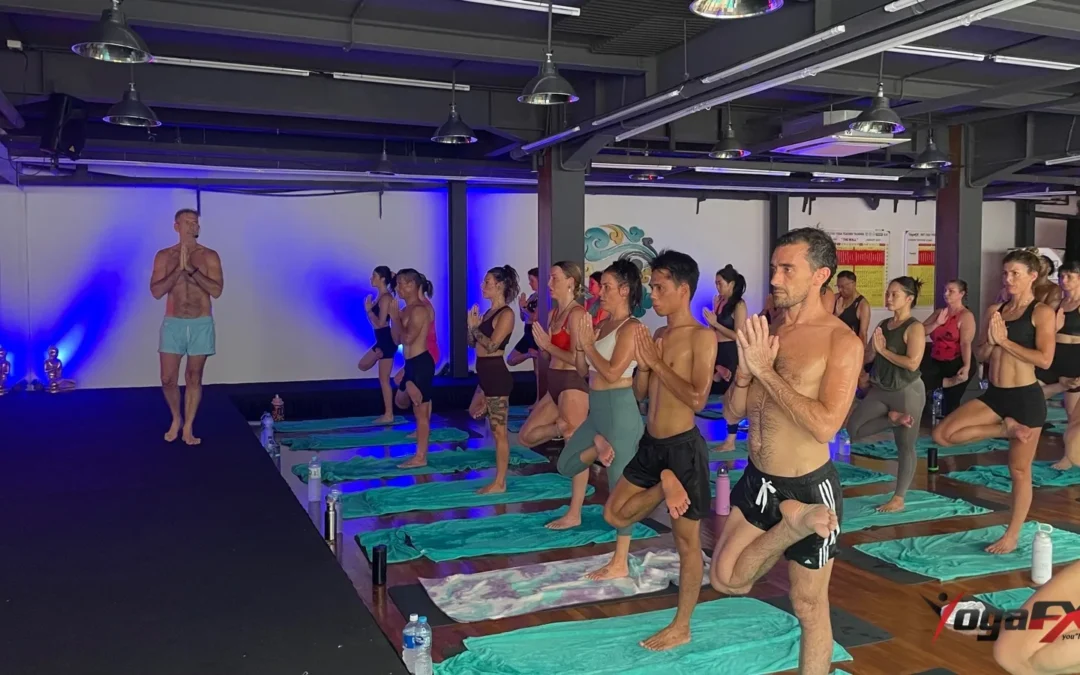
Pranayama breathing in hot yoga means two exercises: Standing Deep Breathing at the start of class and Kapalbhati, called Blowing in Firm, at the end. You can learn both online, at room temperature, before you ever enter a heated room. Start with slow nasal breaths, and add the closing exercise gently.
In this article11 sections
- Pranayama Breathing in Hot Yoga: The 2 Exercises Side by Side
- Nasal Pranayama Breathing as Your Inner Thermostat
- Exercise One: Learn Pranayama Breathing as Standing Deep Breathing
- Exercise Two: Kapalbhati, Learned Gently at Home
- A Four-Week Home Order for Pranayama Breathing
- What the Research Says About Slow Pranayama Breathing
- When Heat Pushes Back: Safety Settings for Pranayama Breathing
- Pair Breath Work With Rest
- What Students Say About Learning to Breathe in Class
- Learn Pranayama Breathing Online With YogaFX
- FAQ
This guide follows the teaching of Mr. Ian Terry, E-RYT 500, founder and lead instructor at YogaFX. He has taught the Original Hot 26&2 method for more than 12,000 hours. We wrote it for online learners, so every step works in a normal room at home. It is general information, not medical advice.
Below you will find how each pranayama breathing exercise works, why the nose matters, what the research shows and a four-week home order that builds the skill safely. We also point out where this practice meets the heat, because a hot room changes the rules.
Pranayama Breathing in Hot Yoga: The 2 Exercises Side by Side
The name 26&2 counts 26 postures and 2 breathing exercises. Pranayama, also called Standing Deep Breathing, comes first. Kapalbhati comes last. In between sit the postures and a short rest, so the breath frames the whole class like a pair of bookends.
| Exercise | Where it sits in class | Breath pattern | Pace | How to learn it at home |
|---|---|---|---|---|
| Pranayama (Standing Deep Breathing) | First, before any posture | Slow inhale through the nose, release through an open mouth | Slow and steady, paced by a spoken count | Daily, standing, about 5 minutes, any room |
| Kapalbhati (Blowing in Firm) | Last, after the floor series | Quick, forceful exhales | Short bursts, built up gently | From week 3, a few gentle rounds, stop at the first sign of dizziness |
| Between the two | During postures and rests | Natural breathing, mostly through the nose | Steady, never held | Notice it in every posture you practise |
Notice what this pranayama breathing asks you not to do. There is no ratio to memorise, no finger position and no breath hold. Each exercise has one clear job, so a beginner can finish it. That simplicity is why it works so well as a home skill.
Nasal Pranayama Breathing as Your Inner Thermostat
Mr. Ian Terry calls the breath your inner thermostat. That phrase is a teaching image, not a research finding. The idea is simple. When a room is hot and your heart rate climbs, many people gulp air through the mouth. The breath turns fast and shallow, and the effort feels bigger than it is.
A slow nasal breath gives you a way to turn the dial back down. In class, Mr. Ian teaches that this calmer pattern keeps the heart steadier and the class manageable. We can see it on the mat week after week. We cannot prove it with a trial, and we say so plainly.
What the biology says
Does the nose really help? The nasal airways make nitric oxide, a gas the body also uses in other ways. A 1996 review in the European Respiratory Journal by Lundberg and colleagues reported that, in healthy people, exhaled nitric oxide seems to come mainly from the nasal airways.
That is a fact about biology. It is not a promise about yoga, and we know of no study that tested nasal breathing inside a 40°C (104°F) yoga room.
There is also a precedent outside yoga. The NHS stress exercise tells readers to try breathing in through the nose and out through the mouth. That is the same pattern as Standing Deep Breathing.
Treat those five settings as a checklist for pranayama breathing in any room. They also set up the first exercise, which we cover next.
Exercise One: Learn Pranayama Breathing as Standing Deep Breathing
In a live class you stand tall, feet together, and the teacher guides your arms into the position the dialogue describes. You breathe in through your nose, then let the air go out through an open mouth. A typical class runs about 2 sets. The exact words belong to the course, so treat the steps below as a map, not a script.
- Stand tall with your feet together and your weight even. Look straight ahead.
- Let your shoulders drop, and lift the ribs without arching your lower back.
- Breathe in through your nose for a slow count of 5.
- Let the breath out through an open mouth for a slow count of 5.
- Repeat for about a minute at first, then stand normally and notice your heartbeat.
A count of 5 in and 5 out comes to about six breaths a minute. That is a sound pace for pranayama breathing, and it sits inside the slow range the research describes. Count in your head, or use a quiet phone timer, so you are never guessing.
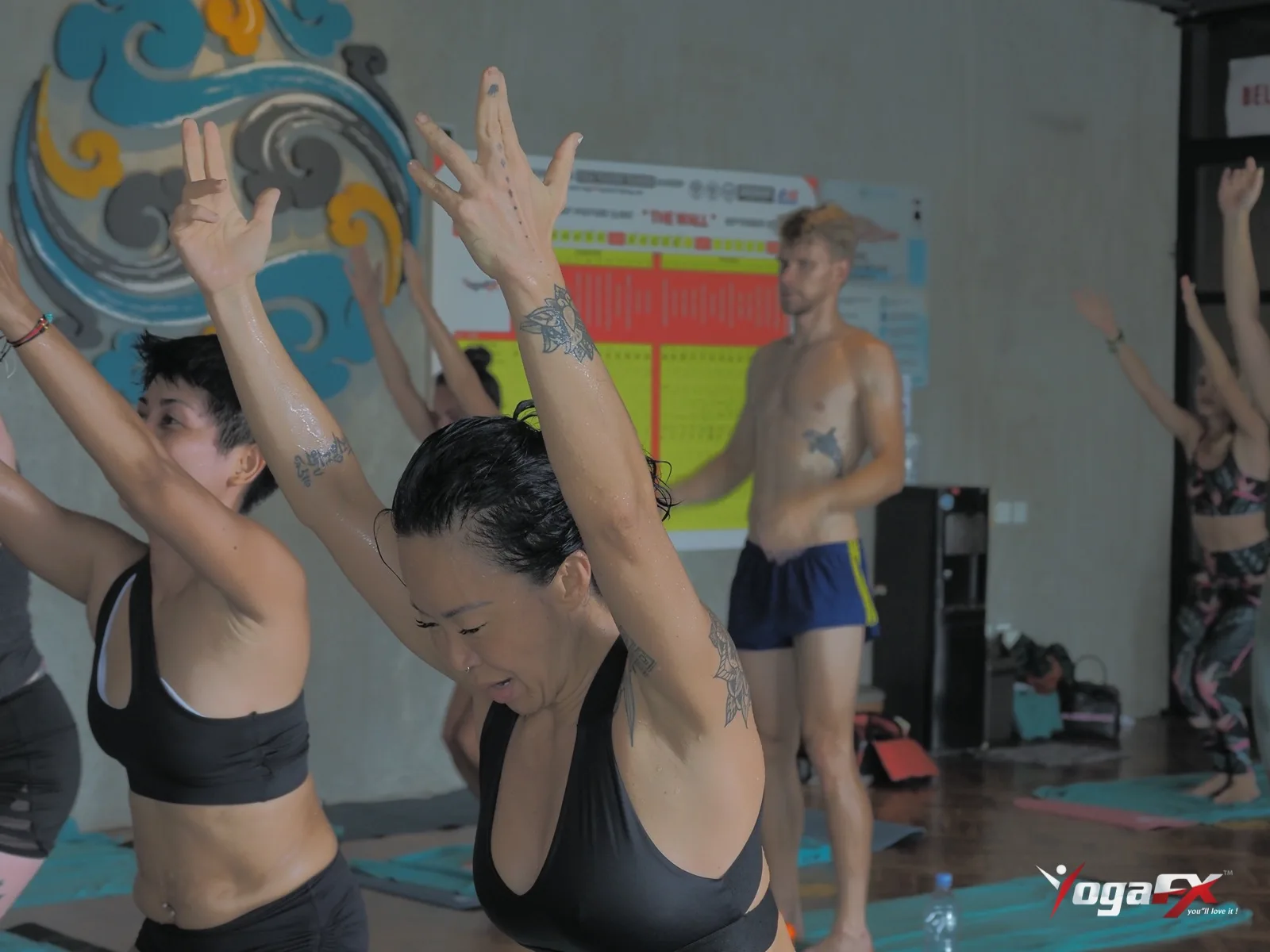
Three pranayama breathing slips to fix first
- Rushing the count. The breath speeds up with the heart, so let your count be slower than your instinct.
- Lifting the shoulders. It tightens the neck and makes the breath shallow. Keep them low and wide.
- Forcing the exhale. The open-mouth exhale is a release. Pushing it out only tires you.
Online learning has one real advantage here. You can film a short clip from the side with your phone, then watch it back. Check that your shoulders stay low and that the count looks calm. A teacher in a hall cannot rewind, but you can. For the full spoken version, see our guide to learning the dialogue from home.
Exercise Two: Kapalbhati, Learned Gently at Home
Kapalbhati, called Blowing in Firm, is a different kind of breath. It is made of quick, forceful exhales, and it arrives at the very end of class, after 90 minutes of effort. That timing makes it the part of pranayama breathing that asks for the most judgement.
Caution is built into public health advice. The US National Center for Complementary and Integrative Health tells people new to yoga to avoid extreme practices, including forceful breathing. So we treat Kapalbhati as something you earn, not something you prove.
- Wait until week 3. Let the slow opening breath feel easy first.
- Keep rounds short. A few gentle rounds beat one hard round.
- Stop at the first light-headed moment. Breathe normally and let it pass.
- Ask your teacher for the exact action. Your course shows it step by step, so we only set the safe pace here.
If you are pregnant, or you live with a heart, lung or blood pressure condition, speak to a doctor before you try forceful breathing. A gentle version done calmly is always better than a hard one done dizzy.
A Four-Week Home Order for Pranayama Breathing
Learning order matters more than effort in pranayama breathing. This plan puts the slow exercise first, adds checks you can do alone, and brings in Kapalbhati only after the base is steady. Practise at the same time each day, so the habit sticks.
| Week | Focus | Daily time | What to check |
|---|---|---|---|
| 1 | Standing Deep Breathing only, count of 5 in and 5 out | 5 minutes | Shoulders low, nose in, mouth out, no strain |
| 2 | Same exercise, plus a side-view phone clip and 2 minutes of rest afterwards | 5 minutes + 2 minutes rest | Breath slows between sets, count stays even |
| 3 | Add a few gentle rounds of Kapalbhati at the end | 5 minutes + a short finish | No light-headedness, stop at the first sign |
| 4 | Open with Pranayama and close with Kapalbhati around one short posture practice from your course | 15 to 20 minutes | Breath stays mostly nasal while you stand and work |
After week 4, keep the two breathing exercises as your opening and closing ritual, and the rest of your practice will feel more connected.
What the Research Says About Slow Pranayama Breathing
The best overview we found is a systematic review of slow breathing published in 2018 by Zaccaro and colleagues. We opened it before using it. From a pool of 2,461 abstracts, only 15 articles met the reviewers' criteria. That is a small body of work, so we read it with care.
For slow pranayama breathing, the authors define slow breathing as fewer than 10 breaths a minute. They report that it promotes autonomic changes that increase heart rate variability. They also report more comfort, relaxation, pleasantness, vigor and alertness, along with fewer symptoms of arousal, anxiety, depression, anger and confusion.
The NHS gives a practical version. Its stress exercise says to count steadily from 1 to 5 and to repeat for at least 5 minutes. A count of 5 in and 5 out fits that advice, and it is why our home plan starts there.
What this means for you
- Slow is the common thread. The pace of Standing Deep Breathing fits the range studied.
- Modest claims only. The evidence concerns well-being in healthy people. It does not show that breathing treats a condition.
- Heat is untested. Nothing we opened tested a heated room, so choose practice for the method, not for that claim.
We also don't claim that breath work cleanses the body or fixes a medical problem. It doesn't, and none of the sources above say so. If you live with anxiety, low mood or a breathing condition, treat this as a supplement to care, never a replacement.
When Heat Pushes Back: Safety Settings for Pranayama Breathing
At home you are not in a 40°C (104°F) room, but sooner or later you will practise in one. The CDC lists the signs of overheating: muscle cramping, unusually heavy sweating, shortness of breath, dizziness, headaches, weakness and nausea. Its warning is plain. If your body gets too hot, you can get sick.
The NCCIH adds that hot yoga has special risks related to overheating and dehydration. It also says to avoid hot yoga while pregnant, because it can cause overheating. So if you feel any warning sign, your breathing exercise is over. Sit or lie down, sip water and let your body cool.
Two of our guides go deeper on this. Read what to do when you feel dizzy and look at how the body adapts to heat before you book your first heated class.
Pair Breath Work With Rest
Pranayama breathing and rest belong together. In a class, a short rest follows the standing series, and your breathing settles on its own. That pause teaches you what a calm breath feels like after effort. Our guide to Savasana and final rest explains why this rest matters after heat.
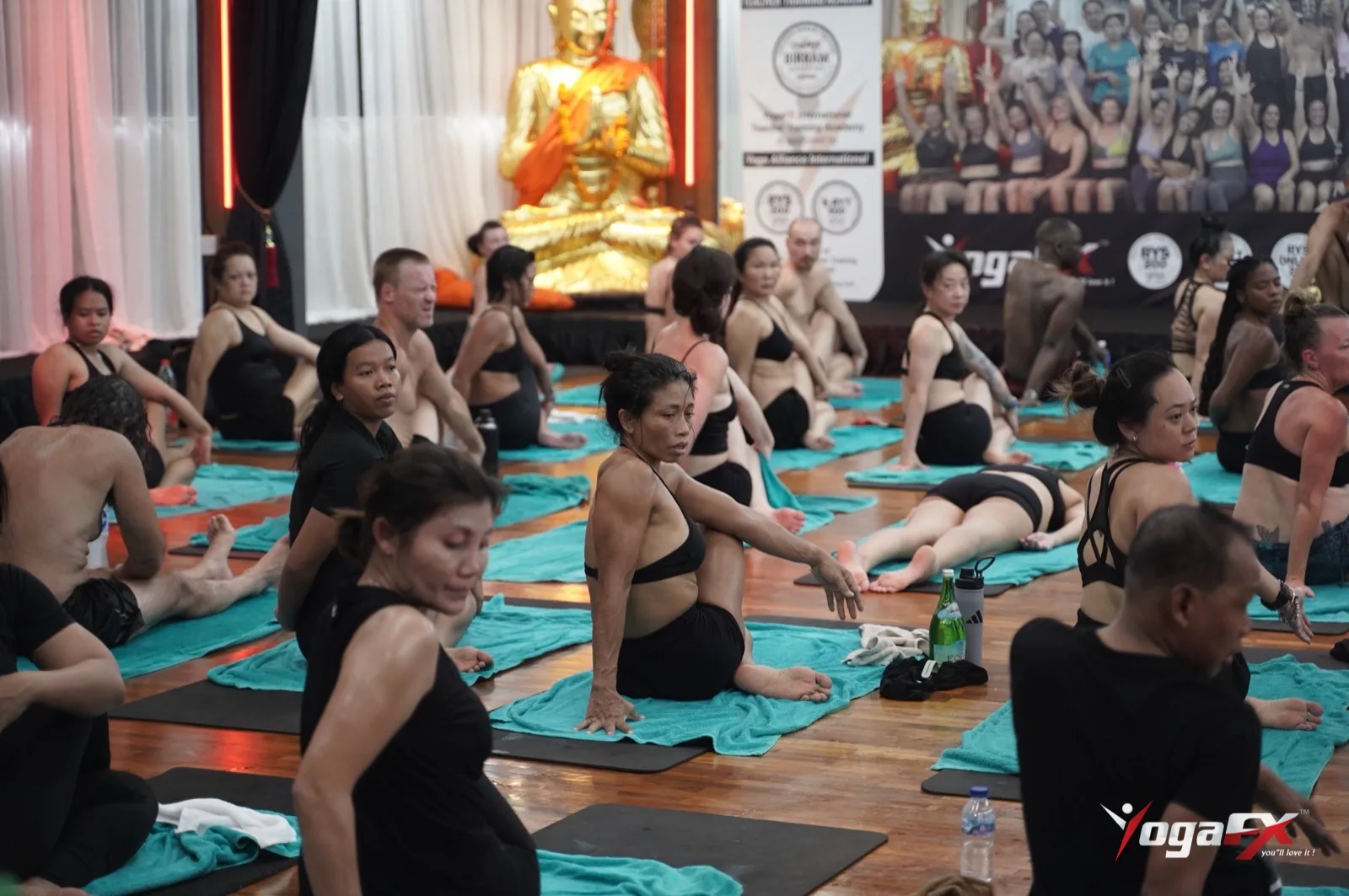
At home, copy that pattern. After your breathing sets, stand or lie still for two minutes and let the breath return to normal without steering it. The two ideas fit together, and they make the next breathing set easier.
What Students Say About Learning to Breathe in Class
None of these YouTube trainees was reviewing pranayama breathing on its own, so we don't present them as proof of anything medical. They show how a week of listening, breathing and staying with the dialogue feels from the inside.
“Thank you all for the love, the support, the strength. It's going to be with me forever.” A trainee in our YouTube review, 2023
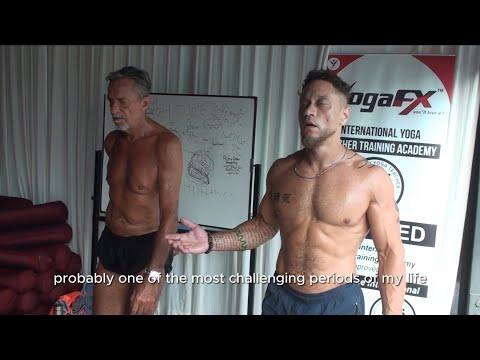
“Thank everyone for this truly life-changing amazing experience.” A trainee in our YouTube review, 2023

A third trainee called the experience a life transformation and an inspiration in a short video review, also recorded in 2023.
Learn Pranayama Breathing Online With YogaFX
The online route is the easiest way to learn pranayama breathing in the right order. The Online Course costs USD 329, or 4 x USD 82. It includes lifetime access to the YogaFX Online Academy, with Posture Clinics, Dialogue Demonstrations and more than 50 premium yoga lectures.
The Starter Kit costs USD 98, or 2 x USD 49, and includes posture demonstrations, the full dialogue, premium lectures and workbooks.
Start on the online hot yoga course page to compare the two. Mr. Ian Terry, E-RYT 500, leads the training, and the same course doubles as pre-course preparation for the live MasterClass in Bali.
Want to hear the count in a real room first? Our sister guide shows how the same two exercises run in a live studio class, with the same slow opening and the closing exercise.
This article is part of our series on the research behind hot yoga benefits. Related reading in Hot Yoga Science and Benefits: Hot Yoga Mental Health in Men: What Researchers Measured and Is Hot Yoga Good for Your Heart? Blood Pressure Trials Reviewed.
FAQ
Which pranayama breathing exercise is best for beginners?
Start with Standing Deep Breathing, the slow opening exercise. Breathe in through your nose for a count of 5, then out through your mouth for 5. It asks for no balance or strength. Leave Kapalbhati, the quick closing exercise, until your slow breath feels easy, usually after two weeks of daily practice.
Can I learn pranayama breathing online without a teacher in the room?
Yes, for the slow opening exercise. A video course lets you rewatch the count, and a phone clip lets you check your shoulders and pace. Learn the closing Kapalbhati more carefully, because the NCCIH advises new practitioners to avoid forceful breathing. If anything feels wrong, stop and ask your course teacher.
How long should I practise pranayama breathing each day?
Five minutes a day is a good start. The NHS says to repeat its breathing exercise for at least 5 minutes, and a count of 5 in and 5 out gives about 6 breaths a minute. Practise at the same time each day, build up slowly, and stop sooner if you feel dizzy.
Is pranayama breathing the same as Kapalbhati?
Not quite. In the Original Hot 26&2 method, pranayama is the slow opening exercise, called Standing Deep Breathing. Kapalbhati, called Blowing in Firm, is the second exercise, made of quick, forceful exhales at the end of class. Yoga also uses pranayama as a wider word for breath control, so Kapalbhati belongs to it too.
Does pranayama breathing have side effects?
Slow, gentle breathing is low risk for most healthy adults, but forceful breathing may leave you light-headed. In heat, the CDC lists dizziness, cramps and shortness of breath as warning signs. Pregnant women, and anyone with a heart, lung or blood pressure condition, should speak to a doctor before practising.
Still have questions? Message Mr. Ian and the YogaFX team on WhatsApp and we will answer them personally.
This article is general information, not medical advice. If you have a heart, lung or blood pressure condition, are pregnant, or live with anxiety or low mood, consult a healthcare professional before you practise breathing exercises or hot yoga, and stop if anything feels wrong.

Founder and lead trainer of YogaFX International Yoga Teaching Academy, with more than 12,000 hours of teaching. He trained for 5 years, from 2014 to 2019, with the founder of the Bikram Hot 26&2 method.
Published · Last reviewed and updated
You may also like
Explore all articles Hot Yoga Science and Benefits12 min read18 Nov 2026
Nitric Oxide Benefits: What Heat and Exercise Studies Show
Read article ↗ Hot Yoga Science and Benefits12 min read16 Nov 2026
Tired After Hot Yoga? Fatigue and Mood Studies Explained
Read article ↗ Hot Yoga Science and Benefits14 min read25 Oct 2026