
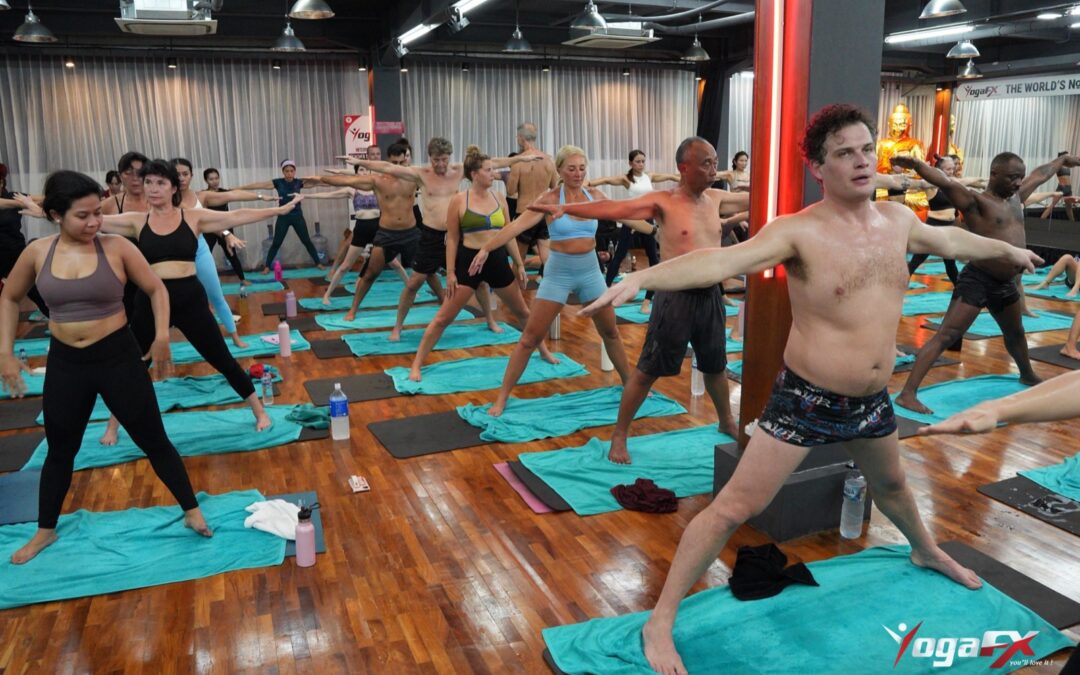
Hot yoga for flexibility can help you reach further, but heat does not make your joints any safer. Muscles feel looser in a warm room, so you can push past your real limit without noticing. The safe depth is the point where you still breathe evenly and feel tension, never sharp pain.
In this article9 sections
- Does hot yoga for flexibility work, and how deep is safe?
- Why heat changes the stretch: muscle, collagen and sensation
- Joint rotation: where your range really stops
- Four safe depth checks for hot yoga for flexibility at home
- Heat at home: what to copy and what to leave out
- What the research says, and what it cannot tell you
- What students say about getting more flexible
- Learn safe depth with the YogaFX Online Course
- FAQ
This guide is written for people who learn at home. You do not have a teacher walking the room, so you need checks you can run yourself. Mr. Ian Terry, E-RYT 500 and Founder and Lead Instructor of YogaFX, has taught more than 12,000 hours. The checks below borrow the alignment-first approach of the Hot 26&2 class he leads.
Does hot yoga for flexibility work, and how deep is safe?
Yes, hot yoga for flexibility can work. A small randomized controlled trial found that 24 heated classes over 8 weeks produced a substantial gain in lower back and hamstring flexibility. The same trial also found an increase in shoulder flexibility, so more than one joint can respond.
Safe depth is a different question from "does it work". With hot yoga for flexibility, the real skill is knowing where to stop. Depth is how far you take a joint inside a posture. Safe depth means you can hold that position, breathe through your nose and leave it without a wobble or a twinge. If you cannot, you went past safe.
Here is the short version before we go deeper:
- Flexibility improves slowly. Research on short stretching programmes points to changes in sensation, not instant changes in tissue length.
- Heat changes how a stretch feels. That can be useful for hot yoga for flexibility, and it can also hide a warning signal.
- Home learners need their own checks. Nobody is cueing you, so the checks have to be simple and repeatable.
If you want to see how a trained team handles the same question in the studio, read how trainees practise safe depth in the Bali studio. This page covers the home-study side.
Why heat changes the stretch: muscle, collagen and sensation
Tendons, ligaments and the joint capsule are rich in collagen, a tough protein that gives tissue its strength. Muscle is more elastic, and it is the first thing you feel stretching. In a posture you load both, and you feel the combined result as one pull.
What a stretch actually changes
A review by Weppler and Magnusson (2010) looked at the theories behind stretching. It reports that muscle length does increase during a stretch because of muscle's viscoelastic properties, but that the increase is transient. It also notes that most gains after short-term programmes of 3 to 8 weeks are attributed to modified sensation.
In plain words, hot yoga for flexibility often works because your nervous system tolerates the stretch. You often gain range without the tissue getting longer. That is not a trick. It is how most people become more flexible. It also means that range you feel today can outrun what your joint is ready for.
The same review says the effects of long-term programmes, beyond 8 weeks, have not yet been evaluated. So no one can promise you a number of degrees for a number of months.
What heat adds
Lambert and colleagues (2020) compared one hour of a Bikram sequence at 105°F (40°C) with the same sequence at 74°F (23.3°C). Sixteen experienced practitioners took part. Hip abduction, which is how far the leg moves out to the side, increased by 6.6 degrees in the heat and 2.3 degrees in the cooler room.
That is a real difference for hot yoga for flexibility, but it is one session, in a small group of experienced people. The authors say further studies are needed to show a dose-response relationship. We can say heat may help acutely. We cannot say it protects you.
Whether warming collagen-rich tissue lets it lengthen safely during a yoga class is not settled by these studies. Treat that as an open question and stay conservative.
Safe depth in 5 numbers
The 2020 lab study ran a Bikram sequence at 105°F (40°C) against 74°F (23.3°C).
Hot room versus cooler room, one session, 16 experienced practitioners.
Heated 90-minute classes in the 2013 trial that raised lower back and hamstring flexibility.
Mayo Clinic suggests about 30 seconds a stretch, around 60 for problem areas.
Body temperature can reach this within 10 to 15 minutes, so heat illness is a real risk.
Joint rotation: where your range really stops
Most people blame "tight muscles" when a posture stalls in hot yoga for flexibility. In practice, the limit is often a joint that has run out of rotation. Think of the hip as a ball in a socket. Some people can turn that ball a long way, and some cannot, and no amount of heat changes the shape of the bones.
Why two bodies reach different depths
This is why two students in the same room reach different depths and both are fine. Compare yourself with your own last session, not with the person on the next mat.
| Area | What limits range | Where you meet it | Home check |
|---|---|---|---|
| Hips | Rotation at the hip joint and the tissue around it | Garudasana (eagle pose) and the standing leg in head-to-knee | Can you keep your hips level while the leg turns? |
| Hamstrings and lower back | Muscle stretch tolerance, plus how far the pelvis tips | Standing and seated forward folds | Can you fold from the hips with a long spine? |
| Mid and upper spine | Spinal extension and shoulder reach overhead | Ustrasana (camel pose) and cobra | Can you keep your neck long and breathe into your ribs? |
| Shoulders | Overhead reach and rotation | Awkward pose, eagle arms, standing bow | Do your ribs stay down when the arms go up? |
| Knees and ankles | Joint angle under load, not stretch | Awkward pose, tree pose, standing bow | Do your knees track over the middle of the foot? |
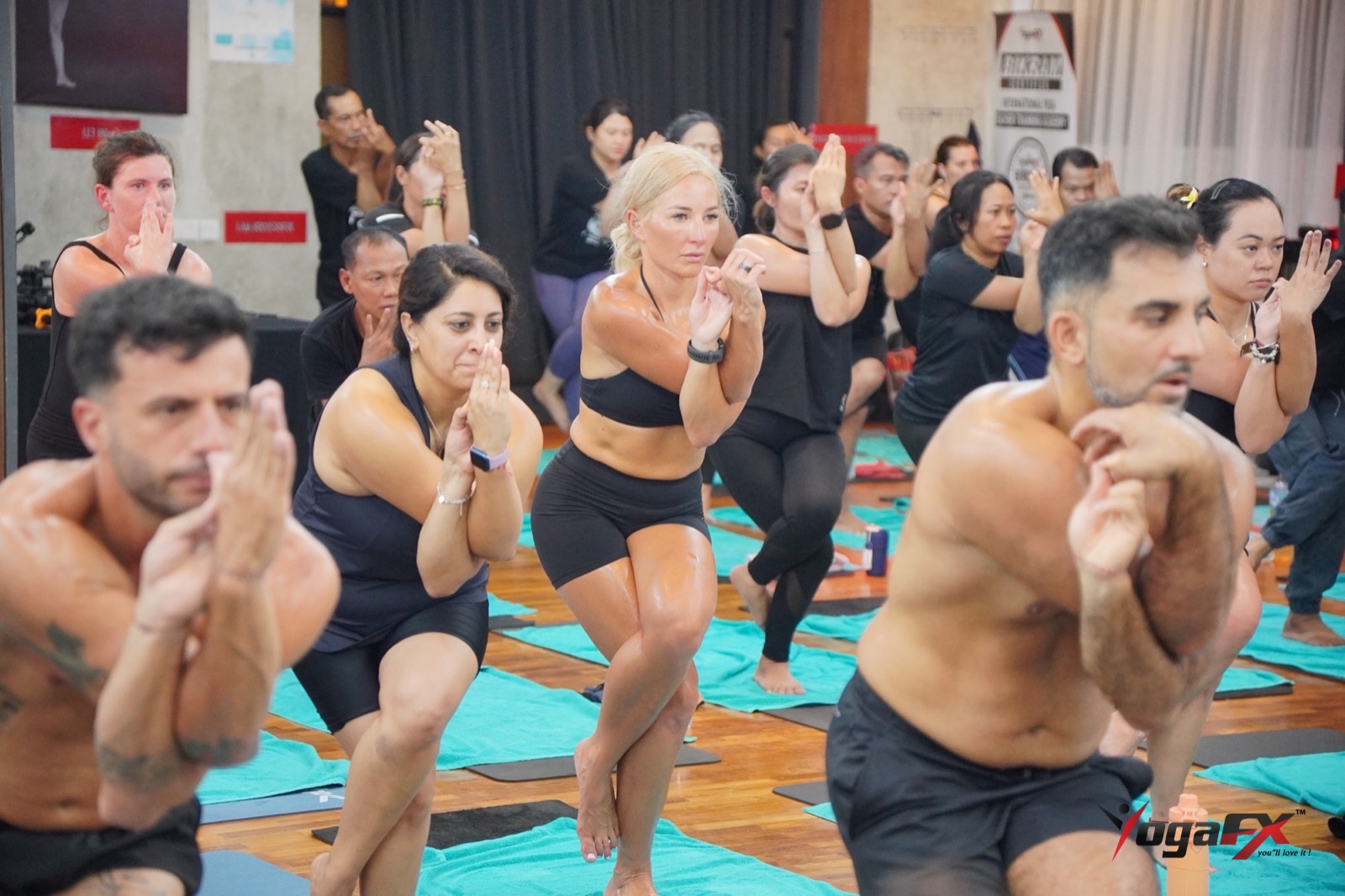
You can study each posture step by step in our guide to all 26 Hot 26&2 poses. For a single posture with a strong backbend, the camel pose lesson shows how to find safe depth in the spine and shoulders.
Four safe depth checks for hot yoga for flexibility at home
A teacher in the room would cue you to ease off. At home, you don't have that voice, so you are the teacher and the student. These four checks replace it, and they suit hot yoga for flexibility at any level. Use them in order, and stop at the first one you fail.
- The talk test. Can you breathe evenly through your nose while you hold the posture? If your breath turns choppy, back out a little.
- The phone test. Prop your phone to the side and film one set. Check that the joint you are working sits stacked and level, not collapsed.
- The next-morning test. Any joint ache the next morning, as opposed to muscle soreness, means yesterday was too deep. Cut back for a few days.
- The two-week ceiling. Add depth only after two weeks at the same depth feel easy. Slow progress beats a setback.
A worked example
Here is a quick example. Say you are in eagle pose and your top foot will not hook behind the calf. The phone test shows your hips twisting to cheat. The fix is not to pull harder. It is to rest the toe on the floor, keep the hips level and breathe. Next month, the hook may come on its own.
Notice what these checks have in common. None of them asks how far you went. They ask how well you controlled it. That is the heart of safe depth, and it is also why heat is only a helper, never a reason to push.
Warm up before you stretch
Warm-up matters too. Walk, march on the spot or do a few easy arm circles first, so you begin the session warm and breathing calmly. A rushed start is an easy way to push too far, too soon.
Mayo Clinic suggests holding each stretch for about 30 seconds, or around 60 seconds in problem areas, and stretching at least two to three times a week. You can read the full guidance on the Mayo Clinic stretching page.
A six-week home depth log
Writing things down turns a vague feeling into a trend, and it keeps hot yoga for flexibility measurable. Use this simple log. It is an original routine for home learners, not a clinical protocol, so adjust it to your body.
| Week | Focus | What to record | Stop sign |
|---|---|---|---|
| 1 and 2 | Alignment only, no extra depth | Breath quality and which side feels tighter | Sharp pain or a pinch in the joint |
| 3 and 4 | Hold each posture a few breaths longer | Hold time and how you felt the next morning | Joint ache the next day |
| 5 | Add a little depth in one posture only | Phone film of that posture, both sides | Hips or ribs move out of line |
| 6 | Repeat the week 5 posture, compare films | Side-by-side comparison with week 1 | Chasing range while breath is choppy |
Heat at home: what to copy and what to leave out
You don't need a 40°C (104°F) room to benefit from careful stretching at home. Hot yoga for flexibility at home works with far less heat. Our studio classes run at about 40°C (104°F) and 40% humidity, and trainees build up to it over several classes. Copying that room in a spare bedroom is a different thing, and it can go wrong.
The CDC and NIOSH page on heat-related illness says heat exhaustion is the body's response to excessive loss of water and salt, usually through heavy sweating. It also warns that heat stroke can be fatal if treatment is delayed. Heat illness is not a problem you can stretch away.
So keep a few rules for home practice:
- Start cool or mildly warm. A comfortable room and a warm-up are enough to practise safe depth.
- Do not stack heat on top of effort. If you feel dizzy, stop, sit and drink water.
- Build up slowly. Read our guides on heat acclimatization and whether hot yoga is safe before you turn up the heat.
What the research says, and what it cannot tell you
Three sources behind this guide
Three sources shape this guide. Each answers a narrow question about hot yoga for flexibility, and none answers the whole one.
- Weppler and Magnusson (2010) is a review of stretching theories. It points to modified sensation as the main reason for gains in short programmes.
- Lambert and colleagues (2020) compared a hot and a cooler room in 16 experienced practitioners. Hip range rose more in the heat in that single session.
- Tracy and Hart (2013) was a randomized trial of 24 Bikram classes in 8 weeks, with 10 people in the yoga group and 11 in the control group. Lower back and hamstring flexibility rose substantially, and shoulder flexibility rose too.
How to read the evidence
Taken together, these suggest that regular practice may raise range over weeks, that heat may add a little in the short term, and that sensation drives much of the change. They don't prove that heat is needed for hot yoga for flexibility. They also do not show that deeper is better.
The 2013 trial was small, with healthy young adults, and it found no change in handgrip strength or aerobic fitness. Do not read it as a promise for older beginners or people with joint problems.
Medical note. This article is education, not medical advice. If you have a joint injury, a heart condition, are pregnant or take medication that affects heat tolerance, consult a healthcare professional before you practise.
What students say about getting more flexible
Numbers only tell part of the story. Here is what three students wrote in their own words. Their results are personal, and yours will differ.
Cinzia, Google review, 2022: "I was able, day by day, to see significant improvements on my strength and flexibility." She credits the course and the teaching of Mr. Ian Terry.
Lucia, Google review, 2021: "The improvement of my strength and flexibility is amazing in only 3 weeks."
Made, Google review, 2024 (translated from Indonesian): hot yoga helped her body feel healthier and more supple, and stiff muscles became looser.
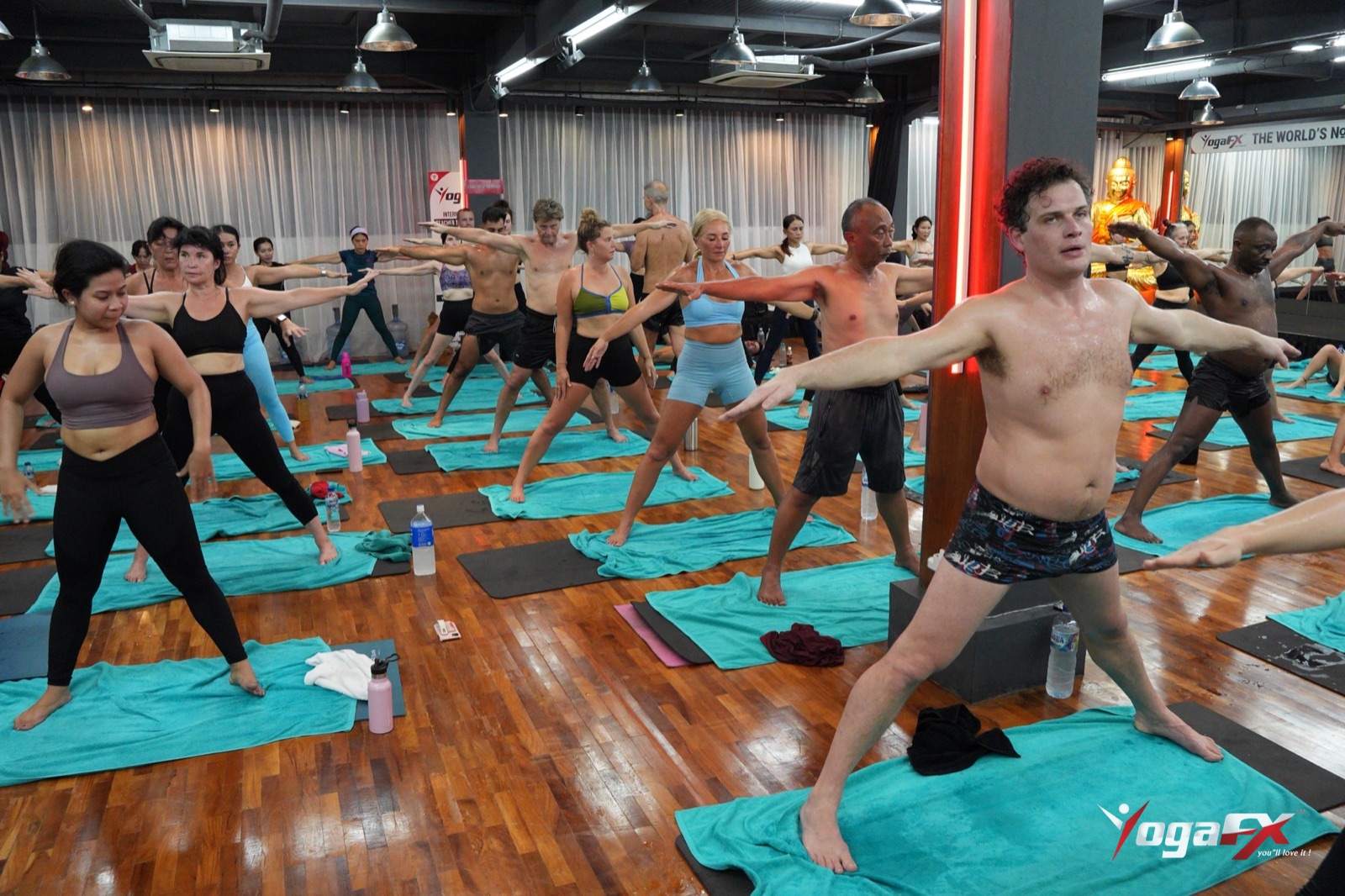
You can also watch a student describe the experience. This video is one of many graduate reviews on our YouTube channel.

Learn safe depth with the YogaFX Online Course
Checks and logs help, but a trained eye helps more. If hot yoga for flexibility is your goal, a structured course keeps depth safe. The YogaFX online hot yoga teacher training course teaches the Hot 26&2 postures with the dialogue, alignment cues and injury awareness a teacher needs. It is self-paced, so you can repeat a lesson until the cue makes sense.
The course costs USD 329, or 4 payments of USD 82. Mr. Ian Terry leads the programme, and the Founder and Lead Instructor of YogaFX holds the E-RYT 500 credential. If you want to try free classes first, start with our page on hot yoga at home and online.
Questions about your own body or the course? Message Mr. Ian and the team on WhatsApp and we will answer personally.
This article is part of our hot yoga benefits research guide. Related reading in Hot Yoga Science and Benefits: Hot Yoga Mental Health in Men: What Researchers Measured and Is Hot Yoga Good for Your Heart? Blood Pressure Trials Reviewed.
FAQ
How can I make my body more flexible for yoga?
Practise regularly and let flexibility build over weeks, as in hot yoga for flexibility programmes. Hold each stretch for about 30 seconds, stop at tension and never at pain, and keep your breath even. Research on short programmes suggests much of the early gain comes from tolerating the stretch, so patience and consistency matter most.
Which yoga style is best for flexibility?
No single style wins for everyone. A fixed sequence such as Hot 26&2 repeats the same stretches each class, which makes progress easy to track. A 2013 trial of 24 Bikram classes found gains in lower back, hamstring and shoulder flexibility. The best style is one you can practise safely and often.
Will hot yoga make me more flexible?
It may, over weeks of regular practice. One study found hip range rose more in a 40°C (104°F) room than in a cooler one, though that was a single session in experienced practitioners. Heat can help how a stretch feels, but safe depth and consistency decide your results.
Do I need a hot room to practise hot yoga for flexibility at home?
No. A comfortable, mildly warm room and a proper warm-up are enough to practise safe depth. Heat adds risk, because heat illness can follow heavy sweating. If you want to build up to heat, do it slowly and stop if you feel dizzy or unwell.
Is hot yoga good for mobility if I have stiff joints?
It can help some people, but stiff or painful joints need care. Go slower than you think, avoid forcing range and speak to a healthcare professional first if you have an injury or a joint condition. Safe depth means tension without sharp pain.
Still have questions? Message Mr. Ian and the YogaFX team on WhatsApp and we will answer them personally.

Founder and lead trainer of YogaFX International Yoga Teaching Academy, with more than 12,000 hours of teaching. He trained for 5 years, from 2014 to 2019, with the founder of the Bikram Hot 26&2 method.
Published · Last reviewed and updated
You may also like
Explore all articles Hot Yoga Science and Benefits13 min read21 Nov 2026
Proprioception Exercises for Your Home Yoga Practice
Read article ↗ Hot Yoga Science and Benefits11 min read25 Nov 2026
Does Hot Yoga Improve VO2 Max? Reading the Trial at Home
Read article ↗ Hot Yoga Science and Benefits12 min read9 Nov 2026