
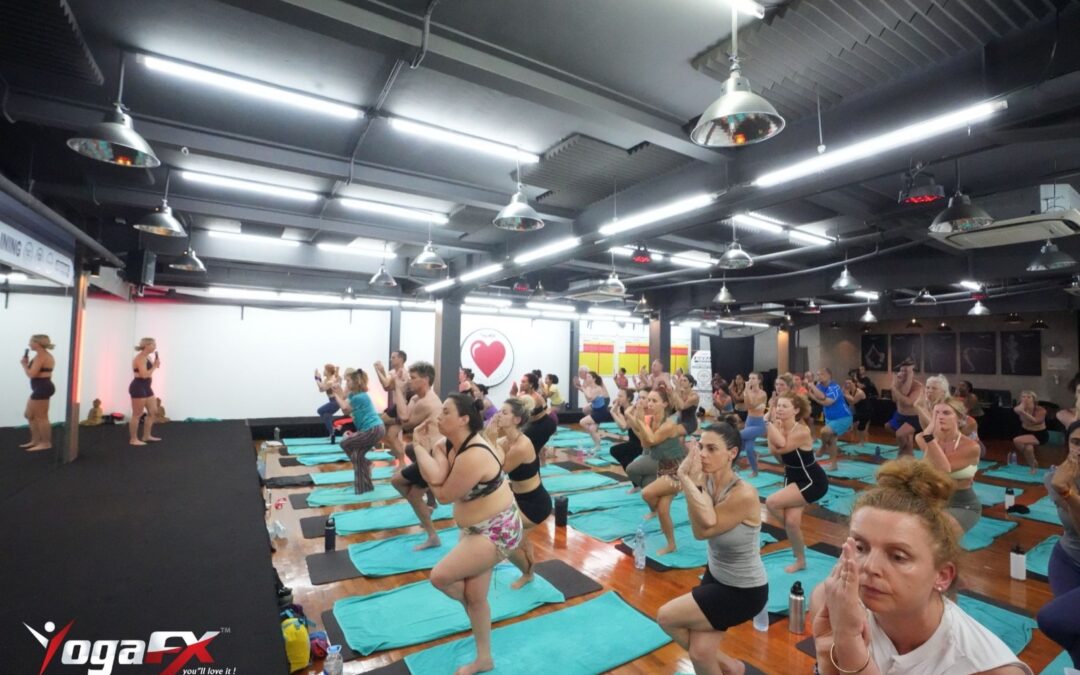
Does hot yoga improve VO2 max? Possibly, but the evidence is thin. One small trial saw VO2 max rise after 12 heated classes over four weeks. A separate study found that one hot class used about the same oxygen as a cooler one. So the hot yoga VO2 max evidence is promising, not proven.
In this article10 sections
- Does Hot Yoga Improve VO2 Max? The Short Answer for Home Students
- What VO2 Max Is and How a Lab Measures It
- How the Four-Week Hot Yoga VO2 Max Trial Was Built
- What One Hot Class Says About Hot Yoga VO2 Max at Home
- Does Hot Yoga Improve VO2 Max in Your Own Log? How to Read Your Numbers
- A Four-Week Home Log That Borrows the Trial's Shape
- How Hot Yoga Fits a Week of Aerobic Work
- What YogaFX Students Say After Training
- Where Online Hot Yoga Teacher Training Fits
- FAQ
This guide is for students who train online and keep their own numbers: a watch score, a resting pulse, a log on the fridge. At YogaFX, Mr. Ian Terry, our Founder and Lead Instructor (E-RYT 500, 12,000+ teaching hours), asks trainees to read research before they repeat it. So we will read the trial together, then turn it into a home log you can trust.
This is education, not medical advice. Please consult a healthcare professional before you start hot yoga, especially with a heart condition, high blood pressure or regular medication.
Does Hot Yoga Improve VO2 Max? The Short Answer for Home Students
Students who learn online ask this in week one. They have a watch on the wrist and a number on the screen. They want to know if heated classes will push that number up, because hot yoga VO2 max claims are everywhere online.
Here is the answer in two parts. Does hot yoga improve VO2 max over several weeks? One small randomised trial says it may. And in a single class? A second study says the oxygen cost stayed about the same as in a cooler room.
- Four weeks of heated classes: VO2 max in the heated group rose from 3.22 to 3.46 litres (109 to 117 fl oz) per minute.
- One heated class: mean oxygen use was 8.9 ml/kg/min in the heat and 8.6 in a cooler room, with no significant difference.
- For your own log: treat any hot yoga VO2 max change as a hint, and write the size of the study next to it.
Both findings come from small groups. That is why the rest of this page is about reading them, not selling them. It's also why we talk about hot yoga cardiovascular fitness in terms of trends, never promises.
What VO2 Max Is and How a Lab Measures It
Harvard Health describes VO2 max as an objective measure of fitness. It is how much oxygen your body consumes during exercise, usually written in millilitres per kilogram per minute. (Harvard Health)
The most accurate test happens in an exercise medicine lab. You wear a heart rate monitor and a mask while you run or cycle, and the effort ramps up. Harvard says the test is intense but short, between 10 and 20 minutes in total.
That matters at home because a hot class is not a lab test. A class is a long, steady effort, so it can't show your ceiling by itself. As a result, any hot yoga VO2 max number you measure on your own is an estimate. Harvard lists a one-mile walk test and an online calculator as ways to estimate it.
Harvard also notes that, other than athletes, most people do not need to know their exact number. It adds that a higher VO2 max is associated with a lower risk of heart disease, diabetes, cancer and stroke. That link is why people care about hot yoga VO2 max figures. It is also why a teacher shouldn't promise to move it.
How the Four-Week Hot Yoga VO2 Max Trial Was Built
The main hot yoga VO2 max trial was published in the International Journal of Yoga in 2021 by Bourbeau and colleagues. (Bourbeau et al., 2021) Reading the design first tells you how far the result can travel, because a small design limits a big claim.
Who took part and what they did
The trial enrolled 22 adults, split evenly by sex, with a mean age of 26. Chance decided who went into each group of 11. One group practised in a heated room at about 40°C (104°F) and 40% humidity. The other practised at 18 to 22°C (64 to 72°F).
Everyone followed one modified Bikram video lasting 75 minutes. They did it three times a week for four weeks, so 12 sessions each.
What moved
In the heated group, hot yoga VO2 max rose from 3.22 to 3.46 litres per minute, a change the paper reports as significant. In the cooler group it went from 3.00 to 3.05, which was not significant. Subtract the two readings and you get 0.24 litres (8.1 fl oz) per minute, a gain of about 7% (our own sum).
The heated group also showed a rise in HSP70, a heat-shock protein, in its blood cells. The cooler group did not. The authors summarised it as a gain in cardiovascular fitness and in cellular heat tolerance after 12 sessions.
What did not move
The same paper reports that no differences were detected between the groups. In plain words, the trial can't say the heat did better than a cooler room, so the hot yoga VO2 max gain may owe something to simply practising. It only says the heated group changed and the cooler group did not change significantly.
Three limits matter. The group was small, each session ran 75 minutes instead of a full class, and plasma volume went unmeasured. So read this result as a reason to look closer, not as a promise about your next class. That means holding hot yoga VO2 max claims lightly.
11 men and 11 women, mean age 26, split into two groups.
Three a week for four weeks, 75 minutes each.
Compared with 18 to 22°C for the other group.
VO2 max in the heated group, from 3.22 to 3.46.
The paper reports no between-group differences.
What One Hot Class Says About Hot Yoga VO2 Max at Home
A 2020 crossover study in the International Journal of Exercise Science looked at a single class. (Lambert et al., 2020) The 16 volunteers were seasoned practitioners (mean age 40, and 14 of them women). Each did the same one-hour Bikram sequence twice, once at 105°F (40.6°C) and once at 74°F (23.3°C), with at least 96 hours between visits.
What the numbers showed
In the heat, mean oxygen use was 8.9 ml/kg/min. In the cooler room it was 8.6. Pulse averaged 113 beats per minute against 109, and energy cost 156 kilocalories against 151. Neither gap reached significance.
The group's baseline VO2 max averaged 36.9 ml/kg/min. Divide 8.9 by 36.9 and one heated class sits near a quarter of that ceiling. That ratio is ours, not the paper's. The authors concluded that heated yoga does not significantly raise aerobic energy cost compared with the same class at room temperature.
Fat use did differ: 0.09 grams per minute in the heat, 0.05 in the cooler room. It was one session, so it says nothing about weight loss.
What it means for your watch
Here is the home lesson. A high pulse on your watch in a hot room doesn't mean your oxygen use is high, so don't read a hot yoga VO2 max rise into one fast class. In this study, heart rate and oxygen use moved only a little between the two rooms. For more on pulse in a heated room, read our guide to hot yoga heart rate zones.
| Study | Who took part | What they did | What they found |
|---|---|---|---|
| Bourbeau et al., 2021 | 22 adults, mean age 26 | 12 modified Bikram sessions of 75 minutes over four weeks, heated against 18 to 22°C (64 to 72°F) | VO2 max rose from 3.22 to 3.46 L/min in the heated group. No between-group differences were detected. |
| Lambert et al., 2020 | 16 experienced practitioners, mean age 40 | One one-hour Bikram sequence at 105°F (40.6°C) and another at 74°F (23.3°C), at least 96 hours apart | Oxygen use 8.9 against 8.6 ml/kg/min and heart rate 113 against 109 bpm. No significant difference. |
| Your own home log | One person, any room, any week | Whatever you record before and after a block of classes | A personal trend. It cannot show cause, because nothing was left to compare against. |
Does Hot Yoga Improve VO2 Max in Your Own Log? How to Read Your Numbers
You are one person without a control group. If your watch score moves after a month of classes, you cannot know if the classes, the weather, your sleep or a new watch did it. That is the gap between a trial and a log, and it is why hot yoga VO2 max stories from friends prove little.
Four measures a home student can use
Table 2 lists the measures a home student can take, and what each one can and cannot say.
| Measure | How to take it at home | What it can tell you | What it cannot tell you |
|---|---|---|---|
| Resting pulse | Count beats for 60 seconds on waking, before you get up, for three mornings | A personal baseline and a slow trend over weeks | Your VO2 max, or why the trend moved |
| One-mile walk test | Walk one mile as fast as you can and note the time and your pulse, with a portable monitor or a pulse check | An estimate that Harvard Health lists for VO2 max | A lab value. It stays an estimate. |
| Wearable fitness score | Read the score on your watch at the same point each week | Whether the device's own estimate drifts up or down | How the device calculated it, or whether the change is real |
| Lab ramp test | Book an exercise medicine lab, wear a mask, and run or cycle at rising effort for 10 to 20 minutes | The most accurate VO2 max measurement, according to Harvard Health | How you will feel in a 90-minute hot class |
Three habits for an honest log
These habits keep a home log honest:
- Use one method. Switching between a watch and a walk test hides the trend.
- Write the conditions. Note sleep, room heat, water and the time of day beside each reading.
- Write the study size. Next to any claim you copy, add "22 adults" or "16 people". It keeps you humble.
Please don't chase a number in the room. If you feel dizzy, sit down. Our guide to hot yoga hydration covers how much water to drink before and after class.
A Four-Week Home Log That Borrows the Trial's Shape
You cannot copy a lab trial at your kitchen table. But you can borrow its shape, so your hot yoga VO2 max log stays tidy: a block of about four weeks, a steady rhythm and one measurement method. Check the plan with your healthcare professional first.
- Week 0: take your baseline. Count your resting pulse on three mornings, and note your wearable score or one-mile walk time.
- Weeks 1 to 4: attend your usual classes at a steady rhythm. Write the date, the room and how the class felt.
- End of week 4: repeat the same baseline measures on the same type of day.
- Afterwards: write one honest sentence, for example "my watch score moved by two points, which may be noise".
Expect noise. For example, a bad night, a hot week or a software update can shift your numbers more than four weeks of classes. That noise is exactly why researchers use control groups.
How Hot Yoga Fits a Week of Aerobic Work
The two hot yoga VO2 max trials do not compare hot yoga with running, cycling or intervals, so they cannot rank one above another. Harvard Health says any aerobic exercise that gets your heart pumping helps, and that "the more vigorous, the better." For people who are already active, it suggests interval sessions several times a week, mixed with slower, longer activity.
So the practical question isn't "hot yoga or a run?" Instead, it is how a hot class fits into a week that already builds aerobic fitness. Our guide on whether hot yoga is a cardio workout reads the heart rate evidence posture by posture. For the wider picture, start with what the research shows on hot yoga benefits.
If you want the teacher-training version of this trial read, with the same studies explained for trainees, see how we explain the VO2 max trial to teacher trainees.
What YogaFX Students Say After Training
Numbers are one side of the story. Our students' own videos are the other, and you'll find both here. None of these reviews measured VO2 max. They show how training feels, which is a different kind of evidence.
Jason, YouTube review, 2026: "I really love hot yoga. I will continue for sure." He started hot yoga six weeks before this video. Watch his full review below.

A trainee in our YouTube review, 2024: described lying awake in week two, going over the dialogue in their head, and still thanked Mr. Ian for the push. (Watch the video)
A trainee in our YouTube review, 2018: finished the course and said, "I feel happy and energetic." (Watch the video)
Where Online Hot Yoga Teacher Training Fits
A teacher who can say "promising, not proven" about hot yoga VO2 max, and add the sample size, earns a student's trust. That habit is part of how we teach at YogaFX. Our online course gives you the hot 26&2 method from home, led by Mr. Ian Terry. You can read the full route in our guide to online yoga teacher training.
The online course costs USD 329, or 4 payments of USD 82. Use it to learn the method first, then bring your questions about heat, effort and numbers to class.
This article is part of our series on the research behind hot yoga benefits. Related reading in Hot Yoga Science and Benefits: Hot Yoga Mental Health in Men: What Researchers Measured and Is Hot Yoga Good for Your Heart? Blood Pressure Trials Reviewed.
FAQ
Does hot yoga increase VO2 max?
It may, but the evidence is small. One 2021 trial of 22 adults saw VO2 max rise in the heated group after 12 sessions, yet the paper reports no differences between the heated and cooler groups. A single class did not raise oxygen use much. Treat the result as promising, not proven.
Does yoga help VO2 max?
The hot yoga VO2 max trials in this guide studied only Bikram-style classes, so they cannot speak for all yoga. Harvard Health says any aerobic exercise that gets your heart pumping helps, and more vigorous work helps more. One hour of heated yoga used about a quarter of the group's baseline VO2 max.
Is hot yoga good for runners?
Hot yoga can sit beside running, but the trials here did not compare the two. Harvard Health suggests that active people mix interval sessions with slower, longer activity. Plan your run days and hot class days with care, drink early, and sit down if you feel dizzy.
Can heat affect VO2 max?
In the four-week trial, VO2 max rose in the heated group, but the paper reports no differences between the groups. In the one-class study, oxygen use was 8.9 in the heat and 8.6 in a cooler room, which was not a significant gap. So the evidence on heat alone is thin.
What is a good way to track VO2 max at home?
Harvard Health says the most accurate test happens in an exercise medicine lab, with a mask, and lasts 10 to 20 minutes. At home you only get estimates, such as a one-mile walk test or an online calculator. Use the same method each time and watch the trend, not one reading.
Still have questions? Message Mr. Ian and the YogaFX team on WhatsApp and we will answer them personally.

Founder and lead trainer of YogaFX International Yoga Teaching Academy, with more than 12,000 hours of teaching. He trained for 5 years, from 2014 to 2019, with the founder of the Bikram Hot 26&2 method.
Published · Last reviewed and updated
You may also like
Explore all articles Hot Yoga Science and Benefits10 min read13 Nov 2026
Hot Yoga Calories Burned: What Two Lab Studies Measured
Read article ↗ Hot Yoga Science and Benefits13 min read11 Nov 2026
Is Hot Yoga a Good Workout? Lab Data on Effort and Intensity
Read article ↗ Bikram and Hot Yoga Explained11 min read10 Nov 2026