

Hot yoga hydration starts the day before class, not at the water break. Mayo Clinic says some studies suggest a healthy adult needs about 2.7 to 3.7 litres of total fluid a day, and more when you sweat. In one hot yoga study, students sweated about 0.9 litres an hour but drank only 0.2.
Hot Yoga Hydration in Short: 5 Honest Rules
Here is the short version of hot yoga hydration, graded the way we grade every claim on this site. The evidence is small and the people studied are few. Still, five rules hold up when you read the sources and watch real students in a heated room:
- Start early. Drink steadily through the day before class. The sports medicine guideline says to begin several hours ahead, so you arrive hydrated.
- Sip, don't chug. A large gulp in the last 15 minutes tends to leave the stomach sloshing. Small, steady sips work better.
- Match your drinking to your sweat. Students in a hot class study sweated more than four times as much as they drank, and they underestimated how much they lost.
- Add electrolytes when you sweat a lot. Sweat carries sodium, and drinks with electrolytes can beat plain water in some situations.
- Don't overdo it. Too much plain water can push blood sodium too low, which Mayo Clinic calls life-threatening, although it is rare in healthy adults.
None of this is medical advice. Please consult a healthcare professional before changing your fluid habits, especially if you have a heart, kidney or blood pressure condition, or take medication. Hot yoga hydration is personal, and the sections below show you how to find your own numbers.
How Much Water Should You Drink for Hot Yoga?
People often ask how much water hot yoga really needs. The honest answer is that nobody can give you one number, and good hot yoga hydration starts with that. The Mayo Clinic guide says the right amount "depends on many things." Some studies suggest that the average healthy adult gets enough with about 11.5 cups (2.7 litres) to 15.5 cups (3.7 litres) of total fluid a day.
That total includes every source. Food provides about 20% of the water you need, and tea, soup and other drinks count too. So plain water is only part of the picture. The same page says hot or humid weather makes you sweat more, so you need to drink more than usual to replace what you lose.
For exercise, the advice is simple: drink before, during and after a workout. The American College of Sports Medicine position stand on exercise and fluid replacement (Sawka et al., 2007) adds a timing rule. Prehydrating should begin at least several hours before the activity, so that you start well hydrated and your urine output has returned to normal.
A Practical Check: Colour and Thirst
Mayo Clinic gives two easy signs that you are drinking enough. You are not thirsty often, and your urine is colourless or light yellow. Check both on the morning of class. If your urine is dark, start drinking early and keep going through the day.
A hot class is long and demanding. A Hot 26&2 class at YogaFX runs 90 minutes in a room at about 40°C and 40% humidity. That is a lot of time to lose fluid, so what you do in the hours before matters more than what you do in the last ten minutes.
Why We Say Don't Chug
At YogaFX we teach students not to drink a litre of water 15 minutes before they step into the room. It leads to stomach sloshing and nausea, and it makes the first postures harder. Instead, spread your fluid across the day, then take small sips in the hour before class.
If you eat before class, keep it light. Our guide to feeling tired after hot yoga explains how fluid, food and heat together shape how you feel afterwards, and how to tell normal fatigue from a warning sign.
What Researchers Measured in a Hot Yoga Class
Most hot yoga hydration advice is borrowed from running and cycling. A few teams have measured the real thing. The best match we found is a study of 21 hot yoga students, published in the International Journal of Exercise Science in 2017 by Campbell, Pritchett and colleagues at Central Washington University.
The Study at a Glance
The team asked how much hot yoga students sweat, how much they drink, and whether they start class hydrated. The class lasted one hour at 38.7°C and 36% relative humidity. Water was freely available. Here is what they found:
| What was measured | Result in the study | What it means for you |
|---|---|---|
| Who took part | 21 men and women, average age 33 | A small group, so read it as a snapshot |
| Room | 38.7°C, 36% humidity, one-hour class | Close to a Hot 26&2 room, but our class is 90 minutes |
| Started class hydrated | 76% were euhydrated (urine specific gravity below 1.020) | Most arrived in good shape, and about one in four did not |
| Sweat rate | 0.9 litres an hour on average (spread of 0.6) | Some students sweat far more than others |
| Fluid drunk | 0.2 litres an hour on average, and 33% drank nothing | Drinking lagged far behind sweating |
| Body mass lost | 0.9% on average, and about half lost 1% or more | Below the 2% mark on average, but easy to cross in a longer class |
| Sweat sodium | 49.1 mmol per litre on average (spread of 19.2) | Salt loss differs a lot from person to person |
| Awareness | Students underestimated their sweat loss | Feeling is a poor gauge, so measure it |
What Stands Out
Three points stand out. First, drinking lagged behind sweating even with free access to water. Second, the spread was wide, so an average hides the students at either end. Third, people underestimated what they lost. The authors concluded that hydration guidance should be personalised.
We agree with that, and it is why we teach a method rather than a rule. The study also has limits. It was a one-hour class with 21 people, and our class is longer. A longer class gives more time to lose fluid, so your own numbers could be higher than the average here.

Before, During and After: A Hot Yoga Hydration Plan
Now let us turn the evidence into a hot yoga hydration plan you can repeat. The table below groups it by phase. Every row points back to a source, so you can see why it is there.
| Phase | What to do | Why it helps |
|---|---|---|
| The day before and the morning of class | Sip steadily all day. Aim for pale urine and little thirst. | Guidelines say to prehydrate several hours ahead, and Mayo Clinic gives 2.7 to 3.7 litres of total fluid as a general range for adults. |
| The last hour before class | Take small sips. Keep any snack light. Skip the big gulp. | Chugging leads to stomach sloshing and nausea in a heated room. |
| During class | Sip when your teacher allows a break. Breathe through your nose and stay calm. | The 2017 study found students drank far less than they sweated. |
| Right after class | Rehydrate slowly, then add electrolytes if you sweated heavily. | Sports medicine guidance says to replace the fluid and electrolyte deficit. |
| The next hour | Cool down for 10 to 15 minutes before a cold shower, then eat a balanced meal. | Rapid cooling right after class can stress the body, so let it settle first. |
Notice what the plan does not say. It does not tell you to force down water during the standing series. Large amounts of cold water while you are working hard tend to cause cramps and nausea. So the work is done before and after, and class itself is for small sips.
Electrolytes in Hot Yoga: When Is Water Not Enough?
Electrolytes in hot yoga matter because sweat is not just water. (It is not a detox either: see whether hot yoga sweats out toxins.) The students in the study averaged 49.1 mmol of sodium per litre of sweat, with a wide spread. That means a hot class takes salt out of the body as well as fluid. How much depends on your body, your fitness and how well you are used to the heat.
The sports medicine guideline treats this carefully. It says sweat rates and sweat electrolyte content vary between people, so fluid plans should be personalised. It also says drinks with electrolytes and carbohydrate can offer benefits over water alone under certain circumstances. It does not say everyone needs them every time.
Simple Ways Students Replace Electrolytes
- Coconut water. Many students sip it after class, along with their water.
- An electrolyte tablet. Dissolve one in your bottle on days you sweat heavily.
- A small pinch of salt. Some students add it to a bottle, though the amount should be small.
- A balanced meal. Food brings sodium and other minerals back after class.
Mayo Clinic also reminds us to watch sugar, salt and calories in sports drinks, and it says water is the best everyday choice. So think of electrolytes as a tool for heavy sweating, not a daily habit. If you have high blood pressure or take medication, ask your doctor about salt first.
Hot Yoga Hydration in 5 Numbers
The graphic below pulls the key hot yoga hydration figures into one place, so you can screenshot it for your bag.
0.9 L
Sweat per hour
Average sweat rate in a one-hour hot class.
0.2 L
Drunk per hour
Average fluid intake, far below the sweat rate.
33%
Drank nothing
One in three students took no fluid in class.
2%
Body mass line
Sports medicine calls a water deficit above this excessive.
2.7 to 3.7 L
Total daily fluid
A general adult range from Mayo Clinic, including food.
Test Your Own Sweat Rate in 3 Steps
The sports medicine guideline suggests a method that costs nothing. You can estimate your own sweat rate by measuring body weight before and after exercise. You can use it after any hot practice, including a home practice in a warm room, and it turns a guess into a number.
- Weigh yourself before. Use the same scale, wear little, and dry off first. Write the number down.
- Weigh yourself after. Dry off again, and use the same scale and clothing. Write that number down too.
- Add what you drank. The weight you lost, plus the fluid you drank, is roughly the fluid you sweated. One kilogram is about one litre.
Here is a made-up example. Say you weigh 70.0 kg before a 90-minute class and 69.4 kg after, and you drank 0.5 litres during it. You lost 0.6 kg, so you sweated about 1.1 litres. That is roughly 0.7 litres an hour, and a weight loss of about 0.9%, which is under the 2% mark.
Repeat the test on three or four classes, because your numbers change with the weather, your sleep and your food. After a few tries you will know whether you sweat a little or a lot. That is more useful than any rule of thumb, and it is the personalised guidance the researchers asked for.
When You Drink Too Much: The Other Side of Hot Yoga Hydration
Under-drinking gets the headlines. Over-drinking is the other risk in hot yoga hydration, and it is why we say sip rather than chug. Mayo Clinic says drinking too much water is rare, and typically not a problem for healthy adults. It adds that some athletes do it when they prepare for a long or intense workout.
The mechanism is simple. When you drink too much water, your kidneys cannot get rid of the excess. Your sodium levels then become too low. Mayo Clinic calls this hyponatremia and says it can be life-threatening. That is one more reason to add electrolytes, not just more water, on heavy sweat days.
So use two guides together. Day to day, let thirst and pale urine steer you. For a bigger picture, use your sweat test. If you ever feel confused, very nauseous or unwell after drinking a lot, stop and get medical help.
What to Do If You Feel Dizzy in the Room
Good hydration for hot yoga lowers the odds of dizziness, but it does not remove them. Heat, standing balance and long holds can all make you light-headed. Know the steps before you need them.
- Lower your centre of gravity at once. Turn around, with your head to the mirror and your feet to the wall.
- Lie down on your back in savasana and breathe slowly through your nose.
- Never force movement through dizziness, and stay in the room. Tell your teacher.
- Chest pain is different. Stop, and get urgent medical help.
We teach students to stay in the room because moving between very different temperatures can add to the problem. If you rest and the dizziness does not pass, tell the teacher straight away. Most teachers would rather pause the class than watch a student push through.
Heat safety is also part of teacher training. Our guide to hot yoga certification and heat safety shows what teachers must know, so you can see how seriously teachers take it.
Setting Up Hot Yoga Hydration for Home Practice
If you study online, most of your practice happens at home. That gives you something a studio cannot: full control of your bottle, towel and timing. A few simple habits make a home practice safer and calmer.
- Keep a bottle within reach. Put it beside the mat, so you never have to leave the practice for water.
- Use a towel. A good towel keeps your grip as you sweat, and it gives you somewhere to rest your hands.
- Warm up gently. A room that is warm, not hot, lets you learn the postures before you add real heat.
- Cool down properly. Rest for 10 to 15 minutes before a cold shower, and rehydrate slowly.
Home practice is the heart of our online course, and hot yoga hydration is part of it. You learn the 26 postures, the dialogue and the science first, and you find your own hydration numbers at your own pace. Then you walk into a heated room already knowing how your body behaves.

What Our Trainees Say About the Heat
Numbers cannot tell you how a hot class feels from the inside. These comments come from YogaFX students, taken word for word from their public reviews. They are about the whole training, not only hydration, but they show how students describe the sweat and the effort.
"It was sweat, tears, laughter… it was training, life coaching, therapy."
Mariana, Google review, 2022
"I love how I sweated. I don't think I did this much in my life."
A trainee in our YouTube review, 2018
"Thank you very much. Thank you to everyone who always supports me."
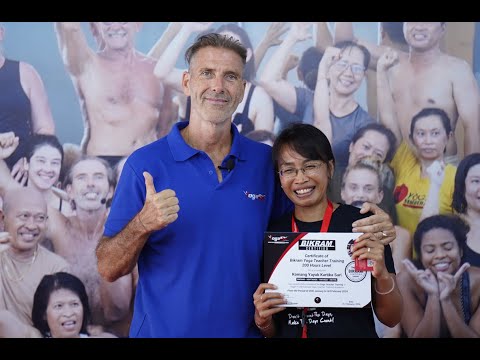
Kartika, YouTube review, 2024 (translated)
Kartika spoke in Indonesian, and the line above is the English translation. You can watch her graduation video below.
What Hot Yoga Teachers Need to Know About Hydration
A teacher who understands hot yoga hydration protects every student in the room. Teacher trainees study this as carefully as any posture, because heat strain is where a class can quietly go wrong. A trained teacher watches for several things:
- Flushed skin or nausea. These can mean a student needs cooling and attention.
- A sudden end to sweating. A student who stops sweating in a hot room needs to rest and be checked.
- A student who never drinks. The study above shows one in three took no fluid, so a gentle reminder can help.
- A student who keeps drinking and feels worse. That is a reason to slow down, not push more water.
Good teachers also explain the plan. They tell new students how to prepare, when to sip, and what to do after class. That is easy to say and hard to teach well, which is why we teach it in steps and check it in practice.
Learn Hot Yoga Hydration and the Full Dialogue Online With YogaFX
Students often ask why teachers fuss about hot yoga hydration. A good teacher answers with evidence, not hype. Our hot yoga online course lets you study the 26 postures, the dialogue and the physiology at home, on your own schedule, and it is Yoga Alliance certified. See the 8-week breakdown of online yoga teacher training to learn how the weeks fit together.
The course is led by Mr. Ian Terry, E-RYT 500, who has more than 12,000 teaching hours. He trained for 5 years, from 2014 to 2019, with the founder of the method. Since 2017, YogaFX has trained more than 1,500 graduates from 80+ countries, and we hold more than 550 reviews across Google, Yoga Alliance and YouTube.
- Learn the science with its limits. Read each study the way we did above.
- Practise at home first. Find your own sweat rate before you add real heat.
- Know the next step. Graduates of the Bali MasterClass register with Yoga Alliance as RYT 200.
When you are ready for the heat in person, the next step is the 6-day Bikram Hot 26&2 Yoga Teacher Training MasterClass in Bali. You will meet the same room, the same dialogue and the same teachers you studied online.
FAQ
Does hot yoga dehydrate you?
It can if you drink less than you sweat. In one study of 21 hot yoga students, people sweated about 0.9 litres an hour and drank about 0.2, and one in three drank nothing. Starting hydrated and sipping through class lowers the risk. Check your own numbers with a before and after weigh-in.
How much water should I drink after hot yoga?
There is no single number. Mayo Clinic advises drinking before, during and after a workout, and sports medicine guidance says to replace the fluid and electrolyte deficit. Weigh yourself before and after class, then drink slowly until you have replaced roughly what you lost. Ask a doctor if you have a medical condition.
Can hot yoga cause an electrolyte imbalance?
Sweat carries sodium, so heavy sweating plus plain water alone can leave electrolytes low. Mayo Clinic says drinking too much water can drop sodium too low, which it calls hyponatremia, though it is rare in healthy adults. Add electrolytes on heavy sweat days and sip instead of chugging.
Should I drink water during hot yoga?
Yes, in small sips when your teacher allows a break. A 2017 study found students drank far less than they sweated, even with free water. Avoid gulping large amounts of cold water during hard postures, because it can cause cramps and nausea. Do most of your drinking before and after class.
Can you drink too much water before hot yoga?
Yes. Drinking a large amount just before class can cause stomach sloshing and nausea. Over a longer period, too much plain water can lower blood sodium, which Mayo Clinic says can be life-threatening, although it is rare. Spread your fluid across the day and sip in the last hour.
Still have questions? Mr. Ian and the YogaFX team answer them personally. Message us on WhatsApp at +62 811 388 8330, or go straight to the online course enrolment page.

Founder and lead trainer of YogaFX International Yoga Teaching Academy, with more than 12,000 hours of teaching. He trained for 5 years, from 2014 to 2019, with the founder of the Bikram Hot 26&2 method.
Published · Last reviewed and updated
You may also like
Explore all articles Hot Yoga Science and Benefits12 min read18 Nov 2026
Savasana Benefits: Why Final Rest Matters After Heat
Read article ↗ Hot Yoga Science and Benefits11 min read17 Nov 2026
Hot Yoga Depression Study: How the Harvard Trial Was Run and Measured
Read article ↗ Hot Yoga Science and Benefits12 min read16 Nov 2026