
Proprioception exercises train your sense of where your joints are without looking. At home, good starting ones are slow balance drills, foot awareness and controlled reaches, done three times a week at room temperature. Studies on ankle sprains and falls support this kind of work, although none of them tested yoga itself.
Most pages about proprioception exercises give you a list of moves and stop there. This guide does it the other way round. First we look at what the research does and does not show. Then we turn it into a graded eight-week plan you can run on a living room floor, with a simple way to track whether it is working.
It also shows where this skill sits in the Original Hot 26&2 sequence, and where the YogaFX Online Course fits for people who want a teacher's voice guiding the learning. Mr. Ian Terry, our Founder and Lead Instructor (E-RYT 500, 12,000+ teaching hours), leads that course.
A quick note first. This is general information, not medical advice. If you have a joint injury, a past fall, dizziness or a nerve condition, talk to a doctor or physiotherapist before you start. Do every drill below at room temperature. Keep the hot room for class.
Proprioception Exercises: What You Can Train at Home
Proprioception is your body's sense of its own position and movement. The Cleveland Clinic calls it an automatic, subconscious process. It says the brain, the receptors in your skin, muscles, ligaments and tendons, and the organs of your inner ear all take part. Your eyes add information, but the page notes that you can have effective proprioception without vision.
That last point is good news if you practise alone. The sense does not depend on a mirror, so a quiet room is enough for proprioception exercises.
So what do proprioception exercises actually do? They make the sense work a little harder than usual. You stand on one leg, narrow your base, move one limb slowly while the rest of you stays still, or change what your head and eyes are doing.
Physical therapists call the formal version proprioceptive training. The Cleveland Clinic says a therapist may prescribe exercises for specific joints and muscles, and may also add balance work such as one-legged balance or walking in a straight line.
People often mix this up with flexibility. They are different skills. You can be very bendy and still wobble on one foot, and you can be stiff and rock steady. Proprioception exercises for balance ask a different question: does your body know where it is when nobody is checking?
What a home practice does well
- Frequency. Ten minutes at home on a Tuesday beats a long class once a fortnight, because regular, repeated practice is what the trials below tested.
- Slow tempo. Nobody is rushing you to the next posture, so you can hold a position and notice what your ankle is doing.
- Low cost. A wall, a flat floor and a timer are all you need for the plan below.
What it cannot do
A living room doesn’t have a second pair of eyes.
A teacher sees your hip drift to one side within a second. At home, you have to catch that drift with a phone clip, a written log or a calm look in the mirror afterwards. We cover how in the tracking section. A home plan also cannot judge an injury, so a sore knee or a wobbly ankle needs a professional, not a better app.
Proprioception Exercises Study by Study: What the Research Shows
Before writing a single drill, we opened each source below and read it. Two things need saying up front. None of these studies used yoga, and none used a hot room. They tested balance and proprioceptive work in general, so treat them as support for the idea and not as proof about any yoga class.
A home programme after an ankle sprain (BMJ, 2009)
Hupperets, Verhagen and van Mechelen ran a randomised trial in the Netherlands, titled Effect of unsupervised home based proprioceptive training on recurrences of ankle sprain, and published it in The BMJ. They recruited 522 athletes aged 12 to 70 who had sprained an ankle within the previous two months. Everyone got usual care. Half of them also received an eight-week home programme of proprioceptive training.
The programme was three sessions a week, up to 30 minutes each, using a balance board, exercise sheets and an instructional DVD. The exercises got harder over the eight weeks. After one year, 22% of the training group reported another sprain, against 33% of the control group. The relative risk was 0.63, with a 95% confidence interval of 0.45 to 0.88.
There is a catch worth knowing. Only 23% of the training group followed the programme fully, and 29% followed it partly. The authors also note that injuries were self-reported. So the result looks encouraging, but it came from real, messy home practice, which is exactly the situation most of us are in.
Balance exercises and falls in older adults (Cochrane, 2019)
The Cochrane review of exercise for preventing falls pooled 108 randomised trials, published as Exercise for preventing falls in older people living in the community, with 23,407 older people living in the community. Across 39 studies of balance and functional exercises, with 7,920 participants, the rate of falls was 24% lower than in control groups (rate ratio 0.76, 95% CI 0.70 to 0.81). The authors rated this high-certainty evidence.
The review also found that programmes combining balance and functional work with resistance exercise probably reduce falls too. Adverse events were mostly non-serious. Notice who was studied, though: mean age about 76. The review supports balance training for older adults. It does not say a 30-year-old will fall less.
How the evidence stacks up
| Source | Who was studied | What they did | Result | Take-home for you |
|---|---|---|---|---|
| BMJ trial, 2009 | 522 athletes with a recent ankle sprain | 8-week home proprioceptive programme, 3 sessions a week | 22% repeat sprains vs 33% in controls | Structured home practice can work, but only if you do it |
| Cochrane review, 2019 | 23,407 older adults living at home | Balance and functional exercise across 108 trials | 24% lower fall rate in 39 balance studies | Balance work is worth keeping up as you age |
| Cleveland Clinic page | General readers | Explains the sense and gives one-leg stands as examples | Definition and examples, not a trial | Start with simple, familiar balance tasks |
What the evidence cannot tell you
- Yoga was not tested. We cannot claim that any yoga posture gave these results.
- Populations differ. Injured athletes and older adults are not everyone, so your results may differ.
- Adherence was low. Even in a trial, fewer than one in four people did the full programme.
- Self-report has limits. The ankle trial counted sprains that people reported themselves.
That is a useful frame for home proprioception exercises. The research says regular, progressive balance work is worth doing. It does not hand you a magic drill. What it leaves open is the plan, and that is what we build next.
A Graded Plan: Four Levels of Proprioception Exercises Over Eight Weeks
The ankle trial worked because its proprioception exercises got harder in steps. Our plan copies that idea with floor-only drills. Do it three days a week for 10 to 15 minutes. That schedule is borrowed from the trial’s three weekly sessions, but it is a sensible starting dose, not a prescription.
| Level | Weeks | Drill | Sets and time | Pass mark |
|---|---|---|---|---|
| 1 | 1 to 2 | Foot tripod stand | 2 sets of 30 seconds | Steady for 30 seconds with no toe gripping |
| 2 | 3 to 4 | Heel-to-toe stand beside a wall | 3 sets of 20 seconds per foot forward | 20 seconds without touching the wall |
| 3 | 5 to 6 | Single-leg stand with foot clock taps | 3 sets of 15 seconds per leg | Tap four clock positions without losing the hips |
| 4 | 7 to 8 | Single-leg stand with slow head turns | 3 sets of 20 seconds per leg | Two slow head turns with a still hip |
Level 1: the foot tripod stand
Stand barefoot with your feet hip-width apart. Press three points of each foot into the floor: the base of the big toe, the base of the little toe and the heel. Lift your toes gently, spread them, then lay them down again without gripping. Hold for 30 seconds and notice how your weight drifts.
This is the quietest of all the proprioception exercises, and that is the point. You are teaching the soles of your feet to report back. Many beginners find one foot is much less sensitive than the other. That difference is useful information, so note which side it is.
Level 2: heel-to-toe stand beside a wall
Place one foot directly in front of the other, heel touching toe, like standing on a line. Keep a hand an inch from the wall rather than on it. Look at a fixed point at eye level. Hold for 20 seconds, then swap which foot is in front.
Narrowing your base takes away your safety margin, so your ankles and hips have to make many tiny corrections. If you find yourself touching the wall every few seconds, stay at Level 1 for another week. Slow proprioception exercises beat fast ones. There’s no prize for rushing.
Level 3: single-leg stand with foot clock taps
Stand on your left leg with a soft knee and your hands on your hips. Imagine a clock on the floor around your left foot, with 12 straight ahead. Lift your right foot and tap 12, 3, 6 and 9 with your toes, slowly, without letting your hips tilt. Then swap legs.
Now the free leg is moving while the standing leg keeps the whole body steady. This is closer to real life, where you rarely stand still, and that’s why this level matters. Watch for a hip that drops or a standing knee that locks backward, because both mean the drill has outrun your control.
Level 4: single-leg stand with slow head turns
Stand on one leg beside the wall, eyes open. Turn your head slowly to the right, back to centre, then to the left, keeping your hips still. The Cleveland Clinic notes that the inner ear is part of the position-sensing system, so moving your head adds a different challenge to the same stand.
If this makes you dizzy, stop and sit. Don’t push through it. Our guide to what to do when you feel dizzy on the mat explains when to rest and when to get advice.
Rules for every level
- Wall or chair close by. Keep one within reach for every drill.
- Barefoot on a flat floor. Socks and soft rugs make balance harder in the wrong way.
- Room temperature. Heat is not part of the plan, and you do not need it to train the sense.
- Stop for pain or dizziness. A sharp joint pain is a signal to stop and ask a professional.
- Rest between sets. Tired muscles wobble for the wrong reasons.
How to Track Your Own Progress Without a Teacher in the Room
When you do proprioception exercises alone, a teacher’s feedback is missing. In the room, a teacher gives you feedback you cannot give yourself. At home you need a substitute, and the cheapest one is a log. After each session write one line: the date, the drill, the seconds you held it and which side was harder. Two minutes of writing is worth more than another set.
Take a baseline in week one. Time how long you can stand on each leg with your eyes open, beside the wall, and write it down. Retest in week eight. This is not a medical test, and a single number can jump around on a bad night. But a trend over eight weeks is something you can trust more than a feeling.
The 20-second phone check
Lean your phone against a water bottle at hip height and film a single-leg stand from the front for 20 seconds. Watch the clip with the sound off and look for three things. Does the hip on the lifted-leg side drop? Do the arms flap out for balance? Does the standing knee snap back? Any of those is a cue for the next session.
We use the same camera trick for postures. Our guide to standing head to knee pose shows how to film and fix a one-leg balance, so you can combine the two guides.
When to stop and ask someone
- You feel dizzy or lightheaded in more than one session.
- A joint swells, locks or gives way.
- You have a recent ankle sprain that is still sore, because a physiotherapist should set your starting level.
- You have fallen in the past year, because falls deserve a proper assessment.
Where This Meets the 26&2 Postures and the Dialogue
Proprioception exercises are not a separate project from yoga. Every standing balance in the Original Hot 26&2 sequence leans on it. You are asked to find a position from the words you hear and the feel of your own body, and in class there is no demonstration to copy. Mr. Ian Terry teaches through the scripted dialogue, so students learn to feel the posture from the inside.
If you want to see how the postures themselves are laid out, start with the balance section of our 26&2 poses guide. For the words that go with them, read about learning the dialogue from home. And for a studio-side look at the same skill, see how the 26&2 postures train balance in a Bali class.
What Trainees Say About Learning With Us
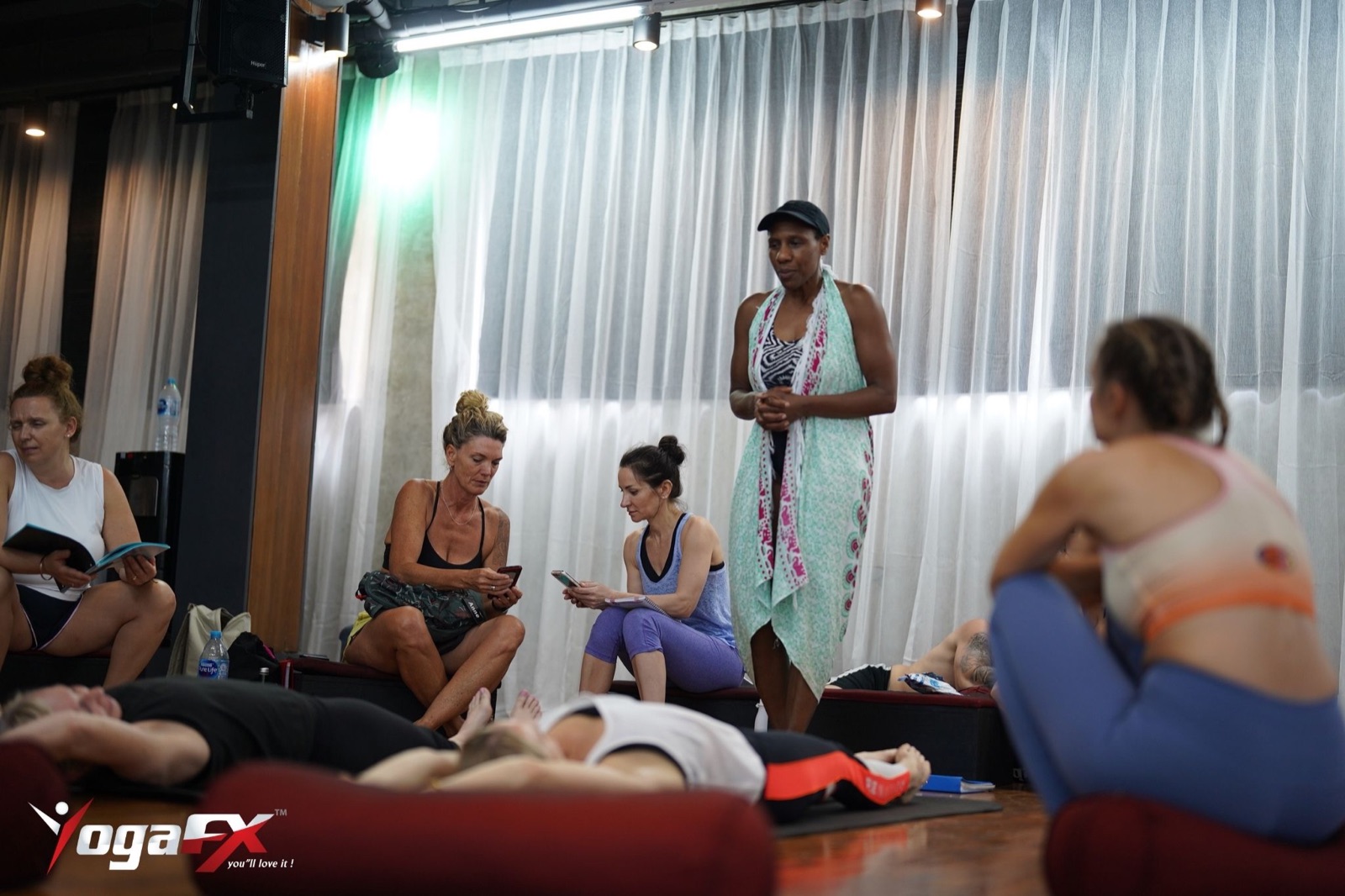
These are words from our own students about training with Mr. Ian and the team. We show first names only, with the review source and year. Nadya recorded her review on video, which you can watch below.
The training was excellent, support from the teacher and the team was great. The information and learning experience was amazing.
Celia, Yoga Alliance review, 2025
I loved every moment of it. High quality teaching, perfect accommodation and school setting, amazing fellow students and the truly inspirational Ian Terry and his hardworking team
Helen, Google review, 2024
It’s not only the dialogue but like you’re pushing me every day.
Nadya, YouTube review, 2026

Learning It With the YogaFX Online Course
The plan above works on its own, and these proprioception exercises cost nothing. If you want more than a plan, the YogaFX Online Course gives you the 26 postures, the spoken dialogue and the science at home, led by Mr. Ian Terry, E-RYT 500, through the Yoga Alliance certified Online Academy. It costs USD 329, or 4 payments of USD 82.
The course is also a good fit if you plan to teach one day. Balance and body awareness are skills a teacher has to explain in plain words, and learning to feel them yourself comes first. You can read how our online hot yoga teacher training is organised on the home page.
If you are visiting Bali, the Seminyak studio offers a Free 1-Day Guest Pass, so your first class is free. It is a good way to feel how a teacher’s cues change what you notice in your own body.
This article is part of our hot yoga benefits research guide. Related reading in Hot Yoga Science and Benefits: Hot Yoga Mental Health in Men: What Researchers Measured and Is Hot Yoga Good for Your Heart? Blood Pressure Trials Reviewed.
FAQ
What are proprioception exercises for adults at home?
They are slow drills that make your position sense work harder, such as standing on one leg, standing heel to toe, tapping a foot around a clock face or turning your head while balancing. Do them near a wall, barefoot, at room temperature, and stop if you feel dizzy or any joint hurts.
How often should I do proprioception exercises?
A sensible start is three short sessions a week, about 10 to 15 minutes each. The BMJ ankle trial used three sessions a week for eight weeks, with sessions of up to 30 minutes. Short and regular beats long and rare, so pick days you will really keep.
Can proprioception exercises help after an ankle sprain?
A 2009 BMJ trial of 522 athletes found that an eight-week home programme was linked to fewer repeat sprains, 22% against 33%. That study used a balance board and an instruction DVD, not yoga. If your ankle is still sore or swollen, ask a physiotherapist before you start.
Are proprioception exercises safe for older adults?
Balance and functional exercises reduced falls in a large Cochrane review of older people living at home, and adverse events were mostly non-serious. Safety still depends on set-up. Stand beside a wall or sturdy chair, wear no socks on slippery floors, and check with a doctor if you have dizziness or a past fall.
Do I need a balance board for proprioception exercises?
No. The drills in this guide use only a wall and a flat floor, and each level makes the task harder by narrowing your base, shifting your weight or moving your head. A balance board was part of the BMJ ankle trial, but you can build the same progression without buying equipment.
Still have questions? Message Mr. Ian and the YogaFX team on WhatsApp and we will answer them personally.

Founder and lead trainer of YogaFX International Yoga Teaching Academy, with more than 12,000 hours of teaching. He trained for 5 years, from 2014 to 2019, with the founder of the Bikram Hot 26&2 method.
Published · Last reviewed and updated
You may also like
Explore all articles Hot Yoga Science and Benefits11 min read21 Nov 2026
Hot Yoga Dizzy? What to Do and When to Rest on the Mat
Read article ↗ Hot Yoga Science and Benefits13 min read21 Nov 2026
Is Hot Yoga Safe? Reading the Evidence on Heat Risk
Read article ↗ Hot Yoga Science and Benefits11 min read20 Nov 2026