

Hot yoga vs sauna is a comparison of moving in heat against sitting in heat. The sauna study we checked followed 2,315 Finnish men for a median of 20.7 years. The hot yoga trial we checked ran for 8 weeks with 80 adults. They measured different outcomes, so neither one crowns a winner.
Mr. Ian Terry, E-RYT 500, has more than 12,000 teaching hours in hot rooms. This guide to hot yoga vs sauna follows his teaching on pacing heat, and it keeps that teaching apart from the published research so you can see which is which.
This is general information, not medical advice. Please consult a healthcare professional before you add any heat session to your week, especially if you have a heart condition, low blood pressure, depression or you are pregnant.
Hot Yoga vs Sauna: The Short Answer
Both rooms raise your body temperature, but the real difference is what you do while you are in them. In a sauna you sit still. In a hot class you work for 90 minutes. So that one change decides what the research can and cannot tell us.
Here is the short version of hot yoga vs sauna, using only studies we opened and read. Because the evidence is thin in places, we flag each limit as we go.
- Sauna evidence: a large Finnish cohort links frequent sauna bathing with fewer fatal heart events in middle-aged men. It is observational, so it shows a link and not a cause.
- Hot yoga evidence: one 8-week randomised trial found a larger drop in depression symptoms than a waitlist. It was small and had no active comparison group.
- No head-to-head study: we found no trial of hot yoga vs sauna side by side. Any claim of a winner therefore goes beyond the data.
- Your goal decides: rest in heat and skill in heat are different jobs, and the choice section below shows how to pick.
If you would like a studio view of the same question, one Bali team wrote up how a Bali studio compares a heated class with a sauna visit. This guide takes a different route. It reads the two studies side by side and asks what each one really measured.
Passive Heat vs Active Heat: What Really Differs
For example, researchers talk about passive heat and active heat. Passive heat means the room heats you while you rest. Active heat means you generate warmth by working inside a warm room. Because of that, a sauna counts as the first and a hot yoga class as the second.
Hot yoga vs sauna: sitting in heat
In a sauna, heat is the only load. Your skin warms and you sweat, but your muscles do no work. So any effect that a sauna study reports comes from heat exposure on a resting body, plus whatever else sauna users do differently from non-users.
Hot yoga vs sauna: moving in heat
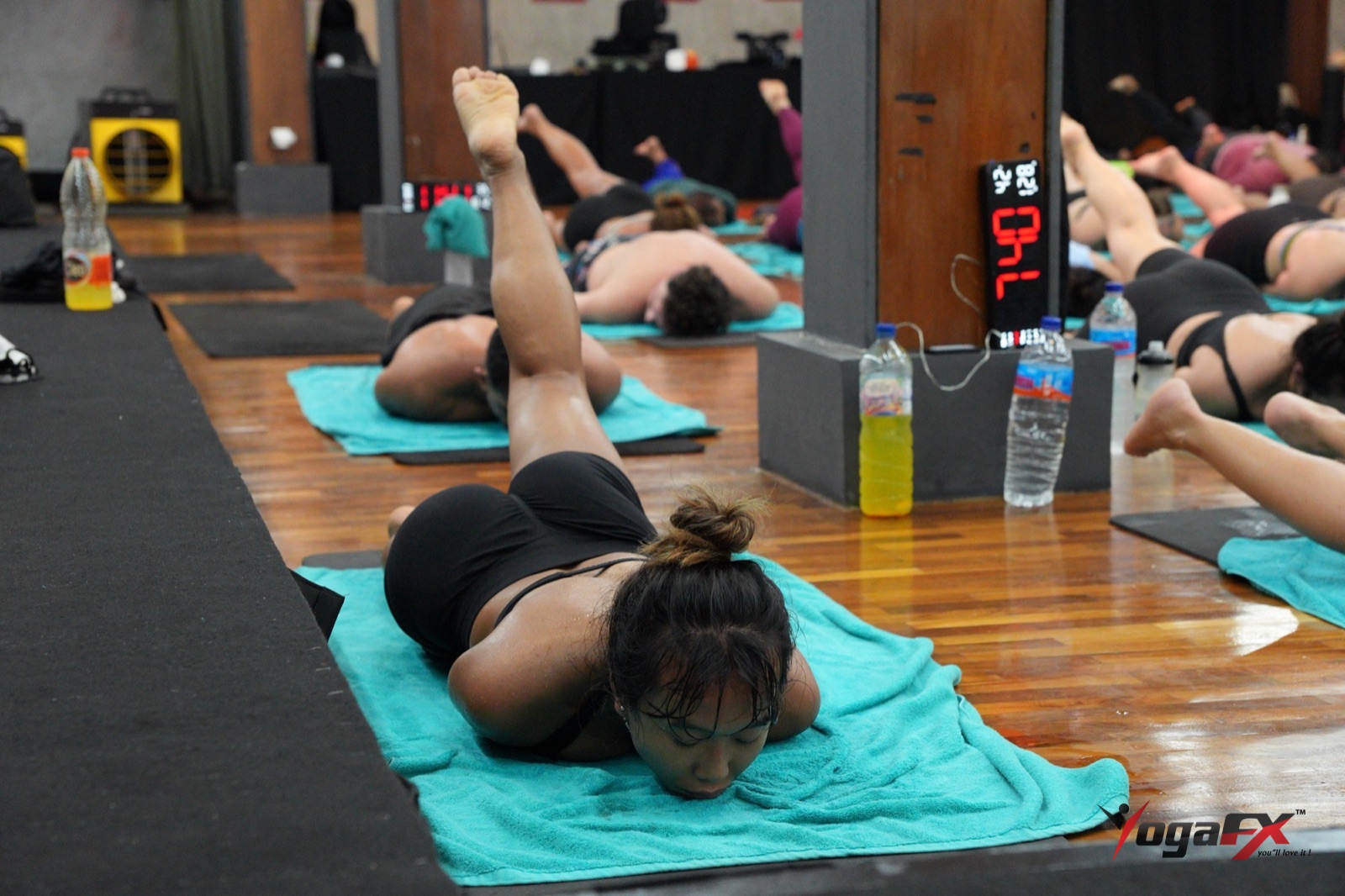
In a standard YogaFX class the room runs at 40 degrees Celsius and about 40% humidity, and the class lasts 90 minutes. You stand, balance, bend and breathe on a set script. As a result, heat and effort stack on top of each other, and that is a very different job for the body than sitting on a bench.

Why this matters for the research
Yoga adds movement, breathing, attention and a group of people. That means a good result in a yoga trial cannot be pinned on heat alone. Sauna cohort studies have the opposite problem. People choose how often they use a sauna, and frequent users may differ in other habits. For that reason, hot yoga vs sauna is never a clean test of heat, and you shouldn't read it as one.
Hot Yoga vs Sauna Evidence at a Glance
The hot yoga vs sauna table below sets the two studies next to each other. It uses only figures we read in the study records. Where a record gave no number, we say so instead of guessing.
| Question | Sauna study (Finland) | Hot yoga study (heated hatha yoga) | What it means for you |
|---|---|---|---|
| Study type | Prospective cohort, so it observes | Randomised controlled trial against a waitlist | A trial can test cause, but only for its own question |
| Who took part | 2,315 men aged 42 to 60 | 80 adults randomised, with moderate-to-severe depression | Different people, so results do not transfer |
| How long | Median follow-up of 20.7 years | 8 weeks | Years of follow-up versus a short course |
| What was measured | Fatal heart events and deaths from any cause | Depression symptom scores | Different outcomes cannot be ranked against each other |
| Headline result | 4 to 7 sessions a week vs once a week: sudden cardiac death hazard ratio 0.37 (95% CI 0.18 to 0.75) | 59.3% of the yoga group cut symptoms by half or more, vs 6.3% on the waitlist | Both are promising, and both are specific |
| Main limit | Observational, men only, one region of Finland | Small, and no active comparison group | Neither study tested the other room |
Read this hot yoga vs sauna table with one caution. A hazard ratio of 0.37 means a lower relative risk in that group of men. It does not mean a sauna will cut your own risk by that amount. Likewise, the yoga result describes one trial group, not every student. That is why we show the limits next to every number.
Five numbers behind the comparison
Hot yoga vs sauna: five numbers from two studies
2,315
Finnish men followed
Aged 42 to 60 at the start of the sauna study.
20.7 years
Median follow-up
Long enough to count deaths, not just habits.
0.37
Hazard ratio
Sudden cardiac death, 4 to 7 sauna sessions a week vs once a week.
80
Adults randomised
Heated yoga trial, 8 weeks, with a waitlist group.
59.3% vs 6.3%
Symptom response
Yoga group vs waitlist, symptoms down by half or more.
Sauna Research: A 20-Year Finnish Cohort
The sauna study is a 2015 paper in JAMA Internal Medicine by Laukkanen, Khan, Zaccardi and Laukkanen. Its title is Association between sauna bathing and fatal cardiovascular and all-cause mortality events. It used data from the Kuopio Ischemic Heart Disease Risk Factor Study in Eastern Finland.
The team followed 2,315 men aged 42 to 60. Baseline data were collected between 1984 and 1989, and follow-up lasted a median of 20.7 years. During that time there were 190 sudden cardiac deaths, 281 fatal coronary heart disease events, 407 fatal cardiovascular events and 929 deaths from any cause.
How often mattered
The researchers sorted the men by how often they used a sauna. The comparison group went once a week. Here is what the paper reports for sudden cardiac death:
- Once a week: 601 men, used as the reference group.
- Two to three times a week: 1,513 men, hazard ratio 0.78 (95% CI 0.57 to 1.07). That interval crosses 1, so the result is not clear on its own.
- Four to seven times a week: 201 men, hazard ratio 0.37 (95% CI 0.18 to 0.75), with a P value for trend of .005.
Session length showed a similar pattern. Compared with sessions under 11 minutes, sessions over 19 minutes had a hazard ratio of 0.48 for sudden cardiac death (95% CI 0.31 to 0.75). Sessions of 11 to 19 minutes did not differ clearly (0.93, 95% CI 0.67 to 1.28).
The paper also reports similar trends for the other heart outcomes and for deaths from any cause. However, the session-length link was not significant for all-cause deaths, so the longer-session result needs careful reading.
Limits to keep in mind
This is an observational study, so it shows only that men who used saunas more often had fewer fatal events, but it cannot show that the sauna caused the difference. For example, men who sauna four to seven times a week may live differently in other ways. The authors themselves say the mechanisms need further study.
- Men only: the study says nothing direct about women.
- One region: all participants came from Eastern Finland, where sauna is a regular habit.
- No yoga: nobody in the study was doing hot yoga, so it cannot rank the two.
So the sauna paper is useful for hot yoga vs sauna questions, but it answers a narrow one. It tells you about frequent sauna habits in Finnish men. It doesn't tell a visitor who uses a sauna twice a year what to expect.
Hot Yoga Research: An 8-Week Randomised Trial
The hot yoga trial is a 2023 paper in the Journal of Clinical Psychiatry by Nyer and colleagues. Its title is A Randomized Controlled Trial of Community-Delivered Heated Hatha Yoga for Moderate-to-Severe Depression. The trial ran between March 2017 and August 2019, and it compared heated yoga with a waitlist.
A total of 80 adults were randomised, and 65 were analysed: 33 in the yoga group and 32 on the waitlist. The average age was 32.7, and 81.5% of participants were female. Yoga participants attended a mean of 10.3 classes over the 8 weeks.
What the trial found
Because the trial had a control group, we can see that depression symptoms fell more in the yoga group than on the waitlist, with a Cohen's d of 1.04 (P below .001). In plain terms, that is a large difference between the groups, so the result deserves attention.
The paper also counted responders, meaning people whose symptoms fell by 50% or more. In the yoga group 59.3% responded, against 6.3% on the waitlist.
What the trial cannot tell you
The waitlist group did no activity at all. Because that group simply waited, the trial cannot say whether heated yoga beats room-temperature yoga, a gym session, a walk or a sauna. The authors describe their results as feasibility, acceptability and preliminary efficacy, and they call for more research with active comparison groups.
- Heated hatha yoga: the paper describes heated hatha yoga, not the Bikram Hot 26&2 class specifically.
- Depression focus: participants had moderate-to-severe depression, so the result may not apply to people without it.
- Early evidence: this is one trial, so it needs repeating before anyone treats it as settled.
For hot yoga vs sauna, please read this as early research, not as a treatment plan. If you are managing depression, speak with a healthcare professional first. Yoga can sit alongside care, but it does not replace it.
Why Hot Yoga vs Sauna Has No Clear Winner
It's tempting to line up the two headline numbers and pick the bigger one. That would be a mistake in any hot yoga vs sauna debate. The studies differ in four ways that matter, so each difference makes a direct comparison unfair.
- Different people: middle-aged Finnish men in one study, and adults with depression, mostly women, in the other.
- Different outcomes: fatal heart events in one, depression scores in the other.
- Different time scales: about 21 years of follow-up against an 8-week course.
- Different comparisons: sauna users compared with other sauna users, and yoga compared with a waitlist.
As a result, the honest reading of hot yoga vs sauna is modest. The sauna paper links frequent sauna bathing with fewer fatal heart events in one group of men. The yoga paper links heated yoga with larger drops in depression scores in one group of adults. Neither tests the other room.
If you want to go deeper into individual rooms, our other guides each take one comparison at a time. See hot yoga vs infrared sauna, hot yoga vs steam room and heated vs room-temperature yoga trials. For the spacing question, read sauna after hot yoga.
Choosing in Hot Yoga vs Sauna: A Practical Guide
The studies can't choose for you, so your goal has to. Here is how we guide students who ask us about hot yoga vs sauna. This part is YogaFX teaching guidance, not a research result.
- You want to learn a skill: choose the class. A teacher, a script and a group give you something to practise, and a sauna offers none of that.
- You want quiet time in heat: a short sauna visit can fit, provided your doctor has no objection.
- You want to do both: keep them on separate occasions at first, and notice how you feel before you combine them.
- You are new to heat: start with a short, gentle session in either room, and build up slowly over several weeks.
Safety rules that apply to both
- Ask a healthcare professional first if you have a heart condition, low blood pressure, depression or you are pregnant.
- Drink water before and after, because you lose fluid in both rooms.
- Leave the room and sit down at the first sign of dizziness, headache or weakness.
- Never treat a long, hard session as a badge of honour.
Many students ask whether sweat does a cleaning job in either room. We do not make that claim, and neither study we read tested it.
If You Plan to Teach: Reading Heat Is Part of the Job
Students will ask you about hot yoga vs sauna. They will quote a headline, so they will expect a straight answer. A teacher who can say that one study followed Finnish men and did not test yoga earns trust quickly, because that answer is true and it is specific.
That is why we teach heat, including hot yoga vs sauna questions, as a subject, not only a setting on a dial. Mr. Ian trains teachers to separate what research shows from what experience suggests. For example, a trainee learns to say "this trial found" instead of "science proves". That habit protects your students, and as a result it protects you.
You can start that learning at home. The online part of the YogaFX MasterClass lets you study the theory first, so you arrive in Bali ready to practise it. That is the whole point of a hybrid course: theory on your schedule, then teaching skills under a trainer's eye.
What YogaFX Trainees Say
Numbers describe the research. Trainees describe what it's like to learn inside the heat, which is the part hot yoga vs sauna studies can't measure. These two comments come from video reviews recorded at the end of teacher training.
Alena, in a 2025 video review, thanked Mr. Ian for his support and said that being in a room with 60 people felt powerful (close paraphrase from the video). Alena, YouTube review, 2025.
“This has been wonderful and I am very grateful for this experience and for meeting every single individual here.”
Dior, YouTube review, 2024

Train Online First, Then Finish in Bali
Mr. Ian Terry, E-RYT 500, trained for five years, from 2014 to 2019, with the founder of the Bikram Hot 26&2 method. Since 2017, YogaFX has trained 1,500+ graduates from 80+ countries.
The YogaFX MasterClass is a 6-day hybrid. You study online first, then join an intensive in Bali. The next group checks in on Sunday 24 January 2027 and checks out on Friday 29 January 2027 at Soham Wellness Center in Seminyak.
It leads to Yoga Alliance RYT 200-Hour certification and the Bikram Hot 26&2 200-Hour International Yoga Certification. Early Bird pricing is US$1,899 (normally US$1,999), with instalments from US$250 a month and no interest. You can explore the online hot yoga teacher training here.
FAQ
Is hot yoga the same as a sauna?
No. In a sauna you sit in heat. In a hot yoga class you move for 90 minutes in a room at about 40 degrees Celsius and 40% humidity, so effort and heat combine. The research differs too, because the sauna and yoga studies we checked measured different outcomes in different people.
Is hot yoga or sauna better?
In hot yoga vs sauna, it depends on your goal, and the research does not crown a winner. The sauna study we checked looked at heart deaths in Finnish men, while the hot yoga trial looked at depression symptoms. If you want movement and a teacher's guidance, choose class. If you want quiet heat, a short sauna visit fits.
Is hot yoga as effective as a sauna?
No study we opened tested that. The sauna cohort followed 2,315 men for a median of 20.7 years and tracked deaths, while the heated yoga trial lasted 8 weeks and tracked depression symptoms. Because the outcomes, people and designs differ, any claim that one is more effective goes beyond the evidence.
Can sauna replace exercise?
The studies we checked do not say so. The Finnish cohort looked at how often men used a sauna, not whether it replaced training. A hot yoga class adds movement, balance and breathing practice that sitting in a sauna does not. Treat the sauna as a separate habit, and ask your doctor about your plan.
Does hot yoga have sauna benefits?
We cannot say. The sauna paper reports links with fewer fatal heart events, and no yoga study we opened measured those outcomes. The hot yoga trial found larger drops in depression symptoms than a waitlist. Both sets of results are early and specific, so avoid treating them as interchangeable.
Still have questions? Message Mr. Ian and the YogaFX team on WhatsApp and we will answer them personally.

Founder and lead trainer of YogaFX International Yoga Teaching Academy, with more than 12,000 hours of teaching. He trained for 5 years, from 2014 to 2019, with the founder of the Bikram Hot 26&2 method.
Published · Last reviewed and updated
You may also like
Explore all articles ↗ Hot Yoga Science and Benefits10 min read17 Nov 2026
Hot Yoga Depression Study: How the Harvard Trial Was Run and Measured
Read article ↗ Hot Yoga Science and Benefits12 min read16 Nov 2026
Tired After Hot Yoga? Fatigue and Mood Studies Explained
Read article ↗ Yoga for Athletes and Yoga Sport12 min read16 Nov 2026