

The safe hot yoga temperature at home is lower than a studio’s 40°C. No official home standard exists, but a warm room of about 26 to 30°C, checked at mat height, is a sensible start. One number never decides safety, though. How your body copes with the room decides it.
In this article13 sections
- Hot Yoga Temperature at Home: The Short Answer
- Why a Studio Number Does Not Fit Hot Yoga Temperature at Home
- What One University Study Measured in a Heated Room
- Warning Signs While You Practise: What to Do Right Now
- Hot Yoga Temperature at Home: Limits at a Glance
- Hydration and Hot Yoga Temperature at Home: Drink Early
- Heaters and Hot Yoga Temperature at Home: Warm, Not Risky
- A Five-Minute Check Before Every Home Session
- Who Should Check With a Doctor First
- How Mr. Ian Terry and the YogaFX Team Teach Heat
- What Students Say About Training With YogaFX
- Learn the Method First, Then Choose Your Heat
- FAQ: Hot Yoga Temperature at Home
Most people search for a figure to type into a heater. That’s a fair first question. The better question about hot yoga temperature at home is how warm you can go before the heat stops helping you, so this guide covers the room, your body, your heater and your limits. Mr. Ian Terry, E-RYT 500, and the YogaFX team wrote it for students who practise online.
Hot Yoga Temperature at Home: The Short Answer
Here is the plain version. You don’t need to copy a studio. You need a room that feels warm and steady, a way to measure it, and the habit of stopping early. That is how you keep a hot yoga temperature at home both useful and safe.
These are YogaFX teaching suggestions for online students. They are not a medical standard, and no study has tested these exact home settings. Think of them as three limits that work together:
- The room limit. Start near 26 to 30°C (79 to 86°F) and go no higher than about 32°C (90°F) at home.
- The body limit. Stop at the first sign of dizziness, nausea, headache or faintness, whatever the thermometer says.
- The session limit. Keep early sessions shorter than a 90-minute studio class and extend them only when you finish feeling calm.
The room limit protects you before you start. The body limit protects you during the session. The session limit protects you from doing too much too soon. Remove any one of them and the other two have to work harder.
Why a Studio Number Does Not Fit Hot Yoga Temperature at Home
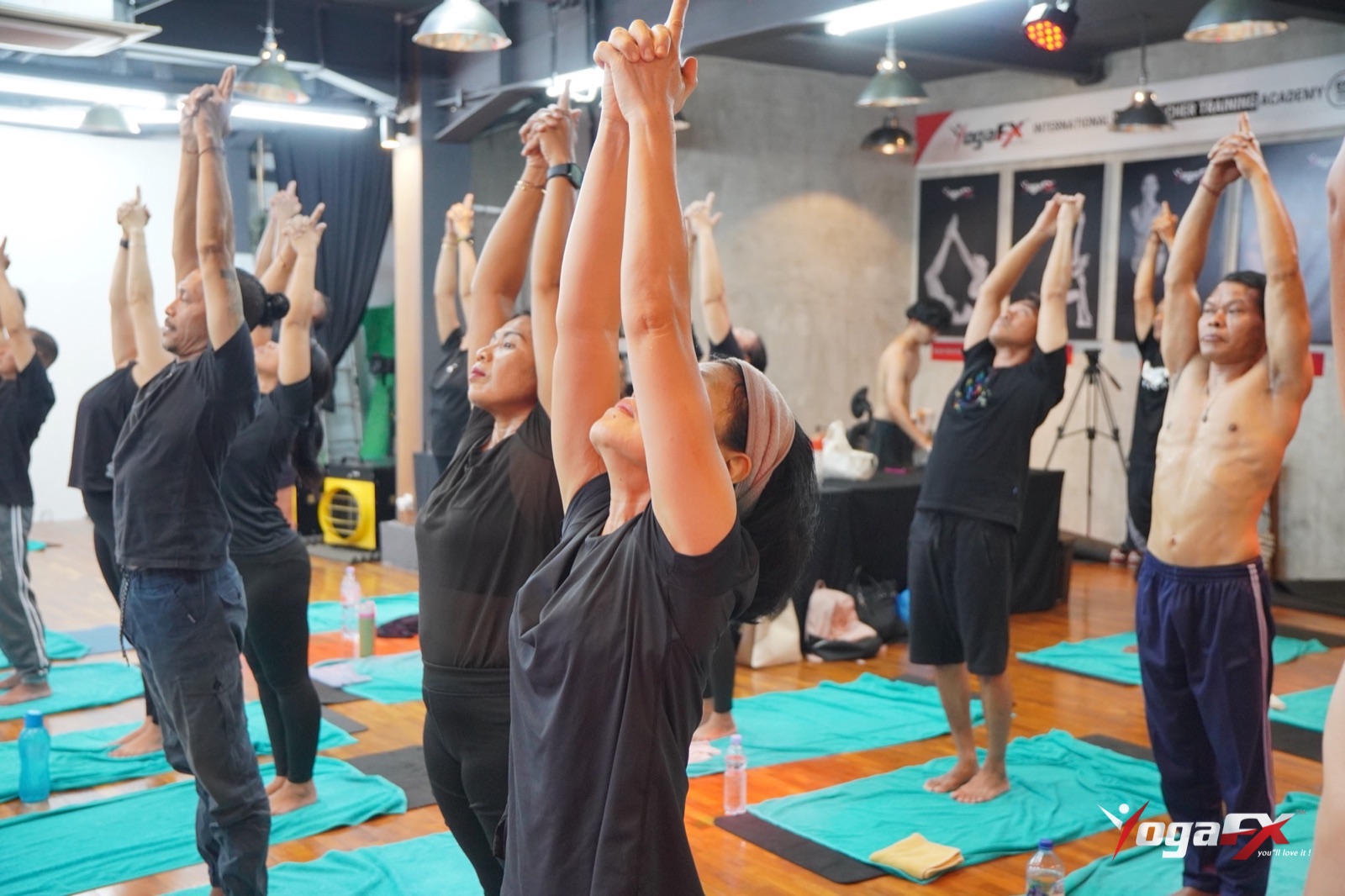
A full class at our Seminyak studio runs at 40°C with about 40% humidity for 90 minutes. There is no music and no demonstration. A scripted dialogue guides every posture, so the teacher keeps both eyes free for the students. The room, the airflow and the teacher all work as one system.
At home, that system is gone. A space heater warms the air near it, so the reading at mat height can differ from the reading across the room. Nobody watches your face. Nobody’s there to tell you to sit down. As a result, your hot yoga temperature at home depends far less on the thermostat than it does in a studio.
If you want to see how a studio room is set and why, read why a full class room is set so warm. Then come back here and plan a smaller, calmer version for your own space. For a step-by-step ladder of home settings, our hot yoga temperature guide for home practice covers each stage.
What One University Study Measured in a Heated Room
Real numbers help here. A master’s thesis from the University of Wisconsin-La Crosse measured what happens inside the body during hot yoga. Ashley Nereng wrote it in 2013 under the exercise physiologist John Porcari. Its title is Heart rate and core temperature responses during basic yoga compared to hot yoga. You can read the record on the University of Wisconsin repository.
Twenty healthy adults aged 19 to 44 took part, 16 women and 4 men. Each did a 60-minute basic yoga class and a 60-minute hot yoga class within 24 hours. Each swallowed a small sensor that reads core body temperature, so the researchers measured the inside of the body, not the skin.
The hot room averaged about 33.7°C (92.7°F) with 35% humidity. These are the main results:
- Core temperature: an average of 37.6°C in hot yoga against 37.4°C in basic yoga, with no significant difference.
- Heart rate: an average of 105 beats per minute in hot yoga against 103 in basic yoga, again without a significant difference.
- Effort: students rated the hot class as harder, 13.6 against 12.3 on the 6 to 20 Borg scale, and that gap was significant.
- Highest reading: the top core temperature for any one person was 39.1°C (102.4°F).
The author concluded that hot yoga did not produce unsafe core temperature or heart rate responses in that room. That is reassuring. However, it is only part of the picture.
What the study cannot tell you
Three limits matter for anyone planning hot yoga temperature at home. First, it is an unpublished thesis, not a peer-reviewed journal paper. Second, the group was small, and every student did basic yoga first and hot yoga second, so the order was never swapped.
Third, and most important, the room was cooler than a studio class. The author calls it the lower end of the usual range and asks for more research at higher temperatures. So the study supports a warm room. It cannot tell you that 40°C is safe for you, in your spare room, without a teacher. One person did reach 39.1°C, which is a reminder that individuals differ.
Warning Signs While You Practise: What to Do Right Now
Your body gives clear signals before heat becomes a problem. The NHS lists the signs of heat exhaustion and the steps to take, and it says heat exhaustion does not usually need emergency help if you can cool down within 30 minutes. Read the full advice on the NHS heat exhaustion and heatstroke page. The table turns it into a mat-side checklist.
| What you notice | What it can mean | What to do now |
|---|---|---|
| Dizziness, headache or nausea | Early heat exhaustion | Stop, move somewhere cool and sip water |
| Heavy sweating with pale, clammy skin | Heat exhaustion | Remove extra clothing, cool your skin with cool water and a fan |
| Cramps in the arms, legs or stomach | Heat exhaustion | Stop, rest and drink water or an isotonic sports drink |
| Still unwell after 30 minutes of cooling | It may be turning into heatstroke | Call your local emergency number and do not drive yourself |
| Hot skin that is not sweating, confusion, fast breathing or a seizure | Possible heatstroke | Emergency: call 999 in the UK or your local number now |
Notice that the first three rows are all about stopping. You don’t need to finish the posture or the set. If you want a longer walkthrough of what to do on the mat, our guide to what to do when hot yoga makes you dizzy goes step by step.
Hot Yoga Temperature at Home: Limits at a Glance
33.7°C room
Average room temperature in the University of Wisconsin-La Crosse hot yoga class (92.7°F).
37.6°C core
Average core body temperature in that hot class, against 37.4°C in basic yoga.
39.1°C peak
Highest core reading for one person in the study (102.4°F). Individuals differ.
30 minutes
NHS: heat exhaustion usually settles if you cool down within 30 minutes. If not, treat it as an emergency.
3 feet
US Consumer Product Safety Commission: keep a space heater at least three feet from anything flammable.
40°C and 40%
The YogaFX studio class room. A studio reference, not a home target.
Hydration and Hot Yoga Temperature at Home: Drink Early
Heat makes you sweat, and sweat takes water with it. The NHS advice for heat exhaustion is to drink plenty of water, or an isotonic sports drink or oral rehydration powder. So the sensible habit is to start the session already hydrated, not to catch up halfway through.
Our YogaFX guidance for home students is simple. Keep a bottle on the mat, sip between postures, and stop if you feel thirsty and light-headed together. For amounts and electrolytes, read our guide to hot yoga hydration.
Humidity matters too, because heavy air feels harder to practise in. A small hygrometer costs very little and shows whether the room sits near the 40% a studio class uses. If the air feels thick, open a window or turn the heater down.
Heaters and Hot Yoga Temperature at Home: Warm, Not Risky
A warm room usually means a heater, and heaters carry their own risks. The US Consumer Product Safety Commission has published plain advice on space heater safety, which you can read on the CPSC heater safety page. These are the points that matter most for a yoga room:
- Choose a certified heater with a guard around the heating element.
- Use a hard, nonflammable surface. Never stand a heater on a rug or carpet.
- Keep three feet clear of bedding, drapes, furniture and your own mat.
- Never leave it on while you sleep, and switch it off when you leave the room.
- Fit working alarms. Have smoke alarms and, for fuel-burning heaters, carbon monoxide alarms.
Notice the third point. Many people place the heater beside the mat to feel warmer. That’s exactly where it shouldn’t be. Instead, place it across the room and let the air warm gradually, then check the reading at mat height.
A Five-Minute Check Before Every Home Session
A short routine keeps your hot yoga temperature at home safe better than any gadget. Run through these steps before you start, because the weather changes your room from day to day:
- Read the thermometer at mat height and write the number down.
- Check the humidity with the hygrometer. Open a window if the air is heavy.
- Place water and a towel within reach, and leave a clear path to a cooler space.
- Set a timer shorter than a full class for your first weeks.
- Ask how you feel. If you slept badly, skipped a meal or feel unwell, lower the heat or skip the session.
After a week of notes, you will see your own pattern. A cold, dry morning and a damp afternoon can feel like two different rooms, even with the same heater setting. That is useful, because it teaches you to trust the signs more than the dial.
Who Should Check With a Doctor First
This is general information, not medical advice. Please consult a healthcare professional before you practise in a heated room. That matters most if you have a heart, blood pressure or kidney condition, take regular medication, are pregnant, or feel unwell on the day.
Heat gives your body extra work on top of the postures, so a doctor can tell you how much extra load suits you. Ask them about hot yoga temperature at home in particular, because nobody will be there to notice if something goes wrong. For a wider look at risk, check the research in our guide to hot yoga safety.
How Mr. Ian Terry and the YogaFX Team Teach Heat
Mr. Ian Terry, E-RYT 500, founded YogaFX in 2017. He has more than 12,000 teaching hours and trained for five years, from 2014 to 2019, with the originator of the Bikram Hot 26&2 method. The YogaFX approach is that a teacher reads the students, not only the thermostat.
That is why our studio classes use a scripted dialogue and no music. The teacher watches breathing, colour and balance, and students may rest whenever they need to. For hot yoga temperature at home, you become your own teacher. Watch for these signs in yourself:
- Your focus. If you lose track of the posture order, step out and cool down.
- Your legs. Shaky legs in postures you know well are a cue to ease off.
- Your stomach. Any queasiness means stop, because nausea is on the NHS list of heat exhaustion signs.
- Your head. A pounding or light-headed feeling is another reason to leave the heat and sip water.
If you will be in Bali, you can feel a class for yourself. Our Seminyak studio offers a Free 1-Day Guest Pass, so your first class is free. If you want to learn the method from home first, the YogaFX Hot Yoga Online course teaches the 26 and 2 sequence and its dialogue step by step. It costs USD 329, or 4 x USD 82.
What Students Say About Training With YogaFX
Our students speak for themselves, so we let them. These short clips come from YouTube videos recorded at YogaFX trainings in Bali. The speakers are not named in the videos, so we credit each one as a trainee in our YouTube reviews.
“Thank you Mr Ian and friends who always gave knowledge. This knowledge is very useful for me, especially since I am already over 50.”
A trainee in our YouTube review, 2023, translated from Indonesian (watch the video)
“I’ve never reached my toes ever, but thank you for the reminder, I can reach my toes.”
A trainee in our YouTube review, 2018 (watch the video)
“Thank you for coming. You shared so much positive vibes, good energy.”
A trainee in our YouTube review, 2018 (watch the video)


Learn the Method First, Then Choose Your Heat
If your goal is to teach hot yoga one day, you don’t need a 40°C room in your house. You need the postures, the dialogue and good judgement about heat. Those are learnable at home, in a room you control, and managing hot yoga temperature at home is part of that skill. As a result, you build real skill while the risk stays low.
When you are ready, you can add a studio experience later and feel the full class conditions with a teacher beside you. That order, skill first and heat second, is the one we recommend for hot yoga temperature at home. See how it fits our wider hot yoga teacher training online programme.
This article is part of our explainer on how hot yoga works. Related reading in Bikram and Hot Yoga Explained: Hot Yoga vs Pilates: Honest Evidence for Men (80% vs 54%) and Bikram Yoga History and the Science: When Researchers Started Measuring Hot Yoga.
FAQ: Hot Yoga Temperature at Home
Can you do hot yoga at home?
Yes, you can practise hot yoga at home, but treat it as a gentler version of a studio class. Use a warm room rather than a 40°C one, measure the temperature at mat height, keep water close and stop at the first warning sign. Many students learn the postures first in a neutral room.
How do I make a room hot for hot yoga?
Start with a closed room, a small heater on low and a thermometer at mat height. Keep any heater at least three feet from flammable items and never leave it on while you sleep. Build up over several weeks. If the air feels heavy or you feel unwell, cool the room straight away.
Is a space heater safe for hot yoga at home?
It can be if you follow basic rules. The US Consumer Product Safety Commission advises a certified heater on a hard, nonflammable surface, kept three feet from flammable items and never left on while you sleep. Fit working smoke alarms, and carbon monoxide alarms if the heater burns fuel.
How long should a hot yoga session at home be?
There is no official limit for home practice. A YogaFX studio class lasts 90 minutes with a teacher watching, but at home we suggest starting with shorter sessions in a warm room. Extend them only when you finish feeling calm, with steady breathing and no headache. Check with your doctor if unsure.
Why are yoga rooms so hot?
Studios heat the room so the body feels warmer and the class feels more demanding. At YogaFX, a class runs at 40°C and about 40% humidity for 90 minutes. Heat is a choice, not a requirement, and it adds effort, so respect it. At home, start warm rather than hot.
Still have questions? Message Mr. Ian and the YogaFX team through our contact page and we will answer them personally.

Founder and lead trainer of YogaFX International Yoga Teaching Academy, with more than 12,000 hours of teaching. He trained for 5 years, from 2014 to 2019, with the founder of the Bikram Hot 26&2 method.
Published · Last reviewed and updated
You may also like
Explore all articles Bikram and Hot Yoga Explained11 min read13 Nov 2026
Sauna After Hot Yoga? What Core Temperature Data Suggests
Read article ↗ Bikram and Hot Yoga Explained11 min read23 Nov 2026
Hot Yoga for Beginners: Learn the Basics at Home First
Read article ↗ Bikram and Hot Yoga Explained12 min read15 Nov 2026