
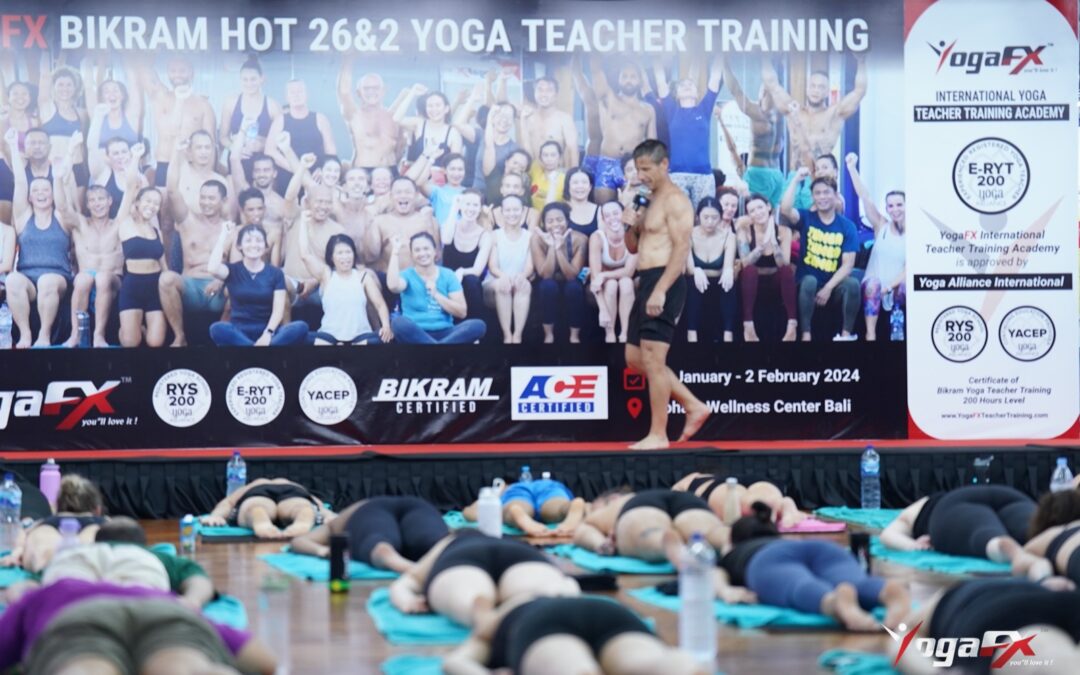
A full 26 and 2 class at YogaFX runs at 40°C (104°F) with about 40% humidity. For home practice, the safe hot yoga temperature is lower: start at 26 to 30°C (79 to 86°F), measure the humidity, and build up slowly. You can approximate a studio, but you cannot copy one without its airflow and a teacher watching.
In this article10 sections
- Hot Yoga Temperature for Home Practice: The Short Answer
- Why a Studio Hot Yoga Room Temperature Is Hard to Copy at Home
- A Hot Yoga Temperature Ladder for Home Practice
- How to Measure Your Hot Yoga Room Temperature and Humidity
- Home Heat Safety Check: Four Steps Before Every Session
- What the Science Says About Heat, Humidity and Safety
- How Mr. Ian Terry and the YogaFX Team Teach the Room
- What Students Say After Training With YogaFX
- Learn the Method Online Before You Chase the Heat
- FAQ: Hot Yoga Temperature at Home
Most people search for a number. That makes sense, because the number is easy to type into a heater. The harder question is what that hot yoga temperature does to your body in your room, so this guide covers both. Mr. Ian Terry, E-RYT 500, and the YogaFX team wrote it for online students. You want some heat in your home practice, but you don't want silly risks.
Hot Yoga Temperature for Home Practice: The Short Answer
Here is the plain version. A studio sets its room with a thermostat, vents and a class full of people. At home you have none of that, so your first job is to measure, not to guess.
People often ask how hot is hot yoga, and the Bikram yoga temperature question comes up just as often. The honest answer is that it depends on the studio, so ask for exact numbers before you book.
These are the YogaFX teaching suggestions for a home hot yoga room temperature. They are teaching guidance for online students, not a medical standard, and no study has tested these exact ranges.
- Start warm, not hot. A room at 26 to 30°C (79 to 86°F) is a sensible first hot yoga temperature for home.
- Keep humidity moderate. Aim near the 40% a studio class uses, and open a window if the air feels heavy.
- Build over weeks. Raise the heat only after several calm, easy sessions at the stage before.
- Stay below the studio. Treat the studio's 40°C (104°F) as a ceiling you may never reach at home, and that is fine.
Why a Studio Hot Yoga Room Temperature Is Hard to Copy at Home
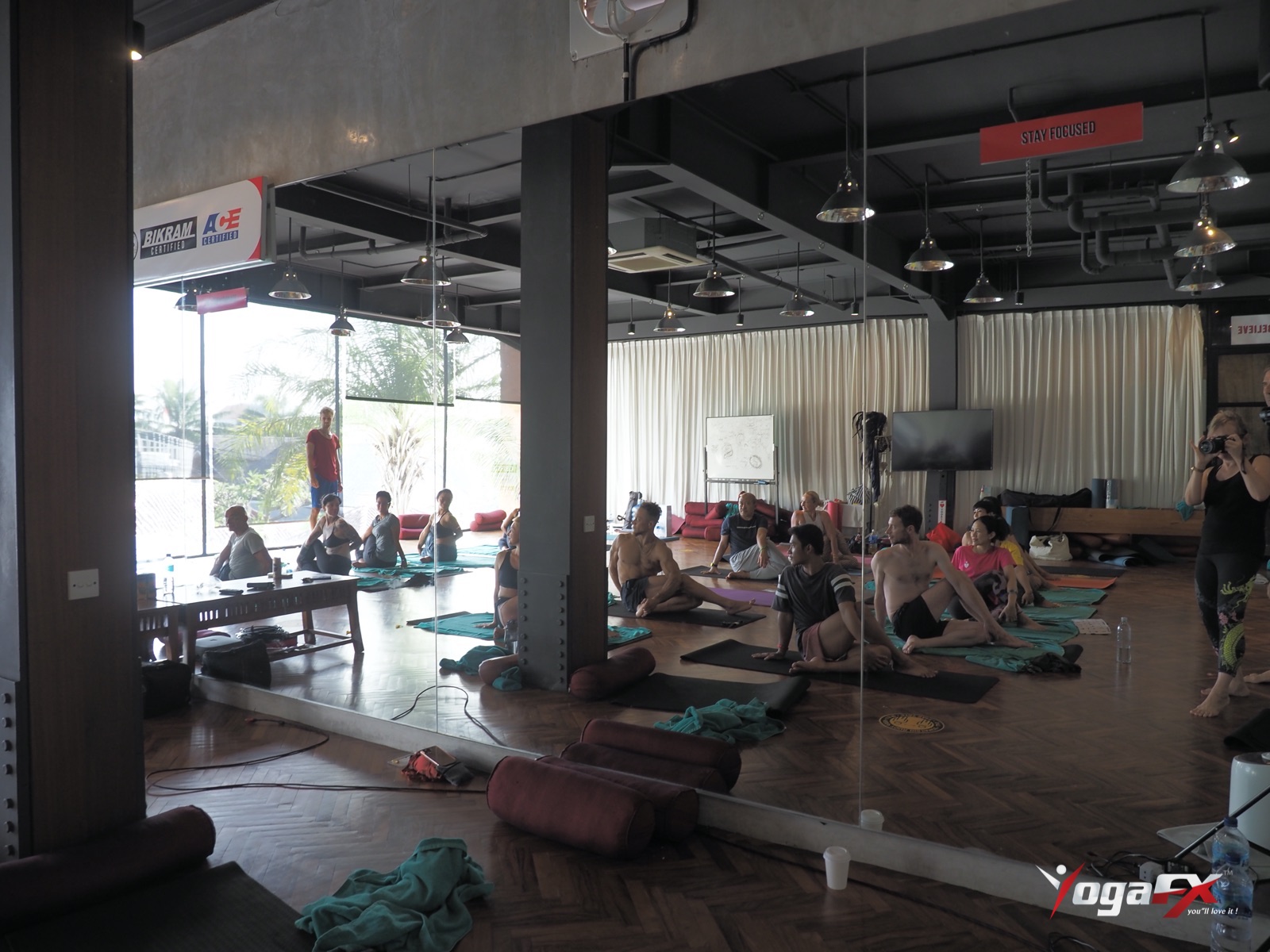
A studio room is not just a hot room. It is a system. Heaters, fans, humidity control and trained eyes all work together, and a class of students adds heat and moisture of its own. Take away one part and the same hot yoga temperature feels very different on the thermometer and on your skin.
At home, three things change:
- The heat source is blunt. A space heater warms the air near it, so the temperature at mat height can be far from the number across the room.
- Nobody is watching your face. In a class, a teacher notices when colour drops or breathing turns ragged. At home, that job is yours.
- Humidity is easy to ignore. Yet it decides how well your sweat can cool you, so it deserves a number of its own.
The Mayo Clinic explains the last point clearly. Its heat exhaustion guide says that when humidity is high, sweat evaporates less readily. The body then struggles more to shed heat. Read it in the Mayo Clinic overview of heat exhaustion.
That is why the same hot yoga temperature can feel fine on a dry day and harsh on a damp one. To see how a full studio room is set, read how a full 26 and 2 class room is set and why. Then come back here and plan your own, smaller version.
A Hot Yoga Temperature Ladder for Home Practice
Think of the hot yoga temperature as a ladder. You climb one rung at a time, and you may stay on a rung as long as you like. The table sets out four stages. It is YogaFX teaching guidance for people studying online, so treat it as a starting point, not a rule.
| Stage | Room setting | Humidity | Who it suits | What to check |
|---|---|---|---|---|
| 1. Neutral | 20 to 24°C (68 to 75°F) | Whatever the room gives you | Complete beginners and anyone new to the postures | Learn the breathing and the order first |
| 2. Warm | 26 to 30°C (79 to 86°F) | Near 40% | Healthy adults after a few easy sessions | Water in reach, towel on the mat |
| 3. Hot | Up to about 32°C (90°F) | Near 40%, never heavy | Regular practitioners cleared by a doctor | Thermometer at mat height, a ten-minute cool down |
| 4. Studio | 40°C (104°F) | About 40% | A studio class with a trained teacher | Not a home target |
Stages 1 and 2: learn in a neutral or warm room
Start in a room that feels pleasantly warm, not stuffy, because comfort keeps you relaxed. For example, a closed room with a small heater on low, checked with a thermometer, is plenty for a first month. At this stage the postures matter more than the hot yoga temperature, because balance and breathing take time to learn.
If you are new to the method, read how the 26 and 2 method works at home before you turn anything up. It explains the order of the postures and why the dialogue stays the same from day to day.
Stage 3: only when the earlier stages feel easy
A hotter room is a choice, not a goal. Raise the hot yoga temperature only if you finish stage 2 sessions feeling calm, with steady breathing and no headache afterwards. If a session leaves you wiped out, go back one stage. That is not failure. Instead, it shows you what your body can handle.
Heat also changes how much water you lose, so plan for it. Because a hotter room means more sweat, drink early and keep a bottle on the mat.
Stage 4: leave the 40°C (104°F) room to the studio
A hot yoga temperature of 40°C (104°F) works in a studio because the whole setup is built around it. The class is 90 minutes long. The teacher guides every posture with a scripted dialogue, and students can rest whenever they need to.
At home, you rarely have those safeguards. So for most online students, stage 4 is something to try once in a studio, not to recreate in a spare room. That means you can learn everything else first and decide on the studio heat later.
How to Measure Your Hot Yoga Room Temperature and Humidity
A guess is not a measurement. Four simple habits change your practice more than any heater. They show you the real hot yoga room temperature, not the one you hope for:
- A thermometer at mat height. Warm air rises, so a reading near the ceiling flatters the room.
- A hygrometer. This small meter tells you whether the air sits near 40% or feels heavy.
- A timer. Keep early sessions shorter than a full 90-minute class, and extend them only by choice.
- A clear exit. Place your mat so you can step out and cool down in a few steps.
Check the hot yoga temperature and humidity before every session, because the weather changes your room. A cold, dry morning and a damp afternoon can feel like two different studios, even with the same heater setting. Write the numbers down for a week, and you will soon see your own pattern.
Home Heat Safety Check: Four Steps Before Every Session
1. Measure
Put a thermometer at mat height and a hygrometer beside it. Aim for humidity near 40%.
2. Warm slowly
Stay at the stage you know. Raise the heat only after several easy sessions.
3. Keep water close
Place a bottle and a towel within reach, and sip during the session.
4. Know your stop signs
Dizziness, nausea, headache or faintness: stop, move somewhere cooler and drink water.
104°F (40°C) core
Mayo Clinic: seek help straight away once core body temperature hits this level.
What the Science Says About Heat, Humidity and Safety
Heat gives your body a second job on top of the postures. That is why the hot yoga temperature matters for safety, and not only for comfort. Your body has to cool itself, and its main tool is sweat.
The Mayo Clinic says your body relies mostly on sweat to cool down in hot weather. As sweat evaporates, it helps regulate body temperature. When you exercise hard in hot, humid conditions, it adds, the body is less able to cool itself efficiently.
The same page lists the signs of heat exhaustion. They include heavy sweating, faintness, dizziness, fatigue, a weak and rapid pulse, muscle cramps, nausea and headache. Symptoms can start suddenly or build over time, so for that reason a long session in a warm room deserves respect. See the full list in the Mayo Clinic guide to heat exhaustion.
The US National Institute for Occupational Safety and Health (NIOSH) is part of the CDC. It describes heat exhaustion as the body's response to an excessive loss of water and salt, usually through heavy sweating. Its listed symptoms include headache, nausea, dizziness, weakness and thirst. Read the details in the NIOSH guide to heat-related illnesses.
When to stop and cool down
The Mayo Clinic advice for suspected heat exhaustion is short. Pause, rest, get somewhere cooler, and sip cool water or a sports drink. It also says to contact a healthcare professional if symptoms get worse or do not improve within an hour.
- Dizzy or faint: lie down and rest. Our guide to what to do when hot yoga makes you dizzy explains the next steps.
- Nausea or headache: stop the session, cool the room and drink water.
- Confusion or trouble drinking: get urgent help straight away.
One number needs care. Mayo says to seek help straight away once a person's core body temperature, measured with a rectal thermometer, hits 104°F (40°C) or more. That is the temperature inside the body. It is not the temperature of the room, even though a studio room is also set at 40°C (104°F). Keep the two apart in your head.
This is general information, not medical advice. Please consult a healthcare professional before you practise in a heated room. This matters most if you have a heart, blood pressure or kidney condition, take medication, or are pregnant.
How Mr. Ian Terry and the YogaFX Team Teach the Room
Mr. Ian Terry (E-RYT 500) started YogaFX in 2017. Over 12,000 teaching hours sit behind him, and he trained under the originator of the Bikram Hot 26&2 method between 2014 and 2019. The YogaFX approach is that a teacher reads the room and the students, not only the thermostat.
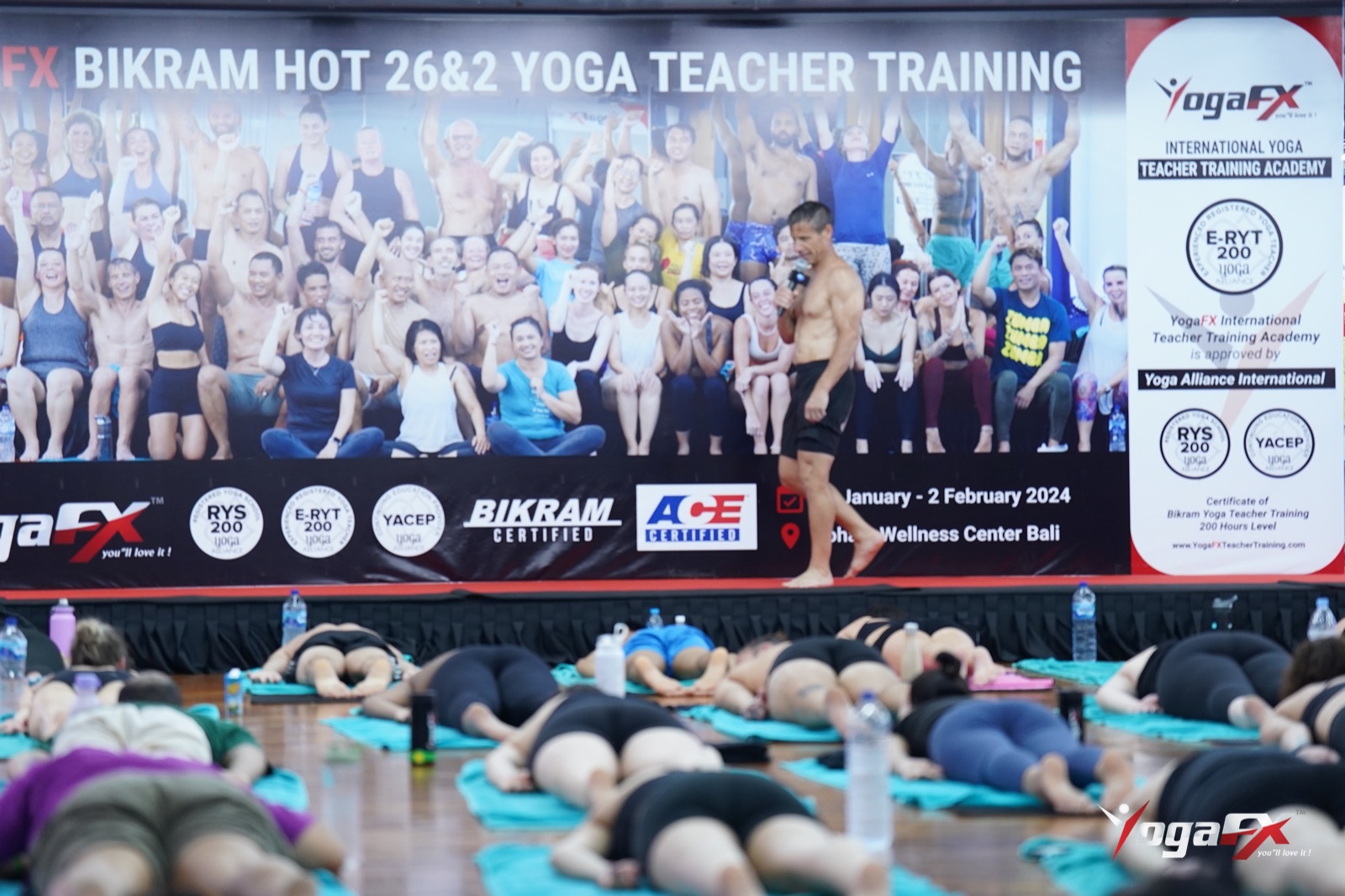
In our Seminyak studio, a class runs 90 minutes at a hot yoga temperature of 40°C (104°F) and about 40% humidity. There is no music and no demonstration. A scripted dialogue guides every posture, so the teacher keeps both eyes free for the students. The studio opens at 06:00 and closes at 22:00, seven days a week.
At home, you become your own teacher for the heat. Watch for these signs in yourself:
- Breathing. If you gulp air through your mouth, the room is too much for today, so turn the heat down.
- Colour. Check your face in a mirror. Very flushed or very pale skin means rest.
- Balance. If your standing postures wobble more than usual, ease off the heat.
- Thirst and headache. Both say you started the session short of water.
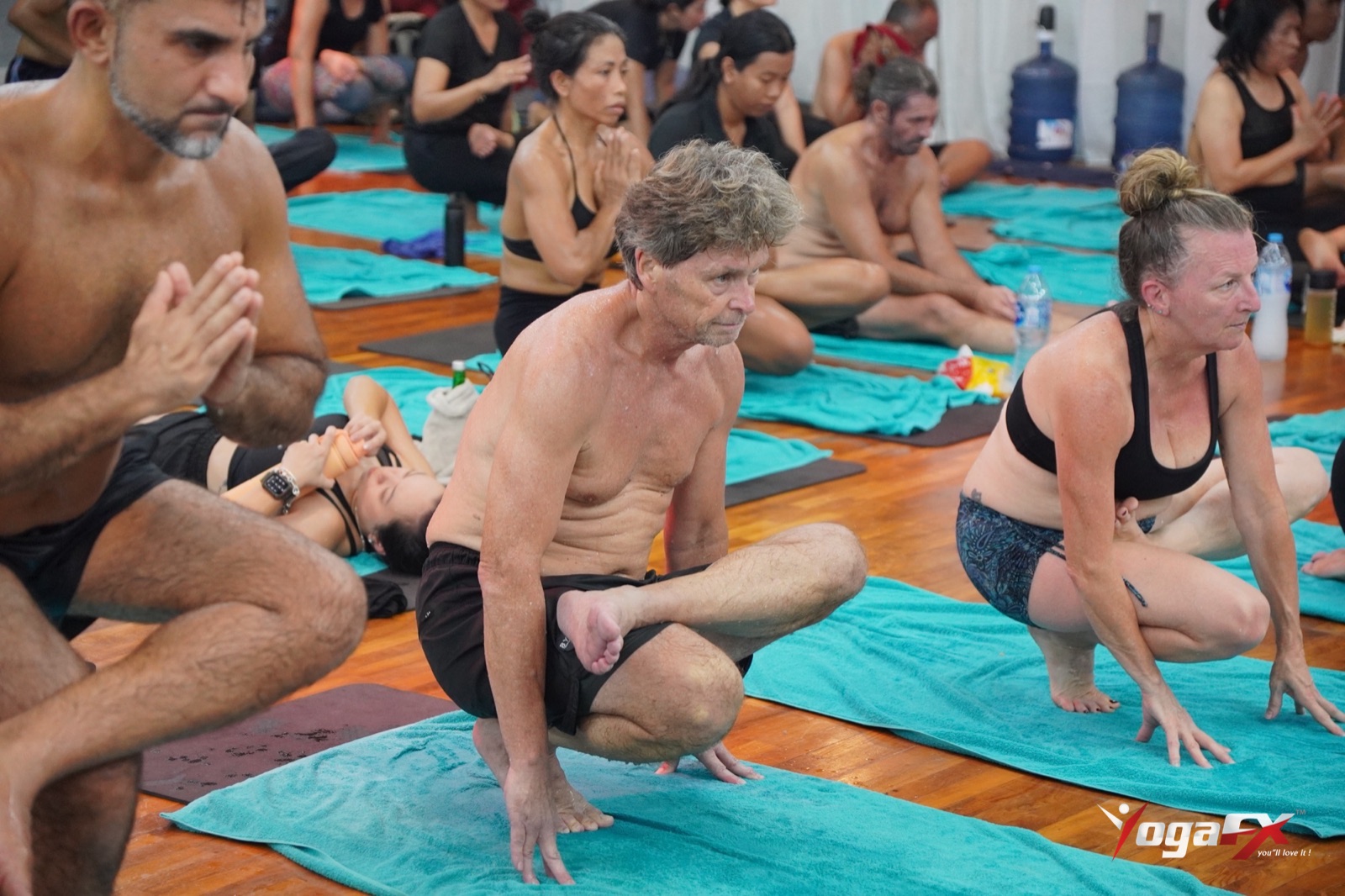
If you will be in Bali, you can try a class for yourself. Our Seminyak studio offers a Free 1-Day Guest Pass, so your first class is free.
What Students Say After Training With YogaFX
Our students speak for themselves, so we let them. These short clips come from YouTube videos recorded at YogaFX teacher trainings in Bali. The speakers are not named in the videos, so we credit each one as a trainee in our YouTube reviews.
“The best training I've ever had in my life.” The speaker compared it with the 15 years of college behind a medical career, and still called this the most impactful training of their life.
A trainee in our YouTube review, 2026 (watch the video)
“It was so mind-blowingly amazing, really.”
A trainee in our YouTube review, 2018 (watch the video)
“I really enjoyed practicing, thank you very much.”
A trainee in our YouTube review, 2018 (watch the video)

Learn the Method Online Before You Chase the Heat
If your goal is to teach hot yoga one day, you do not need a studio hot yoga temperature in your living room. You need the postures, the dialogue and good judgement about heat. Those are learnable at home, in a room you can control. As a result, you stay safe while you build real skill.
The YogaFX Hot Yoga Online course teaches the 26 and 2 sequence and its dialogue step by step. It costs USD 329, or 4 x USD 82. See how it fits the wider programme on our hot yoga teacher training online page. Then decide whether to add a studio week in Bali later.
This article is part of our guide to hot yoga and the 26&2 method. Related reading in Bikram and Hot Yoga Explained: Bishnu Charan Ghosh Explained: Lineage Lessons for Home Study and Hot Yoga vs Pilates: Honest Evidence for Men (80% vs 54%).
FAQ: Hot Yoga Temperature at Home
What temperature should hot yoga be?
A full 26 and 2 class at YogaFX is held at 40°C (104°F) with about 40% humidity for 90 minutes. Other studios set their own numbers, so ask before you book. At home, start in a warm room near 26 to 30°C (79 to 86°F) and stay well below the studio setting.
What is a safe hot yoga room temperature at home?
There is no official home standard. As teaching guidance, YogaFX suggests starting between 26 and 30°C (86°F), measuring at mat height, and moving up only after several easy sessions. If you feel dizzy, sick or faint, stop, cool down and drink water. Check with a doctor first if you have a health condition.
What humidity is best for hot yoga at home?
A studio class at YogaFX holds about 40% humidity. At home, a hygrometer helps you stay near that figure. The Mayo Clinic notes that in high humidity, sweat evaporates less readily and the body cools less well. So open a window if the air feels heavy.
Can I do hot yoga at home without a heater?
Yes. A neutral or warm room is a good place to learn the postures, the breathing and the order of the sequence. Heat is optional at the start, because skill comes first. Many online students practise without a heater for weeks, then add gentle warmth only when the movements feel familiar.
How hot is too hot for hot yoga?
Too hot is when your body shows warning signs: dizziness, nausea, headache, faintness or heavy fatigue. Stop, move somewhere cooler and drink water. The Mayo Clinic says to seek help straight away once core body temperature hits 104°F (40°C). Always consult a healthcare professional about heated practice.
Still have questions? Message Mr. Ian and the YogaFX team through our contact page and we will answer them personally.

Founder and lead trainer of YogaFX International Yoga Teaching Academy, with more than 12,000 hours of teaching. He trained for 5 years, from 2014 to 2019, with the founder of the Bikram Hot 26&2 method.
Published · Last reviewed and updated
You may also like
Explore all articles Bikram and Hot Yoga Explained12 min read15 Nov 2026
Hot Yoga vs Steam Room: Why Humidity Changes How You Cool Down
Read article ↗ Bikram and Hot Yoga Explained11 min read23 Nov 2026
Hot Yoga for Beginners: Learn the Basics at Home First
Read article ↗ Bikram and Hot Yoga Explained12 min read11 Nov 2026