
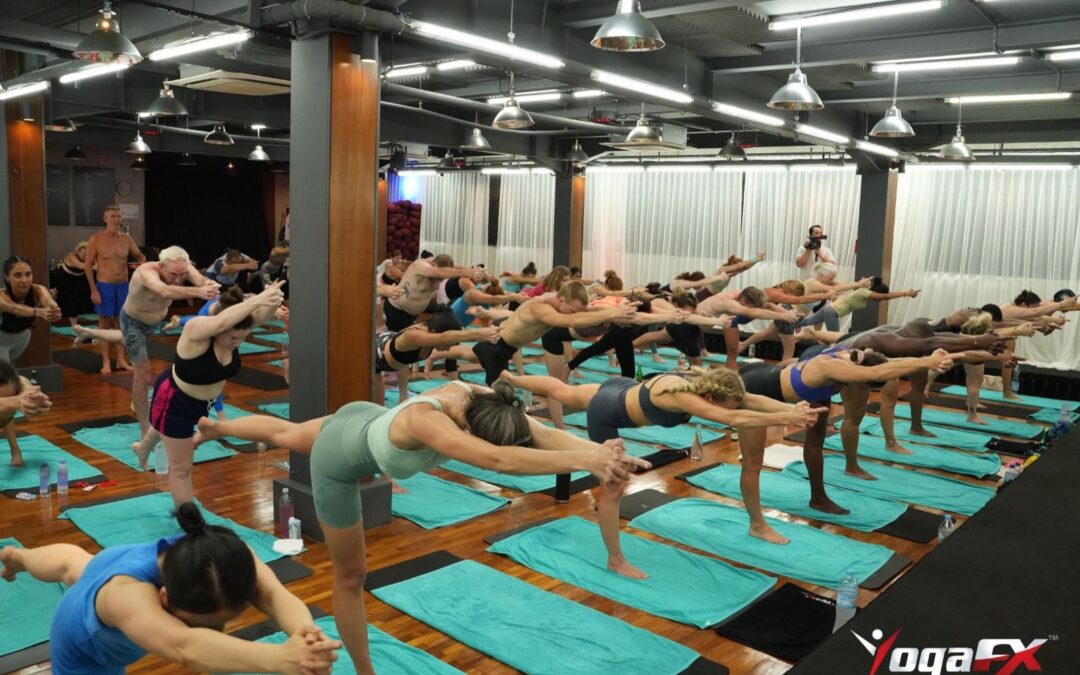
Hot yoga men vs women shows one clear difference in the only study that measured both sexes in a real class. Men averaged about 80% of predicted maximum heart rate and a peak core temperature of 103.2°F. Women averaged 72% and 102.0°F. Same room, same 26 postures, different load.
That finding comes from a small study of 20 regular practitioners, so it describes what happened to them, not what will happen to you.
Still, it is the best direct look we have at how a heated class treats a man and a woman differently. Below we read it line by line, add the calorie data, and turn it into pacing rules you can use at home before you ever step into a heated studio.
One note first. This article is general information, not medical advice. If you have a heart condition, high blood pressure, or you take regular medication, please consult a healthcare professional before any heated practice.
Hot Yoga Men vs Women: The Numbers Side by Side
Twenty healthy volunteers took part: 7 men and 13 women, aged 28 to 67. All of them practised regularly and were used to the heat. A team led by Emily Quandt and John Porcari at the University of Wisconsin-La Crosse measured them through one 90-minute class. Core temperature came from a swallowed sensor, read before class and every 10 minutes after. Heart rate was logged every minute.
Here is the whole hot yoga men vs women picture first. Read each row left to right, then keep going for our reading of what it means.
| Measure | Men (7) | Women (13) | What it means |
|---|---|---|---|
| Average heart rate, % of predicted maximum | About 80% | About 72% | Men worked closer to their ceiling across the class. |
| Highest heart rate, % of predicted maximum | 92% | 85% | Both sexes spent time near the top of their range. |
| Average highest core temperature | 103.2°F | 102.0°F | The gap was statistically significant, with men higher. |
| Single highest core temperature | 104.1°F (one man) | Not reported | One man ended the class above 104°F. |
| Rate of perceived exertion | Similar | Similar | Both groups rated the effort about the same, even though the bodies differed. |
| Calories in 90 minutes (separate 2014 study) | About 460 kcal | About 333 kcal | Roughly a brisk walk of the same length. |
Two details of the hot yoga men vs women table deserve a second look. First, the volunteers rated their effort about the same, yet the men's hearts and core temperatures ran higher. That means how a class feels is not a reliable guide to how hot your body is getting.
Second, the study did not say how many of the seven people above 103°F were men. It only says that seven of the 20 passed that mark.
80% vs 72%
Average heart rate
Share of predicted maximum for men vs women across the class.
103.2°F vs 102.0°F
Peak core temperature
Average highest reading, men vs women. Men were significantly higher.
7 of 20
Passed 103°F
Volunteers whose core temperature went above 103°F during class.
104.1°F
Single highest reading
One man finished the 90 minutes above 104°F.
About 60 min
When it got risky
The researchers saw dangerous core temperatures from about the hour mark.
10 to 14 days
Heat acclimatisation
How long most healthy people need to adapt to working in heat.
Notice what the study did not find. Nobody showed signs of heat intolerance, and no one was hurt. The researchers still called the rise in heart rate and temperature "alarming" given how little movement happens in the class. They also noted that sweating was not enough to cool people down.
Reading the Hot Yoga Men vs Women Data Carefully
Any hot yoga men vs women study this small has limits, and being clear about them is part of reading it well. Here are the four that matter most.
- It is tiny. Seven men is not a population. A single outlier, like the man at 104.1°F, can move an average.
- The volunteers were experienced. They knew the room. A beginner has not yet adapted, so the true load on a first-timer could be higher.
- There was no control group. We cannot say what a cooler room or a shorter class would have done in this same group.
- The study does not say why men ran hotter. Body size, fitness and how hard each person pushes may all play a part. That is our guess, not a finding.
So treat the hot yoga men vs women gap as a reason to pace yourself, not as a verdict on which sex "handles" heat better. Plenty of women will run hotter than the average man in the same room, and the reverse is just as true.
What the Calorie Data Adds
Heart rate is only one side of the hot yoga men vs women comparison. A separate 2014 study by Porcari and colleagues at the same university measured energy use across a 90-minute class. Men burned about 460 kcal and women about 333 kcal, with heart rates near 80% of maximum. In plain terms, that is similar to a brisk walk of the same length.
That sounds underwhelming next to the heart-rate figures, and it is the central puzzle. The class raises your heart rate and core temperature more than the movement alone would explain, because much of the strain comes from the heat itself. We unpack this in our guide to whether hot yoga counts as a cardio workout.
Calories also differ by body size, so the sex gap here is partly a size gap. A larger person simply moves more mass. Compare yourself with your own previous classes, not with a stranger on the next mat.
Pacing Rules for Men and Women in a Hot Room
The Wisconsin team made three recommendations after the study: shorten the class, lower the temperature, and focus on hydration. We cannot change the room at a studio, but we can change how we show up to it. These rules apply to everyone, and they matter most for anyone who tends to run hot.
- Stay for the first 45 minutes, then check in. The researchers saw dangerous core temperatures from about the hour mark. Rest in Savasana or sit out a posture instead of pushing through.
- Drink before you are thirsty. Porcari put it bluntly: nothing is gained from withholding water in any setting.
- Learn the early signs. Cramps, headache, dizziness and general weakness are the warning signs of heat intolerance. If one appears, lie down and cool off.
- Give yourself two weeks. Most healthy people need 10 to 14 days to adapt to heat. Go three or four times in your first fortnight rather than seven.
- Skip the competition. Because effort felt similar across the sexes in the study, you cannot judge your own heat load by comparing your breathing with the person beside you.
If you want the broader picture first, start with hot yoga for men: the research study by study. Men in their forties or older should also read what the trials found for that age group.
A Room-Temperature Warm-Up Before You Try the Heat
The Wisconsin volunteers were already used to the heat. If you are not, build the skill before the temperature. This 20-minute session uses five postures from the Original Hot 26&2 sequence, and it works the same way for men and women.
- Standing deep breathing, 2 minutes. Ten slow breaths with your hands clasped under your chin. Lift your elbows as you inhale.
- Half Moon, Ardha Chandrasana. Hold each side for 15 seconds, twice, with soft knees.
- Awkward pose, Utkatasana. Hold for 20 seconds, three times, resting between rounds.
- Tree pose, Vrksasana. Hold each side for 20 seconds, twice. It shows you quickly how steady you feel.
- Cobra, Bhujangasana. Hold three times for 10 seconds, then lie flat for two minutes.
Do it three times a week for two weeks. Write down your resting breathing after the last posture and how long you hold Tree before you wobble. Those two numbers tell you more about your readiness than a stranger's pace ever will. For more detail on each shape, see our guide to the 26&2 poses.
Where Hot Yoga Men vs Women Research Still Has Gaps
Most hot yoga men vs women questions remain open, because the research has been done on mixed groups that skew female, and few papers split their results by sex. That is why this one small study matters so much, and why it cannot carry a whole decision by itself.
- The Wisconsin study is the only hot yoga men vs women study we know of that reports core temperature separately for men and women in a real class.
- Sex-specific results for mood, strength and heart health are mostly missing, because the trials did not analyse men and women apart.
- Trials that compare a hot room with a cooler one, such as the 2018 Hunter trial in adults aged 40 to 60, did not report results separately for men and women in the summaries we found.
A 2025 systematic review by Willmott and colleagues pooled 43 studies and 942 participants and found signs of benefit for flexibility, bone density and well-being. It is useful background, but it does not settle the sex question either.
Our sister studio site also shares its own view in a studio-side look at men and women in the same class.
You can read the original numbers yourself in the American Council on Exercise write-up, ACE-sponsored research on Bikram yoga and core body temperature, or in the full study summary (PDF).
What Hot Yoga Men vs Women Findings Mean for Teachers
If you plan to teach, the hot yoga men vs women gap is more than trivia. A teacher scans a room of mixed bodies and has to decide when to cue a rest, when to remind students to drink, and when to slow the pace. The Wisconsin data gives you a concrete reason to watch the people who look strongest, not only the ones who look uncomfortable.
- Watch for quiet distress. Effort ratings were similar across the sexes, so a student who says "I am fine" may still be running hot.
- Normalise rest. Say out loud at the start of class that sitting out a posture is part of the practice, for everyone in the room.
- Cue water early. Do it before the 45-minute mark, not at the first sign of trouble.
- Teach the warning signs. Cramps, headache, dizziness and weakness belong in your opening briefing.
Heat safety is also a standard part of what you will meet when you look into hot yoga certification, and it is a core topic in our online course.
What Trainees Say After the Heat
Data tells you what happens on average. Trainees tell you how it feels. Here is what three YogaFX students wrote after their courses.
"The last six days has been amazing beyond amazing... they have been very professional, everything very smooth, organized, efficient."
Lily, YouTube review, 2025
"3 intense weeks of yoga. It was an extraordinary experience. Out of the ordinary organization and professionalism."
Michele, Google review, 2022
"Sooooo nice school you'll love it."
Arkan, Google review, 2022
You can watch Lily's video review below.
Learn the Method Online With YogaFX
Some people who read the hot yoga men vs women research want to go further and understand how a teacher manages heat, pace and safety in a room of mixed bodies. That is exactly what our hot yoga teacher training online course teaches. You study the 26 postures, the dialogue and the science at home, on your own schedule.
The course is led by Mr. Ian Terry, E-RYT 500, who has more than 12,000 teaching hours. He trained for five years, from 2014 to 2019, with the founder of the method. Since 2017, YogaFX has trained more than 1,500 graduates from over 80 countries.
When you are ready for the heat in person, the next step is the six-day Bikram Hot 26&2 Yoga Teacher Training MasterClass in Bali. The next batch checks in on Sunday 24 January 2027 at Soham Wellness Center in Seminyak. The Early Bird price is US$1,899 (normally US$1,999), with payment plans from US$250 a month.
FAQ
Do men get hotter than women in hot yoga?
In the one study that measured both, yes. Men reached an average highest core temperature of 103.2°F against 102.0°F for women, and the difference was statistically significant. The study had only 7 men and 13 women, so it shows a pattern in that group, not a rule for every person.
Is hot yoga harder on men or women?
Both groups rated their effort about the same, yet men averaged about 80% of predicted maximum heart rate against 72% for women. That suggests the load differs even when it feels equal. Size, fitness and effort all play a part, so pace yourself by how you feel, not by your neighbour.
How hot does your body get in hot yoga?
In a 90-minute class in a room heated to about 105°F, seven of 20 experienced practitioners passed 103°F core temperature, and one man reached 104.1°F. Researchers saw dangerous readings from around the 60-minute mark. Nobody in the study had symptoms, but heat illness risk rises near 104°F.
How long does it take to adapt to hot yoga?
Most healthy people need about 10 to 14 days to acclimatise to heat. Start with three or four classes in your first two weeks, drink water early, and rest whenever you feel cramps, headache, dizziness or weakness. Adapting gradually is safer than trying to match experienced students in week one.
Still have questions? Message Mr. Ian and the YogaFX team on WhatsApp and we will answer them personally.

Founder and lead trainer of YogaFX International Yoga Teaching Academy, with more than 12,000 hours of teaching. He trained for 5 years, from 2014 to 2019, with the founder of the Bikram Hot 26&2 method.
You may also like
Explore all articles ↗ Teacher Training Guides11 min read14 Nov 2026
International Yoga Sports Federation and Yoga as a Sport: What Recognition Requires
Read article ↗ Teacher Training Guides11 min read13 Nov 2026
Sauna After Hot Yoga? What Core Temperature Data Suggests
Read article ↗ Teacher Training Guides10 min read13 Nov 2026