Heat acclimatization is the set of changes your body makes after repeated exposure to heat, so the same effort feels easier and safer. The CDC puts the main adaptation at 7 to 14 days of gradual exposure. In a hot yoga room, that means you pace your first weeks and let your body catch up.
Heat Acclimatization Explained: What Changes Inside You
Some writers call this heat acclimation or heat adaptation, and this guide uses the terms together. Your body doesn't get used to heat the way you get used to a noisy street. It changes how it handles heat. Your sweat glands, your circulation and your heart do most of the work, and they change quickly once the exposure repeats.
Earlier sweating. Sweat starts sooner, so cooling starts sooner.
More efficient sweat. You make more of it, and you lose less salt in it.
Steadier circulation. Your blood flow holds up better under load.
A calmer heart. You can do the same work at a lower heart rate.
A cooler core. Your core temperature rises less for the same effort.
Researchers at the Korey Stringer Institute at the University of Connecticut add one useful detail. They say these changes depend on exercise volume, intensity and duration, and on keeping your internal temperature raised during the exercise. In plain words, a warm room alone isn't the trigger. You have to move in it, and you have to repeat it.
Who explains this to new students
Mr. Ian Terry, our founder and lead instructor, is an E-RYT 500 teacher with more than 12,000 teaching hours. Every new student asks him about this in the first week. So we teach trainees to explain these changes in simple words, because a teacher who can answer the question calmly makes the room feel safer.
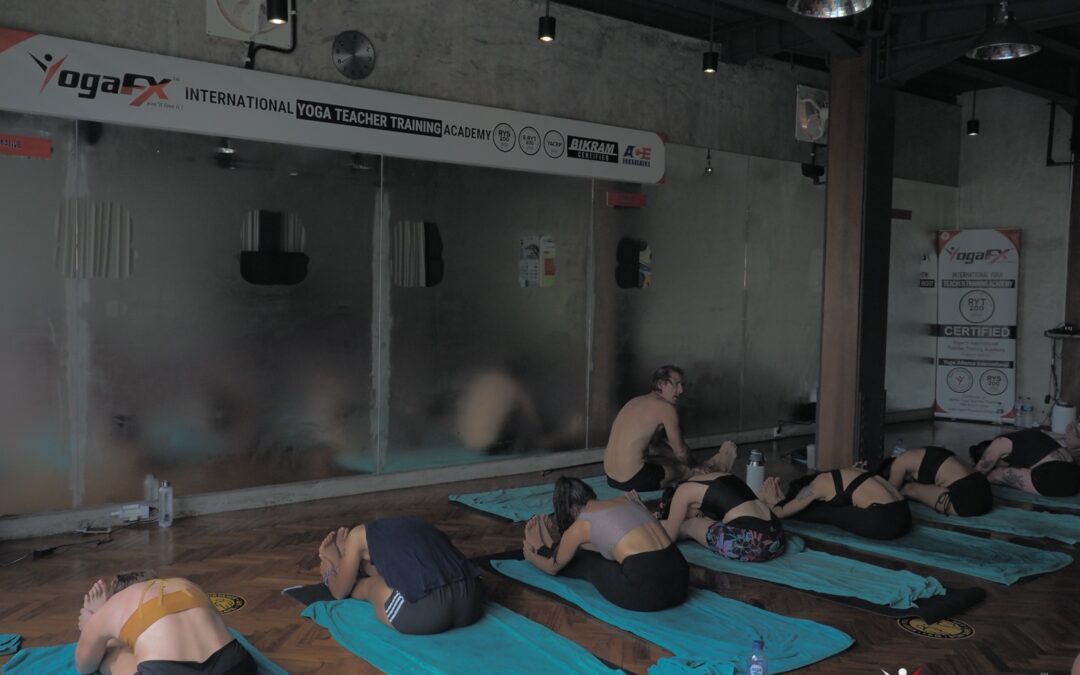
Fogged mirrors show how warm and humid the room is.
How Long Does Heat Acclimatization Take?
Two sources give the same window. The CDC says to increase exposure gradually over a 7 to 14 day period. The Korey Stringer Institute describes the same 7 to 14 days. Both stress that the process is gradual, and the CDC adds that new people need more time than people with some heat experience.
The level of heat acclimatization you reach also varies. According to the CDC, it depends on your starting fitness and the total heat stress you meet. So two students in the same class can adapt at different speeds, and that is normal.
Feeling at home is not the same as full adaptation
Our own guide for new students says to expect 3 to 5 consistent classes before the room stops feeling shocking. Your heart rate feels fast in the first classes, and you tire early. Then it settles. That's a practical rule from teaching, not a lab result.
The two numbers don't clash. Feeling less shaky is the first sign, and full adaptation takes longer. The CDC window describes gradual exposure over 7 to 14 days. A class three times a week is a lighter dose than that, so give yourself more time, not less.
What adapts
How researchers describe it
What you may notice in class
Source
Sweat onset
Sweating starts earlier
You feel damp sooner, and the room feels less like a wall of heat
CDC, KSI
Sweat salt
Less electrolyte lost in sweat
Less salt lost, so ordinary food and drink can replace it
CDC, KSI
Heart rate
Lower heart rate for the same work
Standing postures leave you less breathless
CDC, KSI
Core temperature
Work done at a lower core temperature
You recover faster between postures
CDC, KSI
Effort rating
Lower rating of perceived exertion
The same class feels easier than it did in week one
KSI
Adaptations described by the CDC and the Korey Stringer Institute, translated for a hot yoga student.
Heat adaptation: the numbers that matter
7 to 14
Days to build tolerance
The CDC window for gradual exposure.
2 to 3
Days to win it back
Often regained after a short break.
1 week+
Away means real loss
A gap this long can cost a lot of adaptation.
30 min
Cool-down test
If you are not better after this long, get help.
41°C
Heat stroke level
Body temperature can pass this within minutes.
Sources: CDC NIOSH, Acclimatization (reviewed 3 March 2026); NHS, Heat exhaustion and heatstroke (reviewed 28 May 2026); MedlinePlus, Heat Illness (NIH, updated 15 November 2024).
Heat Acclimatization Science: What Each Source Adds
A good article should tell you where each fact comes from. So here is what we opened, read and checked, source by source.
CDC NIOSH: it fades, and it comes back
The CDC page makes three points that matter to a student. People can keep their acclimatization through a few days away. After a week or more, there may be a significant loss. Then it can often be regained in 2 to 3 days once you return to the heat. The same page says fitness helps you keep it, and that air conditioning will not affect it. So a cool bedroom does not undo your progress.
University of Connecticut: humidity and salt
The Korey Stringer Institute notes that acclimatization to hot and humid conditions has shown a greater sweat rate increase than hot and dry conditions. It also advises extra sodium in the first days of heat practice, and good hydration before, during and after. That advice was written for athletes. Still, a sweaty class asks the same questions of your body.
A 2016 meta-analysis in Sports Medicine
Tyler, Reeve, Hodges and Cheung published a meta-analysis in Sports Medicine in 2016. It pooled studies on how heat adaptation changes physiology, perception and exercise performance in the heat. We couldn't open the full text with our tools, so we name it here without a link and quote no figures from it.
What this means for a yoga student
Why does this matter for a yoga student? Because a hot room is a fixed dose of heat. Your job is to meet it in steps, so your body can match the room instead of fighting it. That is the whole idea behind the plan in the next section, and it is why we put heat acclimatization before posture depth.
We found no study we could open that follows yoga students through acclimatization week by week. Most of the evidence comes from workers, soldiers and athletes. That means the plan below is sensible, not proven. Treat it as a starting point and let your own body overrule it.
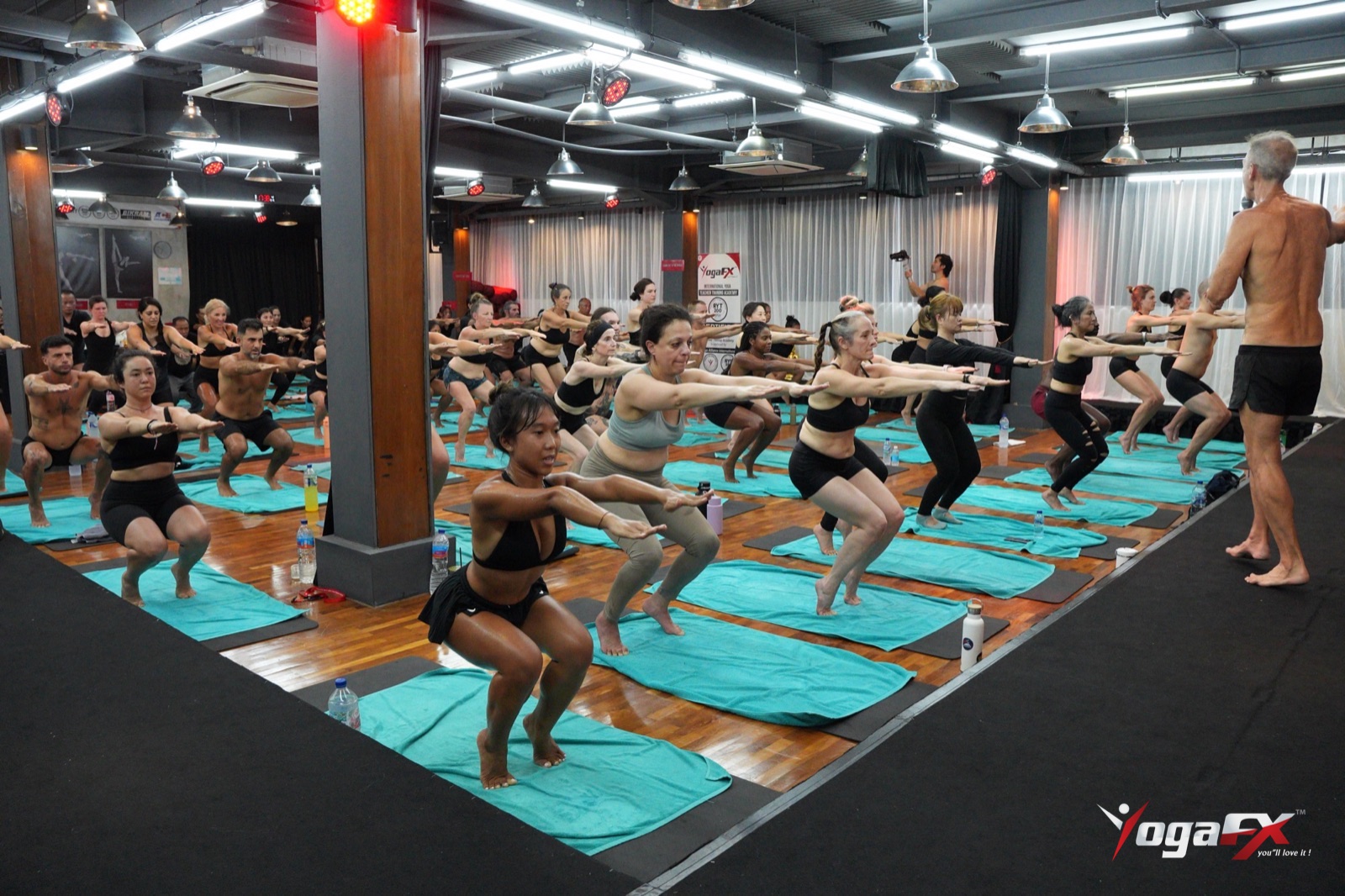
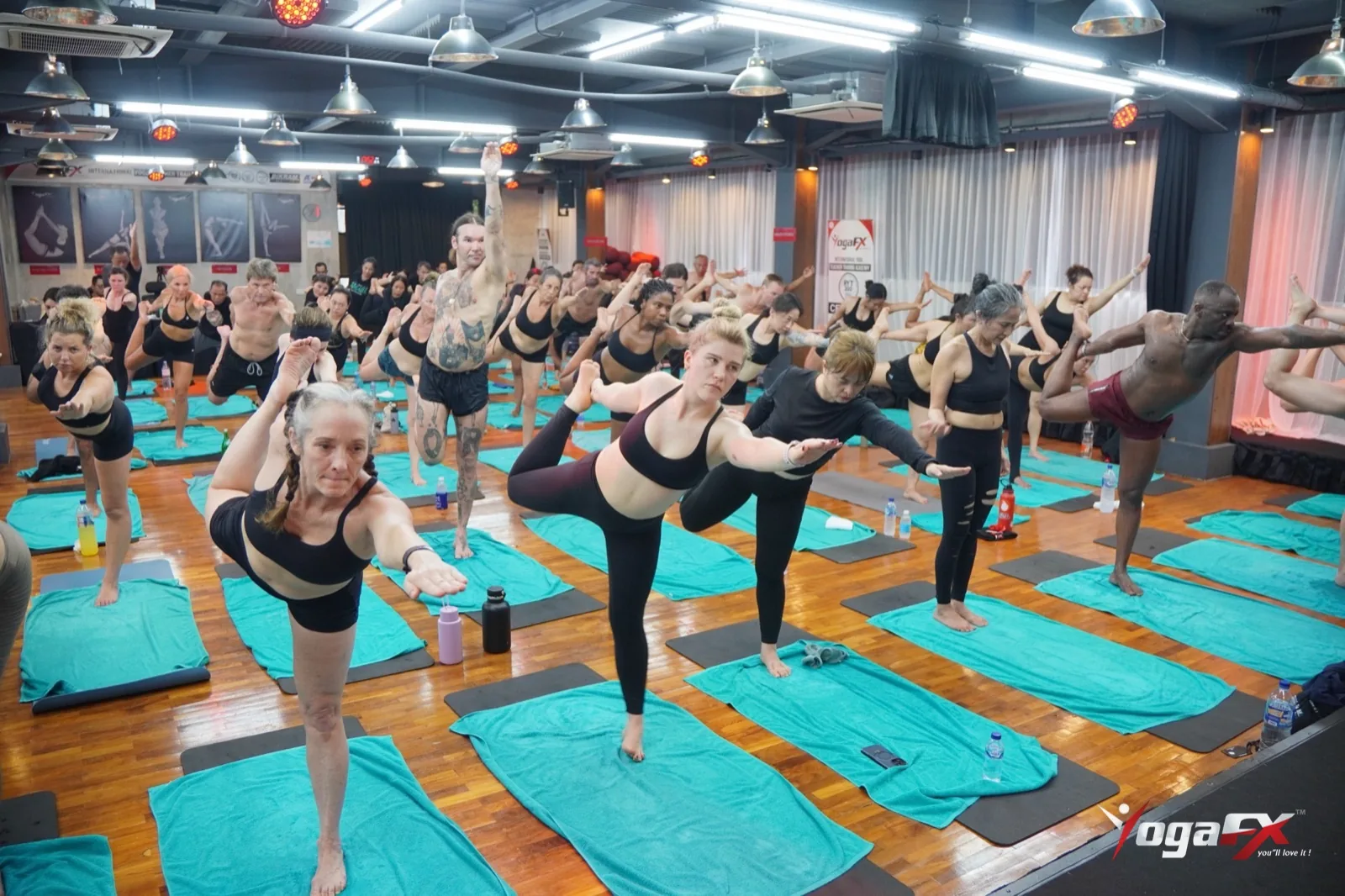
A full class in chair pose, with water beside every mat.
Your First Month: Pace Heat Acclimatization From Home
Learning online has one advantage when you are acclimatizing to heat. You can learn the postures before you add the heat. Then the heat is the only new thing in the room, and your body has one job to do instead of two.
A four-week plan, step by step
The table below is our suggestion, built on the CDC idea of a gradual build. It isn't a prescription. If you feel unwell at any step, stay on that step for another week.
Stage
At home, normal room
In the heated room
Check yourself
Before class one
Learn the breathing and standing postures from the course videos. Build a daily water habit.
No heated class yet
Can you finish a home run-through without feeling dizzy?
Week 1
Run the sequence twice at home
One class. Sit out any posture that feels too much.
Heart rate, mood and sleep that night
Week 2
One home run-through
Two classes, with a rest day between them
Is the first half easier than last week?
Weeks 3 and 4
One home run-through
Two or three classes if you recover well
Do you recover faster after class?
After a break of a week or more
Two home run-throughs
Restart at one class and rebuild
Treat it like week 1 again
A four-week start for heat acclimatization, mixing home practice and heated classes. Adjust it to your own body.
Three pitfalls that slow adaptation
Most stalled starts come from the same three mistakes. Each one looks like effort, but it works against heat acclimatization:
Doubling up. Two heated classes on back-to-back days leave no recovery, so the next class feels worse.
Skipping water until the room. Thirst arrives late, and a dry start makes every posture harder.
Starting again at full effort after a break. A gap of a week or more can cost you a lot, so rebuild on purpose.
Three habits matter more than the exact numbers:
Add one thing at a time. Add a class or add effort, never both in the same week.
Rest between heated days. Your body adapts in the recovery, not only in the room.
Write a one-line note after each class. After a month, the pattern tells you more than any article.
We don't suggest rushing adaptation with extra heat such as long hot baths or saunas. Heat without effort may not trigger the same changes, so skip the shortcuts.
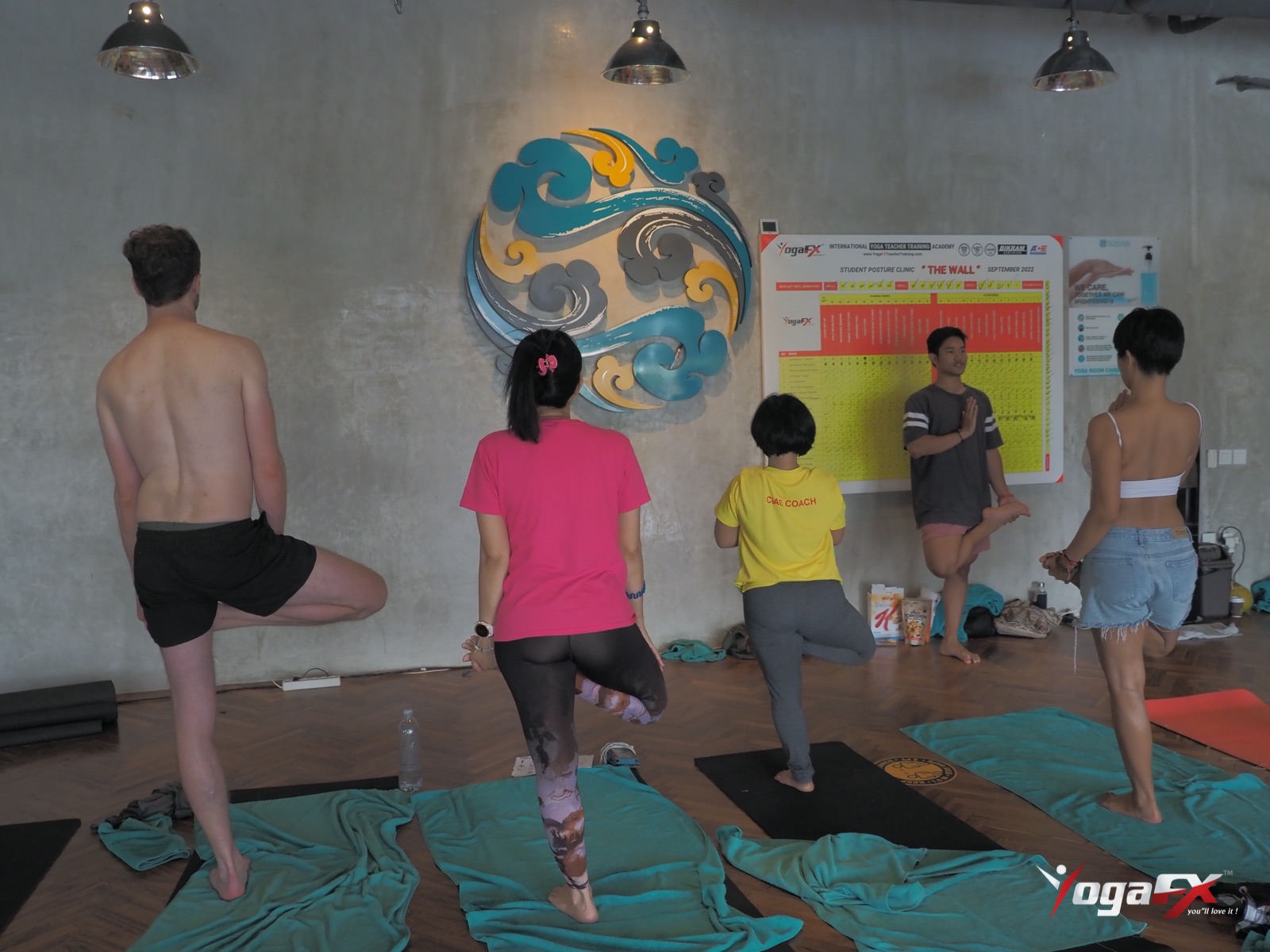
Balance postures show how focus holds up in the heat.
Water, Salt and Sleep While You Adapt
Fluids first
Heat acclimatization asks for fluid, and heat adaptation stalls without it. The CDC page on heat and athletes says people who exercise on hot days are more likely to become dehydrated and get heat-related illness. It tells them to drink more water than usual and not to wait until they feel thirsty.
MedlinePlus lists the same basics in its heat illness summary: drink fluids, replace lost salt and minerals, and limit your time in the heat. So a simple routine for heat acclimatization works for most people:
Start early. Sip water through the day before class, not only on the way in.
Replace salt. After a streaming class, food or a drink with some salt helps.
Keep your mouth closed in the room. Our guide for new students says to breathe calmly through your nose, which helps steady your heart rate.
Protect your sleep. Adapting is tiring, so keep your bedtime steady in the first month.
Warning Signs: When Heat Acclimatization Is Going Wrong
Green, amber and red
Adapting means building tolerance, not ignoring symptoms. The NHS describes heat exhaustion as tiredness, dizziness, headache, nausea, heavy sweating with pale clammy skin, cramps, and being very thirsty. It says heat exhaustion doesn't usually need emergency help if you can cool down within 30 minutes.
Heat stroke is different. The NHS calls it a medical emergency. It lists a very high temperature, hot skin without sweating, fast breathing, confusion, and seizures. MedlinePlus says body temperature may rise above 106 °F (41 °C) in minutes. So use this simple rule in class:
Green: you feel warm, tired and focused. Carry on at your own pace.
Amber: dizziness, headache, nausea or cramps. Stop, sit down, cool down and sip water.
Red: confusion, no sweating while very hot, or you aren't better after 30 minutes. Get medical help now.
Go gradually, and ask your doctor first if you are unsure. This article is general information, not medical advice. Please consult a healthcare professional before you start heated classes, especially if you have a heart condition, low blood pressure, are pregnant, or take medicine that affects fluids or heart rate.
What Students Say About Getting Used to the Room
Numbers describe the average student, and heat acclimatization looks different in every body. Reviews describe a real one. Here is how three of our students put it.
"I'm beginner for yoga first day I feel my body broken but today easy for me."
Febri, YouTube review, 2024
Febri said that in a 30-second graduation clip from a January 2024 training in Bali. A hard first day and an easier day later is exactly the adaptation curve this article describes.
"This training is NOT for the faint hearted."
Anika, Google review, 2025
Anika added that it is for people who are ready to go beyond what they thought possible. That fits the pacing advice above. You build up to it, one step at a time. Ari, a Bali graduate, said in a 2019 YouTube review that the training gave him so much experience and friends from many countries (translated and shortened).
Learn the Method Online With Mr. Ian Terry
YogaFX teaches the Bikram Hot 26&2 method in a 90-minute class at about 40°C and 40% humidity. A scripted dialogue guides every posture, with no music and no demonstration. Mr. Ian Terry trained for five years, from 2014 to 2019, with the founder of the method. Since 2017 he has taught more than 1,500 graduates from over 80 countries.
The YogaFX online course lets you learn the dialogue and postures from home first. It is certified through our Yoga Alliance online academy. It costs USD 329, or 4 payments of USD 82. Trainees also learn what heat does to heart rate, core temperature and sweat, which is the physiology behind this article. See our guide to the physiology module in original hot yoga teacher training for details.
It lowers the strain heat puts on your body. With adaptation you sweat sooner, your heart works less, and your core temperature rises less. MedlinePlus says heat exhaustion can follow exposure to high temperatures without enough fluids. So a gradual start in a hot room is safer than a full-effort first week.
Does heat acclimatization reduce sweating?
No, it usually does the opposite. The Korey Stringer Institute reports that sweat rate increases and sweating starts earlier. The CDC adds that sweat becomes more efficient, with less salt lost. So you may sweat more after a few weeks, but your body cools better and loses fewer minerals.
Can you speed up heat acclimatization?
Not safely by pushing harder. The CDC describes a gradual build over 7 to 14 days. Going faster than your body can adapt raises the chance of feeling unwell in the heat. Regular, moderate exposure, good hydration and rest work best. If you feel dizzy, stop, cool down and slow the plan down.
What happens if I stop practising for a week?
You can keep your acclimatization through a few days away. After a week or more, the CDC says there may be a significant loss. The good news is that it can often be regained in 2 to 3 days of returning to heat. Restart with a lighter class.
When should I stop a heated class?
Stop if you feel dizzy, faint, nauseous, or get a headache or cramps. Sit down, cool down and sip water. Heat exhaustion often eases within 30 minutes, according to the NHS. Confusion, hot dry skin or no improvement means you need medical help straight away.
Still have questions? Message Mr. Ian and the YogaFX team on WhatsApp and we will answer them personally.
The Bikram yoga dialogue is the fixed spoken script that guides a class through 26 postures and 2 breathing exercises in about 90 minutes, and you can learn it from home in four steps: listen as a student, map the structure, practise recalling it aloud, then deliver it to a real person. This guide covers where the script came from and the route we teach online.
Many readers arrive here with a simple question. Is it possible to learn the Bikram yoga dialogue without flying to a studio, and where does the text really come from? The short answer is yes to the first. So what about the second? It has a clearer paper trail than most people expect.
The advice below comes from Mr. Ian Terry, E-RYT 500 and founder of YogaFX. He spent five years as an assistant teacher at international teacher training events run by the founder of the method, and he has taught more than 12,000 hours since. If you want the student's view of the same script, read how the 26 and 2 dialogue works for students in class.
What the Bikram yoga dialogue is and why learn it at home
The Bikram yoga dialogue is a word-for-word teaching script, and that is its whole purpose. The teacher says the same cues in the same order every class, so the words carry the whole lesson. That means every cue matters. There is no music and no demonstration, which is why a teacher who knows the script well sounds calm and steady even in a hot room.
Learning the Bikram yoga dialogue from home makes sense for three kinds of reader. Each has a different reason, and each needs a slightly different pace.
The serious student who wants to understand what the teacher is saying and why the cues come in that order.
The teacher in waiting who plans to attend a live training later and wants to arrive with the words already settled.
The person far from a studio who cannot reach a hot room more than a few times a month and still wants a structured way to study.
Interest in the method is steady. Search tools put the phrase at roughly 110 searches a month worldwide, which tells us this is a small, committed audience rather than a casual one. The same pattern shows up in our own records.
Of the 215 enrolment forms with a written reason that we reviewed for the YogaFX Student Voice Study 2026, 78 name the method itself as the reason for applying.
What the script actually contains
Think of the Bikram yoga dialogue as three layers working together. The first layer is the posture order, 26 postures and 2 breathing exercises. The second is the alignment language, short instructions on where weight goes and what to keep firm. The third is the timing, the pauses and rests that give the class its rhythm.
Most beginners try to memorise only the first layer of the Bikram yoga dialogue. That's why their delivery sounds like a list. Teachers who sound natural learned all three layers together, and the route later in this guide is built around that idea.
Mr. Ian Terry guiding a trainee through a posture during hot 26&2 practical training.
Where the Bikram yoga dialogue came from
The origin of the Bikram yoga dialogue has two halves: the method, and the written words. The method comes from Calcutta. Bishnu Charan Ghosh, a physical culturist and the younger brother of Paramahansa Yogananda, emphasised conditioning and targeted posture work. His student Bikram Choudhury brought that approach to the West in the early 1970s and built the standardised 26 and 2 class around it.
The written words have a paper trail of their own. Court records from a later copyright case list a 1979 book, Bikram's Beginning Yoga Class, and a separate 2002 registration titled Beginning Yoga Dialogue. Those titles are why you still see the script called both a class and a dialogue online.
Period
What happened
Where this comes from
Calcutta, before the 1970s
Ghosh teaches a conditioning-led posture system
Hot 26&2 Yoga lineage notes
Early 1970s
Choudhury begins teaching in the United States
Hot 26&2 Yoga lineage notes
1979
Book published, later described in court records as a literary work
Ninth Circuit opinion, 2015
2002
A registration titled Beginning Yoga Dialogue is listed in the same records
Ninth Circuit opinion, 2015
2015
The Ninth Circuit rules the posture sequence cannot be copyrighted
Ninth Circuit opinion, 2015
Table 1. A short timeline of the method and its written dialogue, from lineage notes and the 2015 court opinion.
One honest caveat belongs here. The exact date the spoken script took the form teachers use today is not documented in the sources we checked, so we do not give one.
What we can say is that the class has been taught as a standard script for decades, and that students and teachers have passed it on through training rather than through a published, authorised text.
Why the dialogue stayed fixed
A fixed Bikram yoga dialogue solves a real teaching problem. When hundreds of teachers across many countries use the same words, a student can walk into any room and recognise the class. The teacher's job then becomes delivery, meaning pace, tone and timing, instead of inventing instructions on the spot.
That is also why the Bikram yoga dialogue is taught in person and through guided study. The words alone do not teach you when to pause. For more on how the method developed and was later studied, see our piece on when researchers started measuring hot yoga.
What research says about learning a script and about heated yoga
Two lines of research are useful here, and it helps to keep them apart. One is about how people learn and keep spoken material such as the Bikram yoga dialogue. The other is about what heated yoga does for the people who practise it.
Recall beats re-reading
A 2006 study on test-enhanced learning in Psychological Science compared two ways of learning prose passages. Some students re-read the material. Others took free-recall tests with no feedback. Five minutes later, re-reading gave better recall. Two days and one week later, prior testing produced substantially greater retention than studying.
The students who re-read also felt more confident, even though they remembered less.
That finding shapes the route in this guide. If you only listen to a recording again and again, you'll feel fluent while the words are still weak. If you close the notes and say the cues from memory, it feels harder, and it works better a week later.
Heated yoga and mood
On the practice side, a 2023 randomized trial from Massachusetts General Hospital (Nyer et al.) randomized 80 adults with moderate-to-severe depression to eight weeks of heated hatha yoga or a waitlist, and 65 were included in the analysis. 59.3% of the yoga group showed a response of 50% or more on the symptom scale, against 6.3% of the waitlist group.
The yoga group attended an average of 10.3 classes over the eight weeks.
Two cautions apply here.
First, the trial studied heated hatha yoga in community studios, not the Bikram yoga dialogue itself, so it cannot tell us whether the script adds anything. Second, it is one trial of modest size. Treat it as a reason to take the practice seriously, not as a promise. Anyone with a health condition should consult a healthcare professional before starting a heated class or changing treatment.
Trainees compare notes between sessions while reviewing the dialogue on a tablet.
A four-step route to learn the Bikram yoga dialogue from home
This is the route we use with online students who want to learn the Bikram yoga dialogue. It is built on the recall research above and on the way Mr. Ian taught dialogue at the large training events he assisted at. You can do it in about six to eight weeks if you study a few short sessions each week.
Step 1: Listen as a student first
Take real classes, in a studio if you can or with guided online practice if you cannot. Your goal is not to memorise yet. It is to hear how the words and the movement fit together, so that later the script means something to you.
Notice where the teacher pauses and how long each pause lasts.
Notice which cues repeat and which are used once.
Write down one thing you heard after each class, in your own words.
Step 2: Map the structure before the words
Draw the class on one page. List the standing series, the floor series and the two breathing exercises, then add the rests. A map gives each cue a place to live. Teachers who skip this step tend to forget a whole posture in the middle of a class. The reason is simple: nothing connected it to the posture before it.
Our 26&2 poses guide lists the postures in order, which makes a good starting map.
Step 3: Practise recalling the dialogue aloud
This is the step the research supports. Take one posture at a time. Read the cues once, close the notes, and say them aloud from memory. Check what you missed, then say them again the next day and again a week later.
Keep each session short, because tired recall teaches little. Ten to fifteen minutes of honest recall is worth more than an hour of re-reading. Record yourself on your phone and listen back for pace, because most beginners speak too fast.
Trainees celebrate after a practice session. Learning the dialogue is easier with a group.
Step 4: Deliver it to a real person
Find one friend or family member and teach them a short section, even if they have never done yoga. A live listener forces you to keep your pace and to notice when a cue lands badly. Ask them one question afterwards: what was unclear?
When you can deliver a full section without notes, you are ready for feedback from a trained teacher. That is the point where a live training adds the most.
Step
What you do
Suggested effort
You are ready to move on when
1. Listen
Attend classes and take notes
2 to 3 classes a week
You can describe the class order without notes
2. Map
Draw the full class on one page
One 45-minute session
Every posture has a place on your map
3. Recall
Say cues aloud from memory
10 to 15 minutes, most days
You can recite one series from memory
4. Deliver
Teach a short section to a real person
One session a week
A listener follows you without questions
Table 2. A suggested pacing for the home study route. These are our teaching suggestions, not trial results.
Common mistakes that slow people down
Re-reading instead of recalling. It feels productive, but the study above suggests it fades faster.
Learning the Bikram yoga dialogue words without the map. You forget the posture order under pressure.
Speaking too fast. Record yourself and slow down by a third.
Studying alone for too long. Get a listener by week four.
26 + 2
One fixed class
26 postures and 2 breathing exercises, taught in the same order every class.
90 min
One scripted hour and a half
The dialogue carries the whole class. No music, no demonstration.
78 of 215
Applicants who name the method
Enrolment forms with a written reason that name Bikram, 26&2 or hot yoga.
USD 329
Online course
Or 4 payments of USD 82. The Starter Kit is USD 98, or 2 payments of USD 49.
Source: YogaFX Student Voice Study 2026 (enrolment forms), YogaFX class format and current online prices.
What the 2015 ruling means for the written dialogue
People often ask whether the Bikram yoga dialogue is secret or banned. Neither is true, as it turns out. The Ninth Circuit opinion of 8 October 2015 held that the sequence of 26 postures and 2 breathing exercises is, in the court's words, an idea, process or system designed to improve health, so it is not protected by copyright. Copyright can still cover the words and pictures used to describe it.
The court did not rule on whether the spoken dialogue is a separate protected work. It treated the dialogue as evidence of the sequence's purpose.
That leaves a practical answer for learners: anyone may teach the sequence, and responsible trainings take care over how they share written teaching text.
This is general information, not legal advice, and you should ask a qualified lawyer if you plan to publish or sell any script.
It also explains why you will not find an official downloadable file from us. We share the Bikram yoga dialogue with enrolled students inside guided study, where the delivery can be taught along with the words.
What YogaFX students say about learning the dialogue
Students rarely describe the Bikram yoga dialogue on its own. They describe the teacher who taught it and what changed in their practice. These are three short reviews from our review store, shown with first names only.
“For these 3 weeks my body went so deep in the postures than never before for my 8 years of yoga practicing!”
Evgenia, Google review, 2022
Rani trained with us in January 2023 and thanked Mr. Ian for giving “100% his energy” to the whole group, with a lot of laughs and support along the way.
Rani, Google review, 2023
“Very very good teacher, very very nice class, I really really enjoy it.” (translated)
Saul, YouTube review, 2024
Saul's video above comes from his graduation ceremony. We include it because it's a student speaking for himself, in his own words, rather than us describing the course.
How YogaFX teaches the Bikram yoga dialogue online
YogaFX International Yoga Teacher Training Academy is based in Bali and has graduated more than 1,500 teachers from over 80 countries since 2017. Mr. Ian Terry holds E-RYT 500 status and leads the training personally. The online side is built for exactly the route to the Bikram yoga dialogue described above.
Starter Kit, USD 98 (or 2 payments of USD 49). Posture demonstrations, the full Bikram yoga dialogue, premium lectures and workbooks for students who want to begin.
Online course, USD 329 (or 4 payments of USD 82). Everything in the Starter Kit plus posture clinics, and it doubles as pre-course preparation for the live MasterClass.
Lifetime access to the online academy, including dialogue demonstrations and more than 50 premium lectures.
Before anyone enrols, Mr. Ian speaks with them personally, often for a long call, because the right starting point depends on your experience. If you want to see how the online pathway fits together, start with our Hot Yoga Online page, or read about men's yoga teacher training online if that is closer to your situation.
If your goal is to teach, our guide to the seven honest steps to becoming a Bikram yoga teacher explains the full pathway, and the online hot yoga teacher training page shows how the online course connects to live training in Bali.
FAQ
Is there an official Bikram yoga dialogue PDF?
No official free PDF exists. Files and flashcards online are unofficial and often contain errors. YogaFX shares the dialogue with enrolled students inside guided study, where delivery is taught alongside the words. Copyright can protect written teaching text, which is why trainings handle it carefully.
How do I memorize the Bikram yoga dialogue?
Learn the class structure first, then practise recalling one posture at a time aloud from memory instead of re-reading. A 2006 study found recall practice gave far better retention after two days and a week. Record yourself, slow your pace, and teach a short section to a real listener.
Is the Bikram yoga dialogue the same as the 26 and 2 dialogue?
In most trainings they refer to the same fixed script guiding 26 postures and 2 breathing exercises in about 90 minutes. The names differ because many studios rebranded. Some classes using those names shorten or reword the script, so check whether the words repeat, the room is silent, and the order never changes.
Can I learn the Bikram yoga dialogue online without a teacher?
You can learn the words and structure online, and the four-step route in this guide works at home. Pace, tone and timing improve fastest with feedback from a trained teacher. Many students study online first, then attend a live training to have their delivery corrected.
Is this the official Bikram Choudhury teacher training?
No. YogaFX is an independent training, not the official Bikram Choudhury Teacher Training. Mr. Ian Terry spent five years as an assistant teacher at the founder's international teacher training events and teaches the Original Hot 26&2 method through the YogaFX academy, which is a Yoga Alliance registered school (RYS 200).
Still have questions?message Mr. Ian and the YogaFX team and we will answer them personally. Tell us where you are in your practice, whether you have a teacher nearby, and how much time you can study each week, and we will suggest a starting point for learning the dialogue.
What to eat before hot yoga comes down to timing. Have a big meal 3 to 4 hours before class, or a small meal or snack 1 to 3 hours before, according to Mayo Clinic. For a 90-minute hot class, keep it light, low in fat and low in fibre, and sip water all day.
What to Eat Before Hot Yoga: The Short Answer
Here is the short version of what to eat before hot yoga when you study at home and work all day. The evidence comes from general exercise research, not from hot yoga trials, so we grade it honestly. Even so, five rules hold up when you read the sources and watch real students in a heated room:
Match the meal to the clock. A large meal needs 3 to 4 hours. A small meal or snack needs 1 to 3 hours.
Keep it light, low in fat and low in fibre. A review of athlete gut problems lists this as the usual pre-exercise advice.
Do not try new food on class day. Mayo Clinic warns that any new food before a workout risks an upset stomach.
Drink steadily, not in one go. Spread your fluid across the day, then take small sips near class.
Eat again after class. Aim for carbohydrate plus protein within two hours.
None of this is medical advice. Please consult a healthcare professional before you change how you eat, especially if you have diabetes, a digestive condition or an eating disorder, or if you take medication. What to eat before hot yoga is personal, and the sections below show you how to find your own pattern.
Why Timing Matters in a 90-Minute Hot Class
A Hot 26&2 class at YogaFX runs 90 minutes in a room at about 40°C (104°F) and 40% humidity. You stand, balance, fold and twist for the whole time. So your stomach has less room for a heavy meal than it would on a gentle walk.
Timing is the core of what to eat before hot yoga. Food needs hours to leave the stomach, and heat plus movement can make a full stomach feel worse. That is why the same salad that feels fine at noon can feel awful in a forward bend at 12:45. Eating before hot yoga is mostly about how long the food has to settle.
The numbers support the caution. A review in Sports Medicine by Dana Lis (2019) reports that gut symptoms affect 30 to 50% of athletes, and that the foods and fluids around exercise influence them. Hot yoga is not the same as marathon running. Still, the lesson carries over, because food choice and timing change how a workout feels.
We also know that a hot class is real work. A 2014 University of Wisconsin study (Porcari et al.) measured about 333 calories burned per 90-minute class in women and 460 in men. You are fuelling a proper workout, so skipping food all day is not the answer either.
Hot yoga nutrition is a young field, and none of these sources studied hot yoga students eating breakfast. So treat every number here as a starting point. Change one thing at a time, and let your own body be the final test.
What to Eat Before Hot Yoga Around Home Study and a Working Day
Most online students do not have a neat schedule. You might study before work, practise at lunch, or fit class in after a long day. So the best answer to what to eat before hot yoga depends on when your day lets you move. This table matches each common pattern to the Mayo Clinic windows.
Your day
Last bigger meal
Pre-class option
After class
Early start, practice before work
The night before, ending 3 to 4 hours before bed
Nothing, or half a banana if you feel hungry
Water first, then breakfast with carbohydrate and protein
Lunch-break practice
Breakfast 3 to 4 hours before class
Small snack 1 to 3 hours before, such as a banana
A balanced lunch within two hours
Afternoon study, evening practice
Lunch 3 to 4 hours before class
Light snack 1 to 2 hours before, like toast with honey
Dinner within two hours of finishing
Long workday, late class
A normal lunch
Small snack on the way, nothing heavy
A light dinner, then sleep
Rest day with home study
Eat normally
No special snack needed
Eat normally and drink water
What to eat before hot yoga by daily schedule. Timing windows from Mayo Clinic (2023). Examples from YogaFX class guidance.
Notice how the table leans on gaps, not on special foods. If you can leave 3 to 4 hours after a full meal, you have solved most of the problem. If you cannot, the snack window is your backup.
Practice Before Work
Early practice is the easiest case, because what to eat before hot yoga is often very little. Many students eat nothing, or a few bites of banana, then eat a real breakfast afterwards. The night-before dinner has already left your stomach, so nothing competes with your postures. If you wake hungry and shaky, a tiny snack beats pushing through.
Practice at Lunch
A lunch-break class is trickier. At lunch, what to eat before hot yoga means a snack, not a meal. Breakfast is far behind you, yet lunch is not an option. A small snack 1 to 3 hours before class is the sensible choice. Keep it simple, because a lunch-hour class leaves no time to digest a sandwich.
Practice After Work
Evening practice gives the most freedom, so what to eat before hot yoga is easy to plan. A normal lunch lands neatly in the 3 to 4 hour window, and a snack covers the gap. The trap is the late, heavy snack at 5 pm. Choose fruit, toast or a few dates instead of a rich meal.
What to Eat Before Hot Yoga: Foods to Choose and Skip
Once the clock is right, the next question in what to eat before hot yoga is the food itself. The review by Lis (2019) says the usual pre-exercise advice to reduce gut symptoms is low fibre, low fat, moderate protein, and no lactose-containing dairy. The table turns that into a shopping list for a 90-minute hot class.
Choose
Skip
Why it matters
Rice, toast, oats or a banana
Large portions of anything
Simple carbohydrate leaves the stomach faster, and big portions feel heavy in forward folds
Eggs on toast, a fruit smoothie made without milk
Fried food and rich curries
Fat slows digestion, so it sits in the stomach longer
Peeled fruit, cooked vegetables
Raw salad, beans and bran
High fibre can cause bloating and cramps close to class
Plain water in small sips
Fizzy drinks and lots of coffee on an empty stomach
Gas and jitters both feel worse in a hot room
Foods you already know
Anything new on class day
Mayo Clinic warns a new food before a workout risks an upset stomach
Food choices before a hot class. Sources: Lis, Sports Medicine (2019); Mayo Clinic (2023); YogaFX class guidance.
Everyone reacts a little differently. Some students handle dairy well, and others do not. The review itself says gut symptoms are personal, so use the table as a draft and edit it after a few classes.
Our Seminyak studio team gives the same advice in person, with the same timing windows. You can read the studio’s own meal-timing guide if you plan to join a class in Bali.
Meal Timing in 5 Numbers
The graphic below puts the key figures for what to eat before hot yoga from the sources in one place. Save it on your phone for busy days.
3 to 4 h
Large meal
Eat a big meal this long before class, says Mayo Clinic.
1 to 3 h
Small meal or snack
The window for a lighter bite, also from Mayo Clinic.
2 to 3 cups
Water beforehand
Drink this in the 2 to 3 hours before exercise, per Mayo Clinic citing ACSM.
30 to 50%
Athletes with gut symptoms
Reported prevalence in a 2019 review, so food choice matters.
2 h
After-class window
Eat carbohydrate and protein within two hours if you can.
What to eat before hot yoga in five numbers. Sources: Mayo Clinic, Eating and exercise (2023); Lis, Sports Medicine (2019).
What to Eat Before Hot Yoga on a Study Day
Online students face a problem that studio students do not. Your kitchen, your laptop and your mat sit in the same room. That makes grazing easy, and it makes a rushed meal before practice even easier.
So build a routine around your study blocks. This is the plan we suggest when you ask what to eat before hot yoga on a busy day:
Pick your class time first. Work backwards to find your last real meal.
Eat lunch away from the mat. A proper break helps you finish eating well before practice.
Keep one safe snack within reach. A banana or a few dates cover the 1 to 3 hour window.
Put the water bottle beside the mat. You never need to leave the practice to find it.
Write down what you ate. Two lines in a notebook make patterns obvious after a week.
If you also want to see how pacing works over your first weeks, read our hot yoga results timeline. It shows what researchers measured week by week, so you can plan food and effort together.
What to Eat After Hot Yoga
Eating well afterwards matters as much as what to eat before hot yoga. Mayo Clinic says to eat a meal with both carbohydrates and protein within two hours of your workout if possible. If your meal is more than two hours away, it suggests a snack.
After 90 minutes in the heat, most students are thirsty first and hungry second. So rehydrate, wait a few minutes, then eat. Here are simple options that fit a normal day:
Rice, fish or chicken, and vegetables. A full plate with carbohydrate and protein.
Eggs on toast with fruit. Quick, cheap and easy to make at home.
Yoghurt with oats and banana. A light option for a late evening class.
A smoothie with a protein source. Useful when you have little appetite after the heat.
Fluids deserve their own plan. Our guide to hot yoga hydration covers water, electrolytes and a simple sweat test. If you feel flat after class, our guide to feeling tired after hot yoga explains how food, fluid and heat work together.
Can You Do Hot Yoga on an Empty Stomach?
When students ask what to eat before hot yoga, the honest answer can be nothing. For most healthy adults, that works if the last real meal was long enough ago. Many students practise on an almost empty stomach and feel clear. Mayo Clinic says snacks soon before a workout probably will not add energy if it lasts under 60 minutes. A 90-minute class is longer, so a small carbohydrate snack may help some people.
However, an empty stomach is not the same as being underfed all day. If you skipped meals and feel shaky, a small snack is the better choice. Rest in the posture, and tell your teacher if you feel faint. Anyone with diabetes or a medical condition should ask a doctor first.
Test What to Eat Before Hot Yoga in 3 Steps
The research gives windows, not rules. A simple experiment turns what to eat before hot yoga into your own routine. Run it over three or four classes, and change only one thing each time.
Choose a baseline. Use one light meal or snack and a fixed gap before class. Write both down.
Rate how you felt. Score your stomach, energy and balance from 1 to 5 after class.
Move one variable. Shift the gap by 30 minutes, or swap one food, then compare the scores.
After a week you will see which gap feels best. That personal pattern beats any list, including this one. If you keep feeling unwell after eating, speak to a doctor or registered dietitian.
What Our Trainees Say
Numbers cannot tell you how a hot class feels from the inside, or how food changes it. These comments come from YogaFX students and are taken word for word from their public video reviews. They are about the whole training, not only food, but they show how students describe the effort and the support.
"She's the one that taught me not to give up and I don't give up because of her."
A teacher who understands what to eat before hot yoga helps every student in the room. New students ask about food in almost every first class. A trained teacher answers calmly. Teachers also study the dialogue, the word-for-word script of the 26&2 class, and stay within what the evidence supports.
Mr. Ian Terry, E-RYT 500, has taught more than 12,000 hours. He trained for 5 years, from 2014 to 2019, with the founder of the method. In YogaFX teacher training, food and heat belong to the same lesson. Trainees learn to explain timing, hydration and warning signs in plain words.
Timing windows. Teachers can explain the 1 to 3 hour and 3 to 4 hour gaps without jargon.
Warning signs. Nausea, dizziness or a sudden stop in sweating means a student needs rest.
Limits. A teacher is not a dietitian, so students with medical needs should see a professional.
Learn Hot Yoga Food, Heat and the Full Dialogue Online With YogaFX
Students often ask why teachers care about what to eat before hot yoga. A good teacher answers with sources, not hype. Our hot yoga online course lets you study the 26 postures, the dialogue and the physiology at home, on your own schedule. It costs USD 329, or 4 payments of USD 82. See the 8-week breakdown of online yoga teacher training to learn how the weeks fit together.
Since 2017, YogaFX has trained more than 1,500 graduates from 80+ countries. We hold more than 550 reviews across Google, Yoga Alliance and YouTube. When you are ready for the heat in person, our Seminyak studio offers a free 1-Day Guest Pass, so your first class costs nothing.
Study the science with its limits. Read each source the way we did above.
Practise at home first. Find your own meal gap before you add real heat.
Take the next step. Move to the 6-day Bikram Hot 26&2 Yoga Teacher Training MasterClass in Bali.
FAQ
Should I eat before hot yoga?
Usually yes, but keep it light and early. Mayo Clinic suggests a large meal 3 to 4 hours before exercise, or a small meal or snack 1 to 3 hours before. Many students practise on an almost empty stomach and feel fine. If you feel shaky, a small snack helps. Ask a doctor if you have a medical condition.
How long before hot yoga should you eat?
Allow 3 to 4 hours after a large meal, and 1 to 3 hours after a small meal or snack, based on Mayo Clinic guidance. For a 90-minute hot class, many students prefer the longer gap. If you only have 30 minutes, skip food and take small sips of water instead.
What not to eat before hot yoga?
Avoid large portions, fried or fatty food, raw high-fibre food such as beans and bran, fizzy drinks and anything new. A 2019 review lists low fibre, low fat and no lactose-containing dairy as typical pre-exercise advice. Everyone reacts differently, so change one thing at a time and note how you feel.
What to eat before hot yoga in the morning?
For early classes, many students eat nothing or have half a banana, because last night’s dinner has already left the stomach. Save the full breakfast for after class, ideally within two hours. If you wake hungry, a small, familiar snack is better than practising dizzy. Sip water through the morning.
Is it bad to not eat before hot yoga?
For most healthy adults it is not bad, if you are well hydrated and ate properly earlier. Mayo Clinic says snacks right before a workout under 60 minutes probably add little energy. Our class lasts 90 minutes, so a small snack may help some people. Stop and rest if you feel faint.
What is hot yoga? Hot yoga is any yoga practised in a deliberately warm room. Researchers define it as 25°C (77°F) or above, and some studios run close to 40°C (104°F). The heat raises your heart rate and your sweat, so the same posture feels harder. This guide explains the meaning, the styles and what the studies found.
This article is general education, not medical advice. Please consult a healthcare professional before you practise in a heated room, especially if you are pregnant, have a heart condition or struggle with heat.
A full class holds the same standing posture together. This is a 90-minute Hot 26&2 class at YogaFX.
What Is Hot Yoga? The Meaning in Plain Words
The hot yoga meaning is simpler than the marketing makes it sound. It is not one method. It is a collective term for any yoga done in warm to hot conditions. The 2025 systematic review by Willmott and colleagues, 2025 in Sports Medicine - Open uses exactly that wording, with 25°C (77°F) as the lower limit.
That review pooled 43 studies and 942 participants. The rooms in those studies ranged from 30 to 52°C (86 to 126°F), and humidity ran from 20 to 60%. Classes lasted between 20 and 90 minutes. So when you read "hot yoga research", the heat can mean very different things from one study to the next.
Why does that matter to you? Because a result from a 40°C (104°F) class does not automatically apply to a 30°C (86°F) class. Good teachers know the difference, and so we teach students to ask which room, which style and which people a study actually tested. Mr. Ian Terry, our Founder and Lead Instructor, teaches students to ask exactly that.
If you would like a walkthrough of what a first class feels like on the mat, the Bali studio has written a first-class guide with the studio view of hot yoga. This page stays with the science and with how you can learn the practice from home.
Types of Hot Yoga: How the Main Styles Differ
Most people meet hot yoga as a class name, not a definition, so "what is hot yoga" has a different answer at every studio. Studios use labels like Bikram, vinyasa or Hatha, and then add heat. The table below shows how the main types of hot yoga are built, and how often each one shows up in the research.
Style
Share in the review
How the class is built
Heat in the research
Bikram or Hot 26&2
74%
Fixed order: 26 postures and 2 breathing exercises, 90 minutes
About 105°F (40°C) and 40% humidity
Generalised hot yoga
19%
Varies by studio and teacher
25°C (77°F) or above by definition
Hatha in heat
5%
Slower postures held for several breaths
Varies by study
Vinyasa in heat
2%
Flowing postures linked to the breath
Varies by study
Table 1. Hot yoga styles by share of the review and by class structure. Sources: Willmott et al., 2025; Mayo Clinic Sports Medicine.
Notice the first row. Bikram dominates the evidence, with 74% in the breakdown by style. So when we say "the research", most of it was done on that sequence or on something close to it.
Two practical points follow from the table:
A fixed sequence is easier to study. The same postures in the same order let researchers compare one group with another.
A changing class is harder to measure. Flow classes vary every session, so results are harder to repeat.
Temperature is often missing. Many studies report a range, so check the method section before you trust a number.
Bikram yoga is one style of hot yoga, not the whole category. It is the best known style, a fixed 90-minute class of 26 postures and 2 breathing exercises. Mayo Clinic Sports Medicine describes the Bikram form as a room heated to roughly 105°F (40°C) with 40% humidity.
Hot yoga is the wider family, and the question "what is hot yoga" only gets a full answer when you name the style. A hot vinyasa class and a Bikram class share the warm room, yet they feel very different. One flows and one follows a script. At YogaFX we teach the original Hot 26&2 sequence, which is also the style behind most of the research.
What Is Hot Yoga Like in a Real Class?
Numbers only go so far, so here is what a Hot 26&2 class feels like. It runs for 90 minutes in a room at about 40°C (104°F) and 40% humidity. The teacher talks you through every posture with a scripted dialogue, so you do not need to know the poses beforehand. There is no music and no demonstration.
The class follows the same order every time. It opens with standing deep breathing, then moves through the standing series, where balance and leg work build most of the heat. After a short rest, the floor series follows with back bends, forward bends and twists. A second breathing exercise closes the class.
Because the order never changes, you can measure your own progress. For example, a posture that felt impossible in week one may feel steady by week four. That repeatability is why this format is also the easiest to study.
So what is hot yoga like for a first-timer? Expect to feel hotter, sweatier and more tired than you imagined, especially early on. Resting is normal, and it is never a failure. Every posture can be adapted, so nobody has to match the person on the next mat.
What Is Hot Yoga Doing to Your Body? The Heat Research
So what is hot yoga actually doing to you? The heat changes how the body responds to the same posture. In the 2025 review, acute hot yoga increased body temperature and heart rate, but it did not increase the energy demand compared with non-heated yoga. In other words, the room feels harder, yet it does not burn more fuel.
That finding surprises many students. A sweaty class feels like a bigger workout, and it is easy to assume the calories follow. The review says otherwise. Sweat is your body cooling itself, and that is a different thing from effort.
Sweat is the body cooling itself. It does not measure how hard the class was.
What regular practice has been linked to
Over weeks of regular practice, the review links hot yoga to several changes. These include cardiometabolic changes such as body composition, lipid profiles and blood vessel function. They also include functional changes such as bone mineral density, balance and flexibility. The authors add that these adaptations appeared without harming kidney function or sleep quality.
Still, the same authors are careful. They conclude that claims of greater health benefits than other forms of yoga or traditional exercise are, at present, unsubstantiated. Many studies in the review lack strong designs. So hot yoga works as exercise, but nobody has proven it works better than the alternatives.
The mood trial everyone quotes
The most cited single study is a randomised trial from Massachusetts General Hospital. Nyer and colleagues, 2023 tested heated yoga against a waitlist in adults with moderate-to-severe depression, and the paper appeared in the Journal of Clinical Psychiatry. According to the Harvard Gazette, the classes were 90-minute Bikram sessions in a 105°F room.
Eighty people were randomised and 65 were analysed. Of those, 59.3% of the yoga group had a symptom drop of 50% or more, against 6.3% of the waitlist group. The yoga group averaged 10.3 classes over eight weeks, and no serious adverse effects were linked to the classes.
Now the limits. The comparison group was on a waitlist, so the trial cannot say whether heat added anything beyond yoga itself. The authors ask for studies against an active comparison. If you live with depression, please speak with your doctor before changing your care. Our full breakdown of the design is in how the trial was run and measured.
25°C
The research definition
Hot yoga means yoga done in warm to hot conditions of 25°C (77°F) or above.
43 studies
The evidence base
with 942 participants make up the largest systematic review so far.
59.3%
Mood response
of the heated yoga group cut depression symptoms by half or more, versus 6.3% on a waitlist.
90 min
The classic class
at about 40°C (104°F) and 40% humidity is the Bikram or Hot 26&2 standard.
Infographic: four facts about hot yoga. Sources: Willmott et al., 2025 (Sports Med Open); Nyer et al., 2023 (J Clin Psychiatry); Harvard Gazette, 23 October 2023; Mayo Clinic Sports Medicine.
Is Hot Yoga Safe? Who Should Be Careful
Hot yoga is not for everyone. Mayo Clinic Sports Medicine says plainly that the intensity and the hot temperatures can cause heat-related illness. It advises checking with a doctor first if you have health concerns or are pregnant. The 2025 review also notes that case studies report ill-health after hot yoga, so caution is advised.
Mayo Clinic Sports Medicine suggests skipping hot yoga if any of these apply:
Heart disease, including any heart condition your doctor is monitoring.
Problems with dehydration, since a hot room means heavy sweating.
Heat intolerance, meaning you feel unwell in hot conditions.
If you notice any of these in class, act at once. Mayo Clinic says to stop all activity and rest, move to a cooler place and drink cool water or a sports drink. The NHS adds that you should cool the skin and stay with the person. Heatstroke is different. Confusion, a very high temperature or loss of consciousness is a medical emergency, so call for urgent help.
Good habits lower the risk, but they do not remove it. Drink before, during and after class. Build up slowly, and stop when you feel dizzy or sick. Our guide to how much water and how many electrolytes hot yoga needs covers the drinking side in detail.
What Is Hot Yoga Made Of? Practise the Parts at Home
You do not need a heated studio to answer the question "what is hot yoga" for yourself. Many people learn the postures at a comfortable room temperature first. Then they decide, with their doctor, whether to add heat. That order is safer, and it lets you focus on alignment instead of surviving the temperature.
A home session based on the 26&2 format has a clear shape. It starts with breathing, moves through standing postures, then floor postures, and ends with rest. Each part trains something different:
Breathing first. Standing deep breathing teaches you to slow down before the harder postures.
Standing postures. These build leg strength and balance, and they raise the heart rate.
Floor postures. They work the spine and hips, and they ask for steady focus.
Final rest. Lying still lets the heart rate settle before you get up.
Balance postures are a good place to start at home, with no heat and plenty of space.
Short, regular sessions beat one long push. Ten calm minutes of breathing and a few standing postures, repeated through the week, build skill and confidence. Over time you also learn how your own body responds to effort.
If you want to see the full list of postures, our 26&2 poses page shows each one. And because the evidence has limits, we only claim what the studies measured.
What Students Say About Learning With YogaFX
Studies tell you what a group did on average. Students tell you what it felt like. These reviews come from YogaFX students, with first names only and the source and year. They describe our in-person training in Bali, which is the teaching style behind the online course.
“This has been life-changing, it's really been an honor.”
Helen, YouTube review, 2024
Helen added that Mr. Ian is “really my yoga family”. A trainee in our 2023 YouTube review said they had done many teacher trainings before and called this one “an actual transformation”. Willy, in a 2020 Google review, described Mr. Ian as a professional, passionate and humble teacher.
Helen's full video review is below.
Across all platforms, YogaFX holds 150 Google reviews, 50 Yoga Alliance reviews and 357 YouTube video testimonials. We share them so you can judge the practice for yourself.
Learn the Science and the Sequence With Mr. Ian Terry
So, what is hot yoga? It is a warm room, a set of postures and a lot of evidence that still needs careful reading. If you want to understand it properly, you can learn it from home. The YogaFX Online Academy is certified by Yoga Alliance, and Mr. Ian Terry leads the teaching. Mr. Ian is E-RYT 500 with 12,000+ teaching hours. YogaFX has run since 2017 and has trained 1,500+ graduates from 80+ countries.
The online course costs USD 329, or four payments of USD 82. It teaches the 26&2 postures and the science behind them, study by study, so you know what each posture does and what it does not do. You can see the course on our hot yoga online page.
Studies link regular hot yoga to better balance, flexibility and body composition, and one trial found better mood in adults with depression. However, a 2025 review says claims that it beats other yoga or exercise are unsubstantiated. Talk to a doctor first if you have heart, pregnancy or heat concerns.
What temperature is hot yoga?
Researchers define hot yoga as 25°C (77°F) or above, and the studies in a 2025 review ranged from 30 to 52°C (86 to 126°F). The classic Bikram format runs at about 105°F (40°C) with 40% humidity. Vinyasa and other heated classes vary by studio, so ask before you book.
Is hot yoga the same as Bikram yoga?
No. Bikram yoga is one style of hot yoga: a fixed 90-minute sequence of 26 postures and 2 breathing exercises at about 40°C (104°F). Hot yoga is the wider term. YogaFX teaches the original Hot 26&2 sequence as independent training, not official Bikram Choudhury teacher training.
Is hot yoga dangerous?
It can be for some people. Mayo Clinic Sports Medicine says the heat and intensity can cause heat-related illness, and suggests skipping it with heart disease, dehydration problems, heat intolerance or past heatstroke. Drink water, build up slowly, and stop if you feel dizzy or sick.
What is hot yoga like for a beginner?
Expect a hotter, sweatier and more tiring class than you imagine, especially early on. Resting is normal. Many beginners learn the postures at room temperature first, then add heat with their doctor's advice. Drink water beforehand, wear light clothing and stop if you feel unwell.
Still have questions? Message Mr. Ian and the YogaFX team on WhatsApp and we will answer them personally.
Hot yoga benefits are real, but they are narrower than the marketing suggests. The best evidence supports better mood in people with depression, some fitness and flexibility gains, and a practice you can build up slowly. Claims that it beats other exercise are unproven. This guide shows what each study found.
This article is general education, not medical advice. Please consult a healthcare professional before you start, especially if you are pregnant, have a heart condition or struggle with heat.
Hot Yoga Benefits at a Glance: Five Findings Worth Knowing
Most online lists of hot yoga benefits copy each other. We didn't. We went back to the studies instead, because a benefit only counts if someone measured it. Below are five findings, each tied to a named study, with a plain rating of how much weight the evidence can carry.
Benefit area
What the study found
Strength of evidence
Mood and depression
In an 8-week trial of 65 adults with moderate-to-severe depression, 59.3% of the heated yoga group cut symptoms by half or more, versus 6.3% on a waitlist (Nyer and colleagues, 2023).
Moderate: one randomized trial, waitlist control
Fitness and heart health
A review of 43 studies and 942 people linked regular practice to cardiometabolic, functional and performance adaptations (Willmott and colleagues, 2025).
Promising: pooled studies of mixed quality
Blood pressure
Across 20 trials of heating methods, including hot yoga, the pooled drop in systolic pressure was 2.46 mmHg and not statistically significant (Hamaya and colleagues, 2025).
Mixed: hot yoga is one of several heat methods pooled
Energy use
Sixteen practitioners did the same sequence hot and at room temperature. Oxygen use, heart rate and calories did not differ between conditions (Lambert and colleagues, 2020).
Moderate: small crossover trial
Body fat
Twenty-two women practising three times a week for six months showed body fat reductions of 3.71% at about 45 days and 6.07% at six months (Zoila and colleagues, 2026).
Low: no control group
Table 1. Hot yoga benefits by area, with the study behind each one and how strong the evidence is.
How to read the evidence ratings
One trial is a signal, not a verdict. A systematic review pools many studies, but it can only be as strong as the studies inside it. So we rate each of the hot yoga benefits by the kind of study behind it.
Randomized trials compare hot yoga with a waitlist or another activity, so they carry the most weight.
Systematic reviews pool many studies and show where the findings agree and where they do not.
Uncontrolled studies follow one group over time. They give useful hints but cannot separate hot yoga from the effect of starting any new routine.
A full class holds one posture together. Mr. Ian Terry's students practise the 26&2 sequence in a 90-minute, 40 degree class at YogaFX.
Hot Yoga Benefits for Mood: What the Harvard-Affiliated Trial Showed
The strongest of all the hot yoga benefits is for mood. A team at Massachusetts General Hospital, a Harvard teaching hospital, ran a randomized trial and published it in the Journal of Clinical Psychiatry in 2023. Adults with moderate-to-severe depression were assigned to heated yoga or to a waitlist for eight weeks.
The result was clear for the group that practised. According to the trial, Nyer and colleagues, 2023, 59.3% of the yoga group had at least a 50% drop in clinician-rated symptoms, compared with 6.3% of the waitlist group. Participants in the yoga group attended an average of 10.3 classes over the eight weeks, as reported by the Harvard Gazette.
What the trial can and cannot tell you
The trial is encouraging, but it has limits, and it doesn't prove that every one of the hot yoga benefits applies to you. The comparison group was a waitlist, not another form of exercise. Because of that, the authors call for further research with active control conditions. Researchers also want to separate the effect of the heat from the effect of the yoga itself.
The Harvard Gazette also reports that participants rated the classes positively and that no serious adverse effects were seen. That is reassuring.
Yet it does not mean hot yoga treats depression. It means one well-run trial found a large improvement in a supervised group, and that's all. If you live with depression, speak with your doctor before you change your treatment. Our full breakdown of the design is in how the Harvard trial was run and measured.
At YogaFX, Mr. Ian Terry (Founder and Lead Instructor, E-RYT 500, 12,000+ teaching hours) teaches students to describe a study in exactly this way: say what it measured, then stop. We build the online course around the same habit.
Hot Yoga Benefits for the Heart, Blood Pressure and Fitness
Next, the heart, where the hot yoga benefits are promising but less settled. The Willmott and colleagues, 2025 systematic review is the largest summary we have. It covered 43 studies and 942 participants, and Bikram yoga was the most common style. Its authors report that regular practice was linked to cardiometabolic, functional and performance adaptations, while the psychological findings were promising but not conclusive.
Blood pressure is more mixed. The Hamaya and colleagues, 2025 meta-analysis pooled 20 randomized trials of heating methods such as hot water bathing, saunas, hot yoga and local heating. Overall, the change in systolic pressure was not statistically significant. A significant fall appeared only for whole-body heating and in people with coronary risk, so hot yoga alone cannot claim it.
Mayo Clinic's sports medicine team takes a careful middle position. Mayo Clinic Sports Medicine notes that yoga may reduce stress, lower blood pressure and lower heart rate, and that researchers are still studying how hot yoga affects body fat and heart health.
For a deeper look at the vascular research, see our guides on hot yoga and blood pressure and whether hot yoga is good for your heart.
Flexibility, strength and balance
Flexibility, strength and balance are the everyday hot yoga benefits students notice first. The 2025 review points to functional adaptations with regular practice, but it also warns that claims of superiority over other exercise are unsubstantiated. In other words, hot yoga works as exercise, yet it is not proven to work better than a well-planned alternative.
Hot Yoga Benefits for Weight and Calories: Setting Honest Expectations
Weight loss is the most searched of all the hot yoga benefits, and it is where the evidence for hot yoga is thinnest. A common belief says that a hotter room means more calories burned. The research does not support that idea.
In the Willmott and colleagues, 2025 review, acute hot yoga sessions raised body temperature and heart rate, but they did not raise energy demand compared with non-heated yoga. The Lambert and colleagues, 2020 crossover trial agrees. Sixteen experienced practitioners did a one-hour Bikram sequence in hot and room-temperature conditions, and their oxygen use, heart rate and calorie expenditure did not differ.
The study by Zoila and colleagues, 2026 did report body fat reductions over six months. However, it followed 22 women with no control group, so it cannot show that hot yoga caused the change.
Fluid lost as sweat returns when you drink, which is why the scale straight after class is a poor measure of progress. Read more in our guides to fluid loss versus fat loss and what two lab studies measured for calories.
Standing postures and breathing work make up much of a hot 26&2 class.
Hot Yoga Benefits by the Numbers
The figures below come from the studies above and from the format of a YogaFX class. Use them as a quick reference, and remember that each number belongs to one study or one setting.
59.3%
Mood response
of the heated yoga group cut depression symptoms by half or more, versus 6.3% on a waitlist.
43 studies
Review size
with 942 participants make up the largest systematic review of hot yoga.
10.3 classes
Average dose
attended over the 8 weeks of the Massachusetts General Hospital trial.
90 min
Class format
at 40 degrees C and 40% humidity is the standard hot 26&2 class.
Infographic: hot yoga benefits by the numbers. Sources: Nyer et al., 2023 (J Clin Psychiatry); Willmott et al., 2025 (Sports Med Open); Harvard Gazette, 23 October 2023; YogaFX class format.
What Hot Yoga Does Not Do, and Who Should Be Careful
Honest hot yoga benefits come with honest limits, and you should know them before your first class. The Willmott review in Sports Medicine - Open notes case reports of ill health, and it concludes that claims of superiority over other yoga or exercise are unsubstantiated. Heat adds stress to the body, so the practice is not right for everyone.
Mayo Clinic Sports Medicine puts it plainly: hot yoga is not for everyone, and the heat plus the intensity could cause heat-related illness. Their advice is to check with a doctor first if you have health concerns or are pregnant. They suggest it is probably best to skip hot yoga if you have heart disease, problems with dehydration, heat intolerance or a past heat-related illness.
Safety habits that matter
Hydrate before, during and after class, as Mayo Clinic advises.
Stop if you feel dizzy, lightheaded or sick in any way, then rest and cool down.
Build up slowly. Start with fewer classes and shorter time in the heat.
Ask a doctor first if you are pregnant, have a heart condition or have ever had heat illness.
There is also a limit on the claims we make. You will not read here that hot yoga treats or fixes any condition, or that it works for everyone. The studies don't say that, and neither do we.
How Often Should You Practise to See Hot Yoga Benefits?
No single frequency is proven. In the Massachusetts General Hospital trial, the Harvard Gazette reports that participants were asked to attend at least two classes a week, and they averaged 10.3 classes over eight weeks. The six-month body fat study used three sessions a week, but without a control group.
So treat those numbers as examples, not prescriptions. The hot yoga benefits you feel depend on you, your health and your pace. Beginners usually do best with a gentle start, one or two sessions a week, then a slow build as the body adapts to the heat. Progress also shows up in small ways first: easier breathing, steadier balance and better sleep after class.
Practical teaching sessions show how the postures are guided in a real class.
What to Practise at Home to Build the Hot Yoga Benefits
You don't need a heated studio to start learning the practice or to understand the hot yoga benefits behind it. In fact, many people learn the postures first at a comfortable room temperature, then decide with their doctor whether to add heat. That order is safer, and it lets you focus on alignment instead of the temperature.
A home session built on the 26&2 format has a clear shape. It starts with breathing, moves through standing postures, then floor postures, and ends with rest. Each part trains something different.
Breathing first. Standing deep breathing teaches you to slow down before the harder postures.
Standing postures. These build leg strength and balance, and they raise the heart rate.
Floor postures. They work the spine and hips, and they ask for steady focus.
Final rest. Lying still lets heart rate settle, and our guide to the benefits of savasana explains why it matters.
Short, regular sessions usually beat one long push when you want lasting hot yoga benefits. Ten calm minutes of breathing and a few standing postures, repeated through the week, build both skill and confidence. Over time you will also learn how your own body responds to effort and to heat.
Comparing heat with other heat-based options
People often ask whether hot yoga is the same as a sauna. It is not, because yoga adds movement, balance and breathing work. We compare the research in our guides to how heat studies compare moving and sitting, and to heated versus room temperature yoga trials.
What Students Say About the Practice
Research tells you what a group did on average. Students tell you what it felt like to practise. The reviews below come from YogaFX students. First names only, with the source and year.
"I've stuck with the program. I've trusted the program."
Jilly, YouTube review of the Bali teacher training, 2019
Dewa, a beginner, wrote in a 2024 Google review that Mr. Ian taught slowly and that hot yoga felt very good for their health. Stephanie, in a 2019 YouTube review, described feeling more confident to teach a yoga class after the training.
Jilly's full video review is below. She reviewed the in-person training in Bali, so it shows the teaching style behind our online course.
Across all platforms, YogaFX holds 150 Google reviews, 50 Yoga Alliance reviews and 357 YouTube video testimonials. We share them so you can judge the practice for yourself.
A student teacher leads a class during YogaFX teacher training.
Learn the Practice From Home With Mr. Ian Terry
If these hot yoga benefits make you want to understand the practice properly, you can learn it from home. The YogaFX Online Academy is certified by Yoga Alliance, and Mr. Ian Terry leads the teaching. Mr. Ian is E-RYT 500 with 12,000+ teaching hours, and YogaFX has trained 1,500+ graduates from 80+ countries.
The online course costs USD 329, or you can pay in four instalments of USD 82. It teaches the 26&2 postures and the science behind them, study by study, so you know what each posture does and what it does not do.
For many healthy adults, yes, in moderation. Trials link hot yoga to better mood in people with depression, and reviews report fitness gains. However, the heat raises body temperature and heart rate, and it suits some people less. Talk to a doctor first if you have heart, pregnancy or heat concerns.
Who should not do hot yoga?
Mayo Clinic suggests skipping hot yoga if you have heart disease, dehydration problems, heat intolerance or a past heat-related illness. Pregnant women should ask a doctor first. Anyone who feels dizzy, lightheaded or unwell in class should stop, cool down and drink water.
Does hot yoga have the same benefits as a sauna?
Not exactly. A 2025 meta-analysis of 20 randomized trials pooled hot water bathing, saunas, hot yoga and local heating. The overall blood pressure change was not statistically significant. Hot yoga also adds movement and breathing work, so the experiences and the evidence differ.
How often should you do hot yoga to see benefits?
No single number is proven. In the Massachusetts General Hospital trial, people with depression averaged 10.3 classes over eight weeks, and the plan asked for at least two a week. Start with fewer classes, build gradually and let your doctor guide you.
Is hot yoga good for weight loss?
The evidence is limited. A 2025 systematic review found hot yoga raised body temperature and heart rate but not energy demand compared with non-heated yoga. A small 2026 study of 22 women reported body fat reductions over six months, but it had no control group, so cause is unproven.
Still have questions? Message Mr. Ian and the YogaFX team on WhatsApp and we will answer them personally.