Bikram vs hot yoga is a question the studies can only partly answer. Bikram is one fixed class of 26 postures and 2 breathing exercises, so it is easy to test. Hot yoga is any heated class, so results vary. Most research tested Bikram, a few tested other heated styles, and none crowns a winner.
That limit matters when you pick a class or a course. Mr. Ian Terry, E-RYT 500, has taught more than 12,000 hours of the Original Hot 26&2. This guide goes through the main studies, says what each one tested, and shows what you can practise at home while you learn online with YogaFX.
Bikram vs Hot Yoga: The Short Answer From the Studies
Here's the verdict in plain words. No study we found has tested Bikram against free-form hot yoga head to head. The evidence comes from separate studies, each on one format. So you can describe each style, but you cannot rank them.
Bikram has the most data. In a 2025 review of 43 hot yoga studies, Bikram made up 74% of the styles tested. Generalised hot yoga made up 19%, Hatha 5% and Vinyasa 2%.
Free-form hot yoga is a loose label. Each studio sets its own sequence, heat and class length, so a result for one class may not hold for the next.
Heat is not proven to add benefit. The same review calls claims that hot yoga beats other yoga or exercise unsubstantiated at present.
Heat does add strain. Body temperature and heart rate rose in the heated classes that were measured, which is why safety comes first.
Bikram, now taught as the Original Hot 26&2, is one specific class. It has 26 postures and 2 breathing exercises in a set order. It runs 90 minutes in a room at about 40°C (104°F) and 40% humidity. Teachers speak a script, and there is no demonstration and no music.
Hot yoga is the wider label. Any yoga in a heated room qualifies, so a hot vinyasa flow, a hot hatha class and a Bikram class all count. That is why two students can say "I do hot yoga" and describe very different hours. So the bikram vs hot yoga question is really a question about structure.
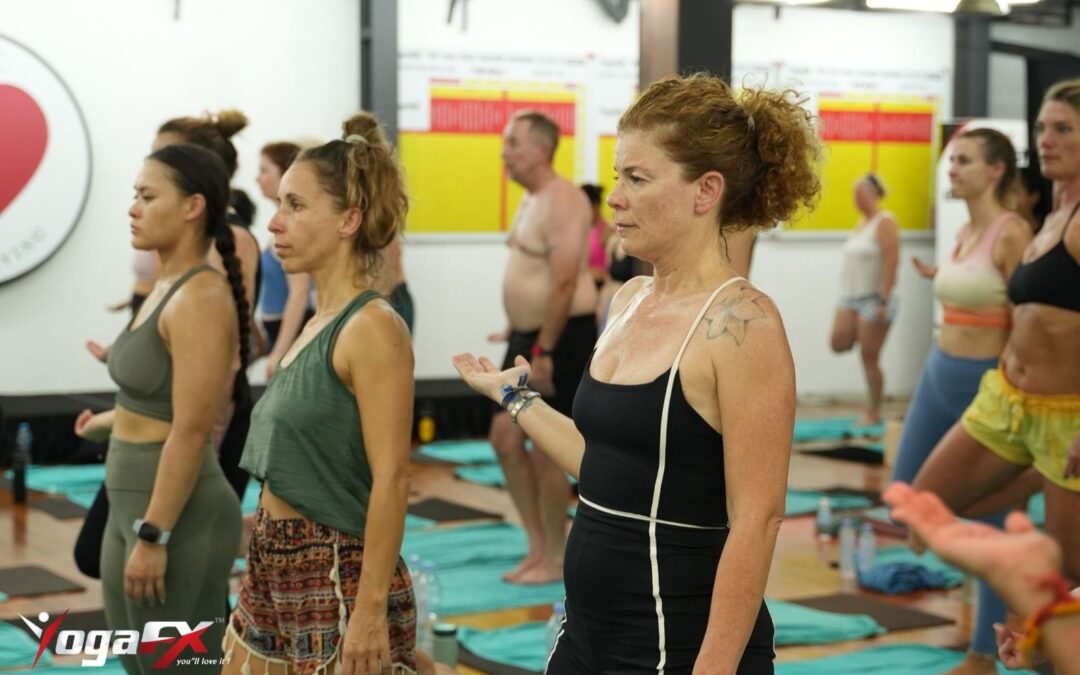
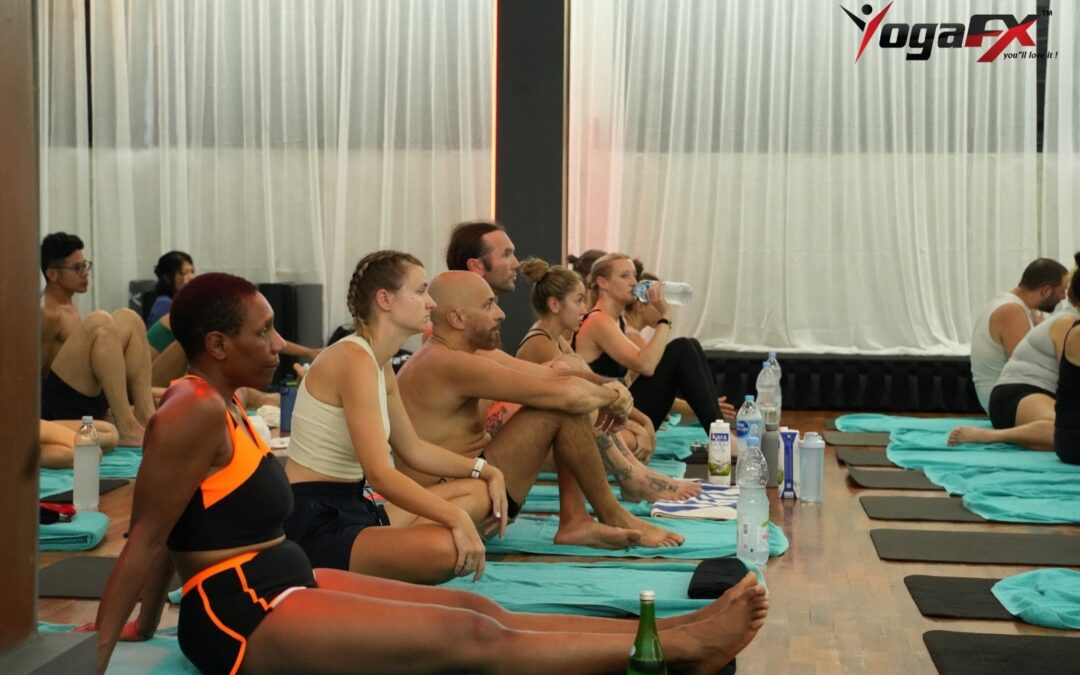
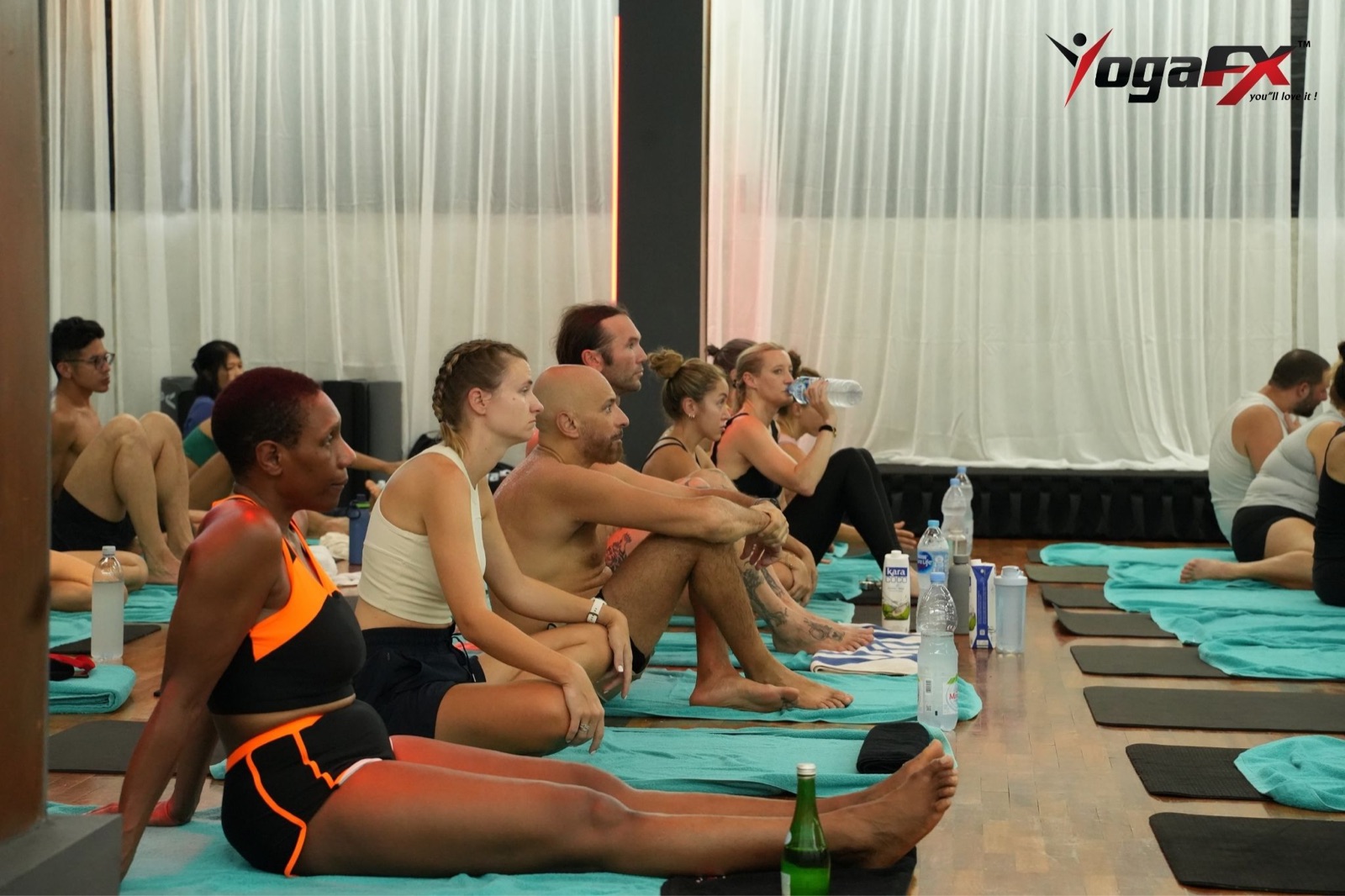
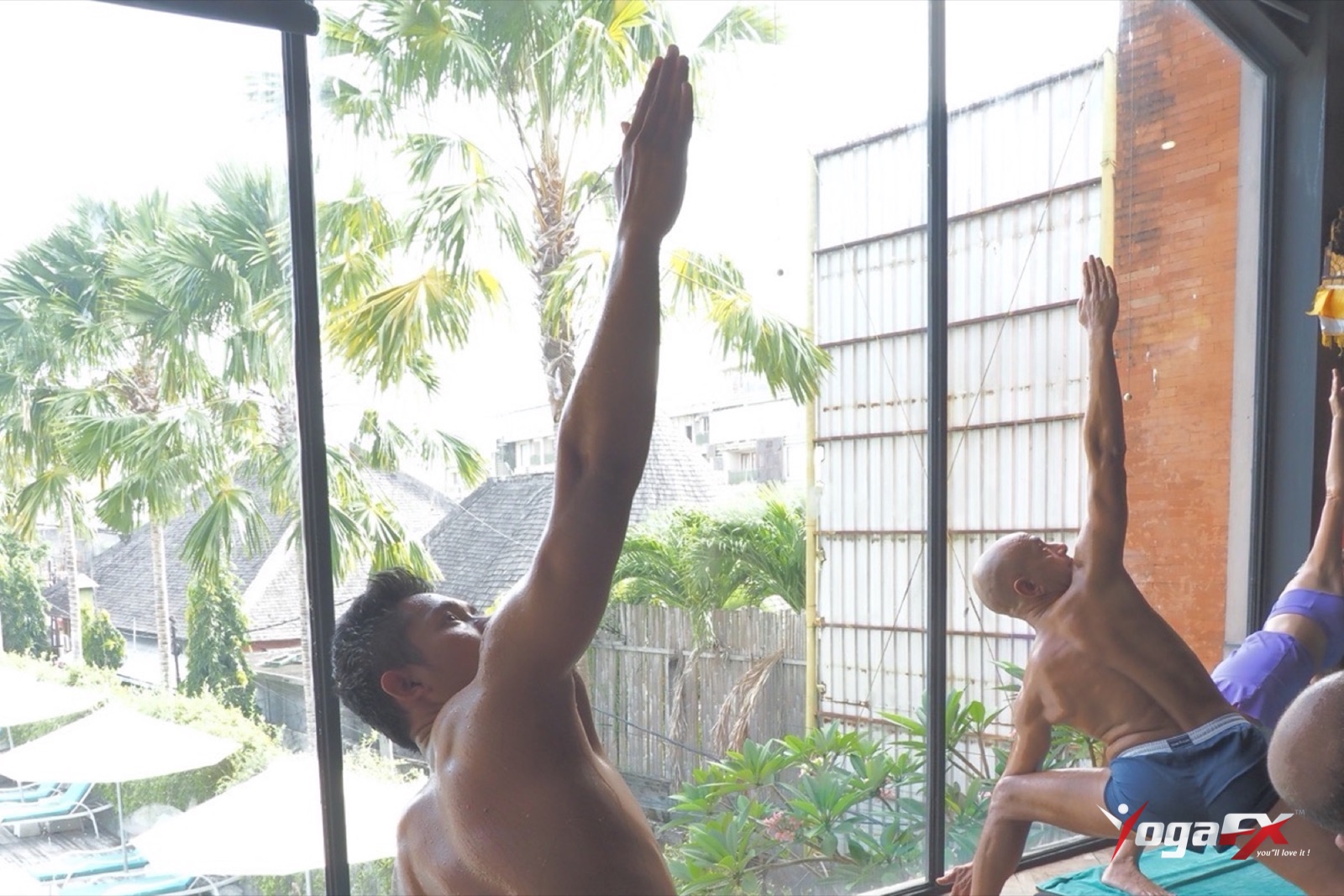
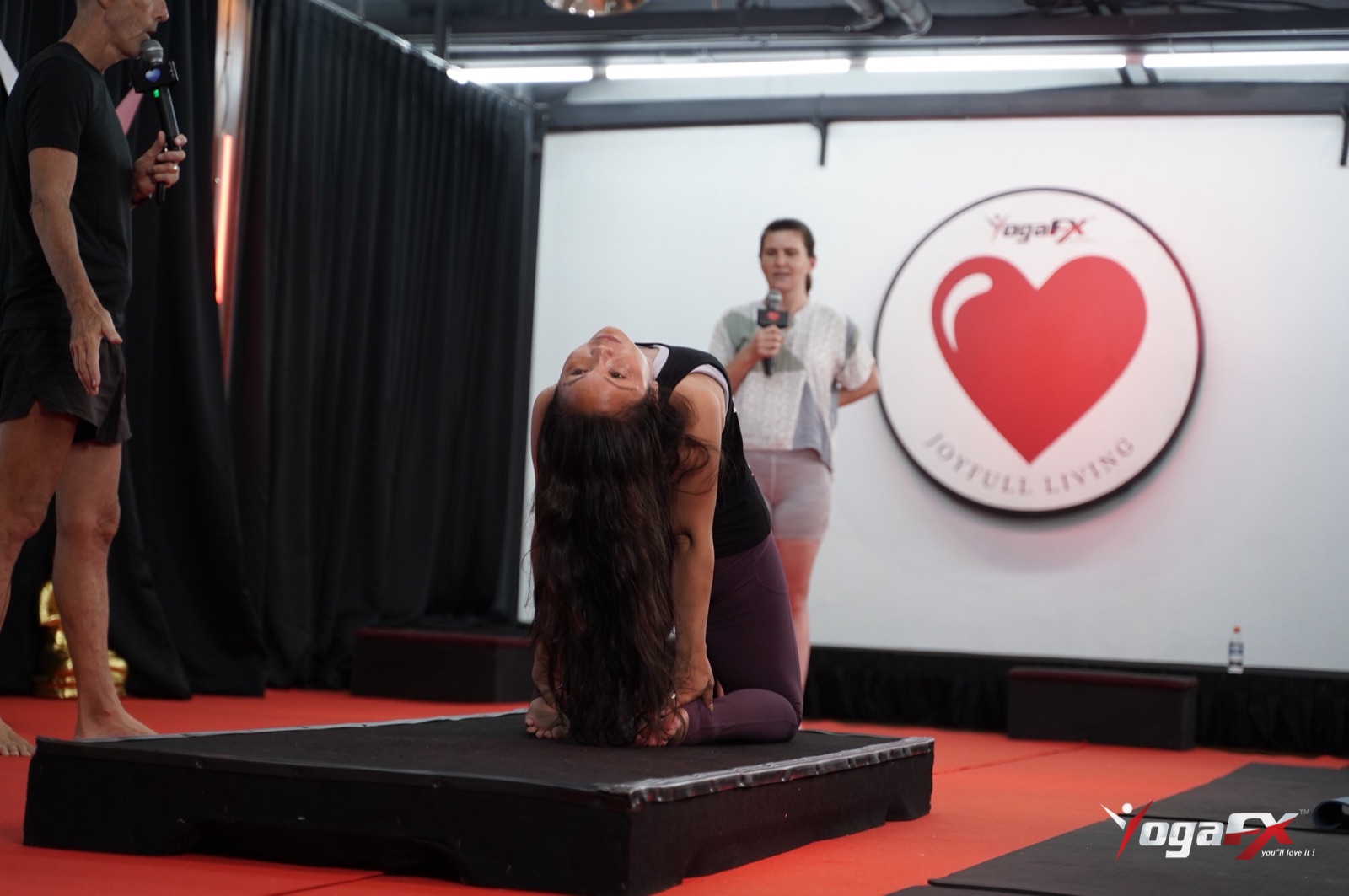
A heated class at YogaFX. Room heat and humidity are the numbers most Bikram studies report.
Three checks before you trust a hot yoga claim
Research can only describe what was done in the room. So before you trust any hot yoga claim, check three things:
Which style was tested. A study of a Bikram class says little about a hot vinyasa flow, and the reverse is also true.
What the room was like. Temperature and humidity change how hard the body works.
Who took part and for how long. A few regular practitioners in one class is not the same as 65 adults over 8 weeks.
Bikram vs Hot Yoga, Study by Study
The table lines up four studies by what they tested. Read the style column first, because it decides which side of the Bikram vs hot yoga question each result speaks to.
The evidence at a glance
Study
Style tested
Design
Main finding
What it cannot tell you
Willmott et al., 2025
Hot yoga of all kinds (mostly Bikram)
Systematic review, 43 studies, 942 participants
Body temperature and heart rate rose in heated classes; training was linked to changes in body composition, balance and flexibility
Whether hot yoga beats unheated yoga. The authors call that claim unsubstantiated
Quandt, Porcari and colleagues, 2015
Bikram
20 regular practitioners, one class, core temperature sensor
Average peak heart rate about 80% of predicted maximum in men and 72% in women; peak core temperature 103.2°F and 102.0°F
What happens to beginners or over weeks of training
59% of the yoga group halved depression symptoms, against 6% of the waitlist
Whether the heat mattered, because there was no unheated yoga group
Tracy and Hart, 2013
Bikram
Training trial in healthy young adults
Reported changes in strength, flexibility and body composition
Whether other heated styles give the same result
Bikram vs hot yoga evidence: four studies, what each tested and what it leaves open
43 studies
942 participants
The size of the 2025 hot yoga review.
74%
Bikram in the review
Share of styles in the hot yoga studies that used the Bikram sequence.
80% / 72%
Peak heart rate
Average share of predicted maximum in men and women in one Bikram class.
103.2°F
Peak core temperature
Average highest reading in the men in that class. For women it was 102.0°F.
59% vs 6%
Depression trial
Responders in heated Hatha yoga against a waitlist after 8 weeks.
Bikram vs hot yoga in five numbers. Sources: Willmott et al., 2025 (Sports Medicine - Open); ACE ProSource, 2015 (Quandt, Porcari and colleagues); Nyer et al., 2023 (Journal of Clinical Psychiatry). Compiled by YogaFX.
The 2025 review: 43 studies and 942 people
Willmott and colleagues pooled 43 studies in Sports Medicine - Open. Together they covered 942 people, 76% of them women. The training studies ran 6 to 36 sessions, 2 to 6 times a week, over 1 to 16 weeks. You can read the record on the Brunel University research archive.
The acute findings are the most useful for the Bikram vs hot yoga question. Heated classes raised body temperature and heart rate. They did not raise energy use compared with non-heated yoga. So a hot room makes the body work harder to cool itself, not harder to move.
Over weeks, training was linked to changes in body composition, blood fats, blood vessel function, bone mineral density, balance and flexibility. Findings on mood and thinking were described as promising but inconclusive.
The authors also warn that some studies were weak in design, and that case reports describe ill-health after hot yoga.
The heart rate and core temperature study
A team at the University of Wisconsin-La Crosse measured 20 regular Bikram practitioners for the American Council on Exercise. There were 7 men and 13 women, aged 28 to 67. Each swallowed a core temperature sensor and wore a heart rate monitor. The ACE write-up of the Bikram core temperature study describes a typical session as a room heated to 105°F with 40 percent humidity.
Men averaged about 80% of predicted maximum heart rate, and women about 72%. Average peak core temperature was 103.2°F in men and 102.0°F in women. One man reached 104.1°F, and 7 of the 20 went above 103°F. None showed signs of heat intolerance. Researcher Emily Quandt said, "The dramatic increases in heart rate and core temperature are alarming when you consider that there is very little movement."
That quote deserves a second read. The class looks calm, yet the body is under real strain. Because the group was small and experienced, the study can't tell a beginner what to expect.
The depression trial: heated Hatha, not Bikram
The most quoted mood study is a 2023 trial by Nyer and colleagues in the Journal of Clinical Psychiatry. It randomised 80 adults with moderate-to-severe depression to 8 weeks of community-delivered heated Hatha yoga or a waitlist. Among the 65 people analysed, 59% of the yoga group had their depression symptoms drop by half or more. In the waitlist group it was 6%.
Two details keep this in proportion. First, the class was heated Hatha, so it says nothing direct about Bikram. Second, the comparison group was a waitlist, so the trial cannot separate the effect of heat from the effect of yoga. The authors themselves call for further research with active control groups.
For a closer look at how it was run, read our guide to the hot yoga depression study. If you live with depression, please talk to a healthcare professional before starting.
The 2013 fitness trial
A 2013 trial by Tracy and Hart tested Bikram training in healthy young adults. It reported changes in strength, flexibility and body composition. We name it without a link here, so treat it as a pointer and not as a figure to quote.
Why Bikram vs Hot Yoga Studies Cannot Crown a Winner
Put the four studies side by side and the gaps are easy to see. Each one answers a different question, so the Bikram vs hot yoga score stays level.
Different styles. The core temperature study used Bikram. The depression trial used heated Hatha. The review mixed everything.
Small or narrow groups. Twenty experienced practitioners, or adults with depression who were mostly young women, do not stand in for everyone.
No unheated comparison. Most designs cannot say whether the heat or the yoga did the work.
Short time frames. The longest training studies in the review ran 16 weeks.
That is also why the flow side of the debate has no clear winner. For a home-study view of fixed series against flow, see our guide to hot vinyasa vs Bikram for home study.
Heat Safety Applies to Both Styles
Whichever side of the Bikram vs hot yoga choice you take, the heat deserves respect. The Mayo Clinic page on heat exhaustion lists the warning signs: heavy sweating, faintness, dizziness, fatigue, a weak and rapid pulse, muscle cramps, nausea and headache.
Its advice is to stop all activity and rest, move to a cooler place and drink cool water or a sports drink. A core temperature of 104°F (40°C) or higher means you should get help right away. Mayo also notes that people who aren't used to the heat are at higher risk, and so are people taking certain medicines.
Stop at the first sign. Dizziness is a reason to sit down, not to push on.
Keep water and a towel within reach so you never have to leave your mat to cool off.
Build up slowly. Start with a shorter session if you are new to heat.
Check with a doctor first if you are pregnant, have a heart condition, or take medicine that affects heat tolerance.
Bikram vs Hot Yoga at Home: What to Practise While You Decide
A four-week test you can run
You don't need a 40°C (104°F) room to learn the shapes. At home, keep the room comfortably warm and the pace steady. The goal for the first month is to learn, not to survive. This four-week test also answers the bikram vs hot yoga question for your own body.
Weeks 1 and 2: one fixed series. Pick the standing series and read the cues before you start. Our guide to the 26&2 postures step by step lists them in order.
Film one posture per session. Check the knee, hip line and spine against the cue, and write down one fix.
Weeks 3 and 4: add one flow class. Swap one session a week for a hot vinyasa or hot hatha class, online or in a studio.
Rate each session from 1 to 10 for effort, enjoyment and how easy it was to notice your own form.
Read your notes at the end. Most people can say which one they would do again tomorrow.
Rest between postures and a spoken script: no demonstration and no music in a fixed-sequence class.
A fixed series gives you the same posture in the same place every day. That makes progress visible, and it makes mistakes easier to catch without a teacher in the room. A flow gives you variety. Both have a place, so use the test to decide which one earns your time.
What YogaFX Students Say About Learning the Fixed Sequence
Numbers only go so far. YogaFX has 150 Google reviews, 50 Yoga Alliance reviews and 357 YouTube video reviews, and three of them speak to learning a set class. That is the practical side of bikram vs hot yoga. Names are first names only.
"This has actually exceeded my expectations of what the experience would be."
None of them says the sequence was easy. They say it was clear, and clarity is what a fixed class gives a learner. Here's Ajay's full video review.
Bikram vs Hot Yoga for Future Teachers
If you want to teach, bikram vs hot yoga becomes a choice between a script and a blank page. Teaching free-form hot yoga means building your own sequences and cues. Teaching the 26&2 means learning a dialogue word for word, then reading the room while you speak. Many new teachers find the script freeing, because it leaves their attention for the students.
Mr. Ian Terry trained for five years, from 2014 to 2019, with the founder of the method. He has taught more than 12,000 hours, and YogaFX graduates now come from more than 80 countries. The online course is USD 329, or 4 x USD 82, and it starts with the fixed sequence so you learn the words and the order first.
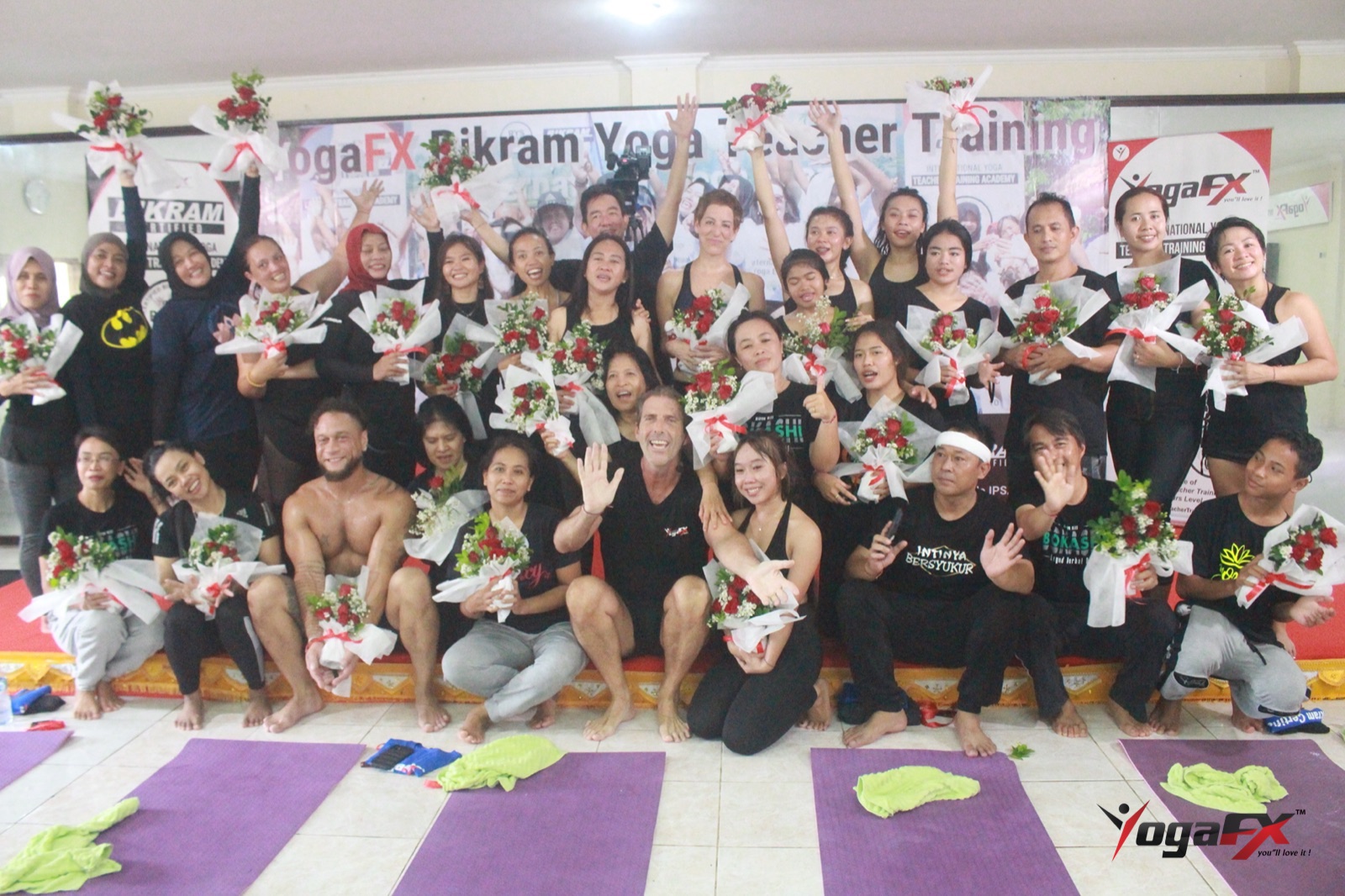
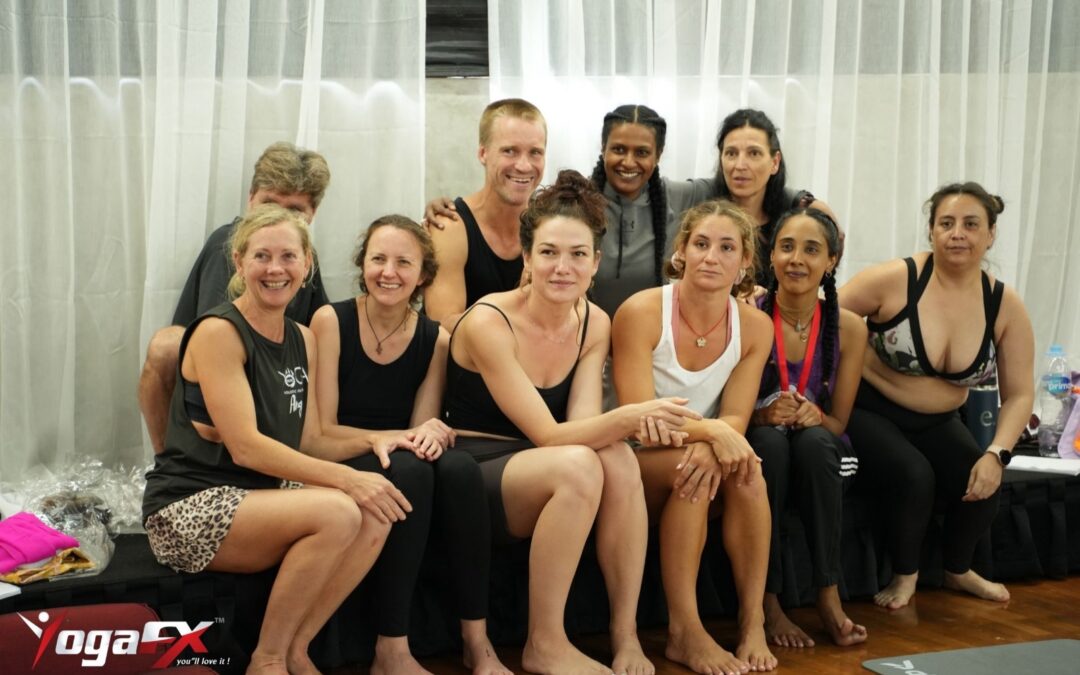
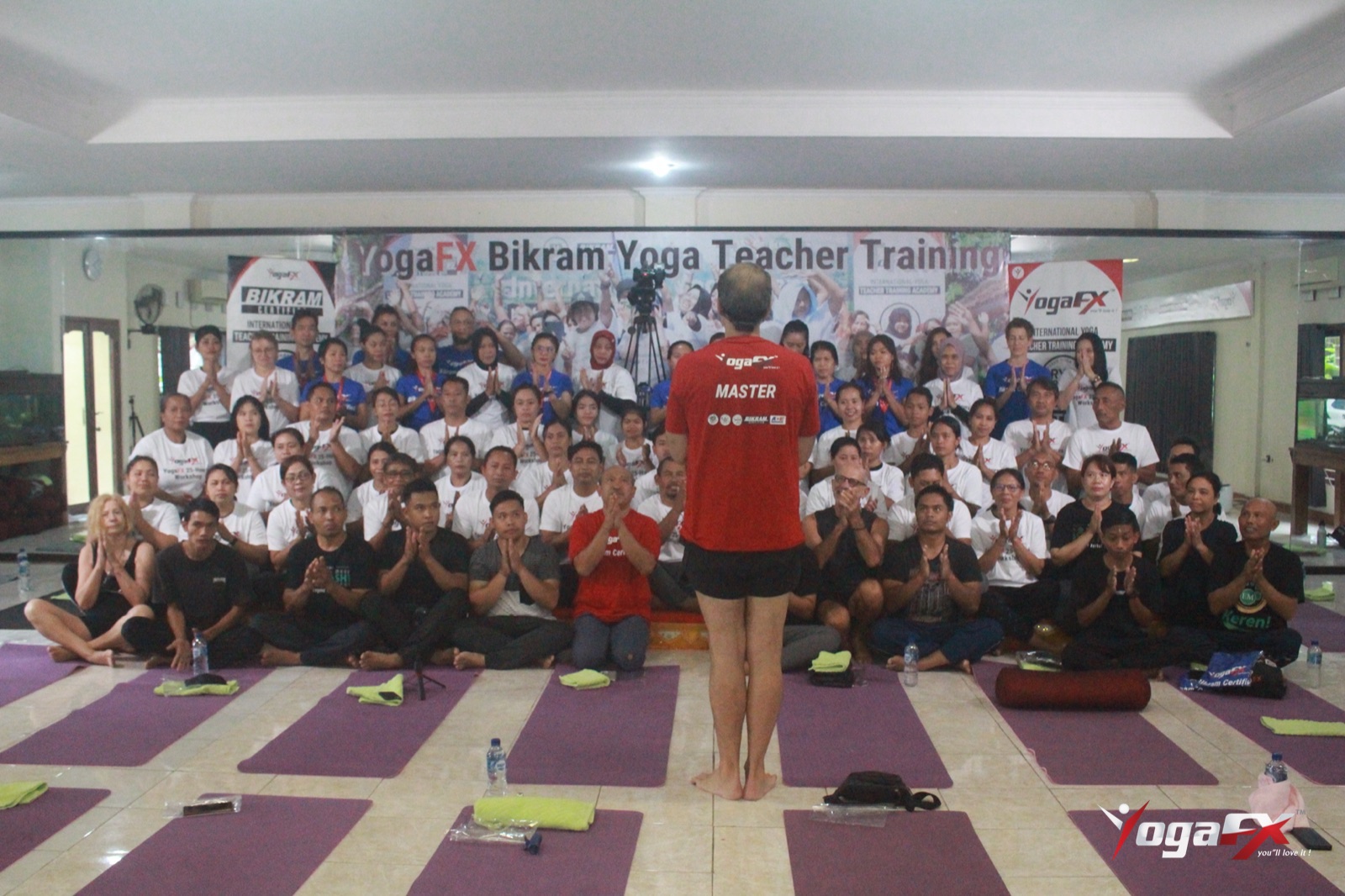
Graduates after a YogaFX hot yoga teacher training.
No. Bikram is one type of hot yoga: a fixed 90-minute class of 26 postures and 2 breathing exercises at about 40°C (104°F). Hot yoga is any yoga in a heated room, so the style, heat and length change from studio to studio. Every Bikram class is hot yoga, but most hot yoga is not Bikram.
What is the difference between Bikram and hot yoga?
The main differences are structure and teaching. Bikram follows the same sequence every time, taught from a script with no music. Hot yoga leaves the sequence, music, temperature and length to the teacher. In research, that means Bikram is easier to test, while results for hot yoga depend on the class studied.
Is Bikram hot yoga good for you?
Studies link regular heated yoga to changes in balance, flexibility and body composition. Findings on mood are promising but inconclusive. Heat also raises heart rate and body temperature, so it carries risks. This is general information, so please consult a healthcare professional before starting if you have a medical condition.
Is Bikram hot yoga hard?
It can feel hard at first. In one study, regular practitioners averaged about 80% of predicted maximum heart rate in men and 72% in women, even though there is very little movement. The postures repeat every class, so many students find it easier to learn. Rest whenever you need to.
Does hot yoga work better than regular yoga?
Not proven. A 2025 review of 43 studies found heated classes raised body temperature and heart rate but not energy use compared with non-heated yoga. The authors call claims of greater health benefits unsubstantiated at present. Pick the style you will keep doing, because consistency matters most.
Standing head to knee pose (Dandayamana Janushirasana) is a one-leg balance. You lock the standing knee, kick the other leg straight in front of you, and fold your forehead toward the knee. You can learn the steps at home, then fix the usual errors by filming yourself and checking the clip against the cue.
Most guides show the shape and stop there. The hard part online is that nobody tells you when you have drifted. A teacher in a room spots a sagging hip in half a second. At home you have a mirror, a phone and your own honest eyes, and that is enough if you know what to look for.
This guide to standing head to knee pose gives you six steps you can rehearse, a simple phone-camera method, and a table that turns what you see into a fix. It also covers what research says about one-leg balance and feedback. Finally, it shows where the YogaFX Online Course fits, for people who want the spoken dialogue and not only the shape.
A quick note first. This is general information, not medical advice. If you have a knee, hip, ankle or back injury, or you feel dizzy standing on one leg, speak to a healthcare professional before you practise. Do all the work below at room temperature, and keep the hot room for class.
Standing Head to Knee Pose: What You Are Really Learning
Standing head to knee pose asks for three things at once: a strong standing leg, a straight lifted leg and a fold that starts from the hips. Each part is easy alone. The pose feels hard because you stack all three on one foot. That is why a calm, step-by-step build beats a big push toward the knee.
The Sanskrit name is a plain description. Dandayamana means standing, janu means knee, shirsha means head and asana means pose. In the Original Hot 26&2 sequence it sits in the standing series, and like most postures it is done twice on each side. You can see every posture in class order on our page of the 26&2 poses.
Some people search for it as head to knee pose. That phrase also names the seated forward fold, so check which one a video shows. In the standing version one leg carries your whole weight. If you want the hamstring side of the story, our guide to hot yoga poses for men places this pose beside the other two head-to-knee postures.
The Steps: Six Moves You Can Rehearse at Home
Read the list once, then do standing head to knee pose slowly. In class, the teacher's spoken dialogue gives the exact timing, so treat these steps as a map and not as the script. Stand near a wall for your first few tries.
Set the standing leg. Put your feet together, shift your weight onto one foot and pick one fixed spot at eye level.
Lift and grip. Raise the other knee, wrap both hands around the foot and interlock your fingers under the ball of the foot.
Lock the standing knee. Tighten the thigh so the kneecap lifts. The leg stays straight and firm, but the knee does not push backward.
Kick forward. Straighten the lifted leg in front of you, push the heel away and keep both hip bones facing the front.
Fold with a long spine. Bend the elbows down, keep the chest tall and let the forehead move toward the knee only as far as the back stays long.
Come out slowly. Lift the head, release the foot, set it down and repeat on the other side.
Most people cannot straighten the leg or reach the knee in standing head to knee pose on day one, and that is normal. Hold the foot with a bent knee and keep the chest tall. Then straighten in small stages. A steady, shorter shape teaches your body more than a wobbly full one.
How to Film Yourself So the Clip Tells the Truth
A mirror helps, but you cannot watch your hip, your knee and your foot at the same time. A short clip can be paused, replayed and compared with last week. So filming your standing head to knee pose is the closest thing to a teacher's second look that you can set up alone.
Side view. Lean the phone against a water bottle at hip height, about two metres away, and film each side once for 20 to 30 seconds.
Front view. Move the phone to chest height and film the same two sides again.
Same spot, same light. Use the same place on your mat each session so clips compare fairly.
No editing. Keep the first take, even when it is messy, because the messy clip is the useful one.
One-leg balance is the base skill. Practise it before you add the kick and the fold.
Three checks for every clip
Watch the clip once with the sound off and look for just three things. First, is the standing knee straight and firm? Second, are both hip bones facing the front? Third, is the chest tall as the head comes forward? Those three checks catch most of what a teacher would correct.
Then ask one question about your standing head to knee pose: what changed since last time? A clip is only useful as a comparison. If the standing knee looks firmer than last week, you have progress even if the foot has not moved an inch.
What Your Clip Shows and the Fix to Try First
Use the table below as a lookup for standing head to knee pose. Find what you see in the clip, read the likely cause, then try the cue in the last column. Change one thing per session, because two changes at once hide which one worked.
What the clip shows
Best view
Likely cause
First fix to try
Standing knee bends and the hip sags behind the foot
Side
The thigh has let go
Squeeze the thigh and lift the kneecap before you raise the other foot
Lifted knee drops below hip height
Side
Hamstrings at their limit, or the grip is too low
Hold the foot with a bent knee, then straighten in three small steps
One hip rides up or the pelvis twists open
Front
Hips are not square
Point both hip bones at the camera and rehearse without the fold first
Back rounds and the chin drops toward the chest
Side
Chasing the forehead instead of the shape
Lift the chest first and fold only as far as the spine stays long
Standing foot grips with the toes or the ankle rolls in
Front
Weight has slid into the toes
Spread the toes and press down through the whole foot
Shoulders creep toward the ears and the jaw tightens
Either
Held breath
Breathe out slowly as you fold and let the shoulders drop
Eyes keep moving and the whole body shakes
Front
No fixed point to steady on
Choose one spot at eye level and stay on it
Table 1. Seven things a phone clip can show in standing head to knee pose, the likely cause and the first fix. Based on cues taught by Mr. Ian Terry at YogaFX.
What the table is really telling you
Notice that most fixes start at the standing foot, not at the lifted leg. That is the main idea of standing head to knee pose. If the base is solid, the kick and the fold have something to stand on. If it is not, no amount of reaching will save the shape.
Three Home Drills for Standing Head to Knee Pose
The standing leg will not lock
Stand side-on to a wall and rest your fingertips on it. Squeeze the thigh of the standing leg until the kneecap lifts, and hold for five slow breaths. Then lift the other foot a few centimetres and hold again. This teaches your leg what a firm knee feels like before the weight of the kick arrives.
The hamstrings will not straighten
Stage the kick instead of forcing it. Hold the foot with a bent knee, straighten a little, pause, then straighten a little more. Stop at the point where the spine is still long. Never bounce. A looped towel around the foot is a handy home aid while you learn, though it is not part of the class.
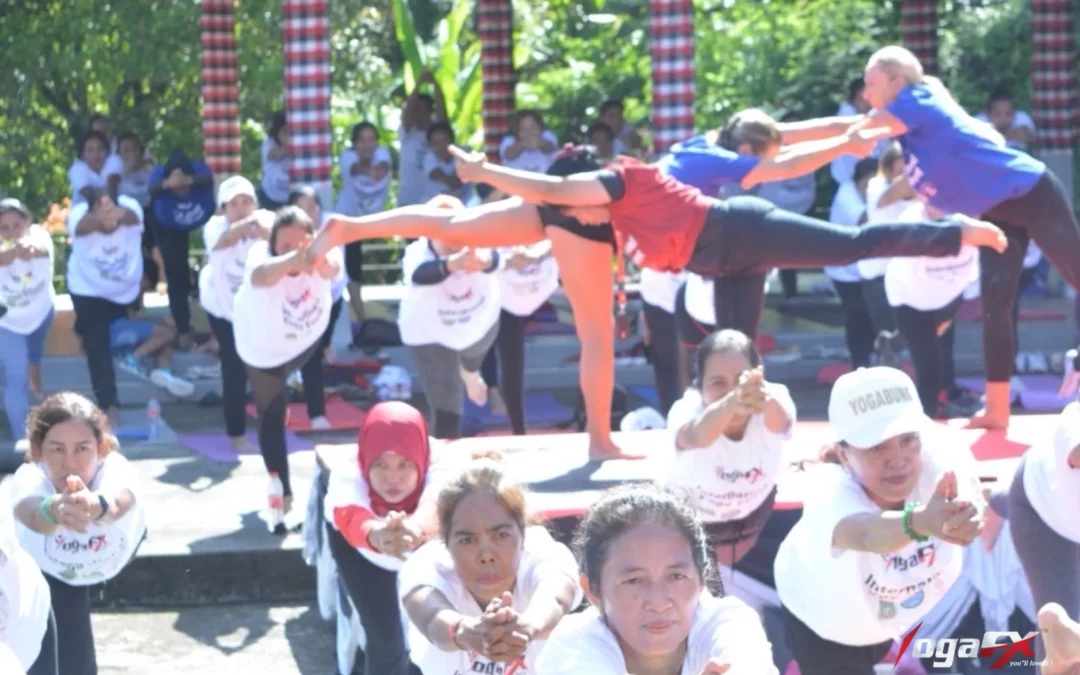
Group practice on a Bali terrace. Everyone follows the same spoken cues, which is why a clip is easy to compare with the cue.
The hips twist open
Place your hands on your hip bones in a short rehearsal with no kick at all. Feel both bones point forward, then lift the foot while keeping that feeling. Film the front view afterwards. If one side rides up, return to the bent-knee version and rebuild from there.
Other one-leg postures train the same base, so they help here too. Standing bow pulling pose, for instance, asks for a firm standing leg and a steady gaze, just as this posture does.
Standing bow pulling pose is another one-leg balance from the same standing series.
A Weekly Self-Check Loop for Standing Head to Knee Pose
You do not need a long routine. Three short sessions a week are enough, with a rest day between them. The loop below keeps each session focused and gives you something to compare next week.
Rehearse without filming. Spend a few minutes on the standing leg and the bent-knee version, with the wall nearby.
Film one clip per side. Use the side view one session and the front view the next.
Pick one fix. Choose the single row of the table that matches your clip and try only that cue next time.
Write three notes. Record how many slow breaths you held, how high the knee reached and which fix you tried.
After a few weeks, read your notes in order. The numbers will be small, but a pattern appears quickly. Perhaps the standing knee firms up first, and the kick follows later. That order is common, and it is a sign that you are building the pose from the right end.
What Research Says About One-Leg Balance and Feedback
Research cannot tell you how fast you will learn this posture. It can tell you why the base skill matters and why seeing yourself helps. Each study below has limits, so read the findings as context, not as a promise.
A 10-second one-leg stance and long-term health
A 2022 cohort study in the British Journal of Sports Medicine followed 1,702 adults aged 51 to 75. Araujo and colleagues found that people who could not hold a one-legged stance for 10 seconds had a higher risk of death from any cause over a median follow-up of 7 years. In an adjusted model, the hazard ratio was 1.84. You can read the abstract on the BMJ site.
This was an observational study, so it shows an association, not a cause. The authors also note that uncontrolled factors, such as recent falls and physical activity, could play a part. It does not say that practising standing head to knee pose will extend anyone's life. It does suggest that steady one-leg balance is a skill worth keeping.
1,702
Adults followed
Aged 51 to 75 in the Araujo cohort, followed for a median of 7 years.
10 seconds
The balance test
Stand on one leg for 10 seconds without support.
17.5% vs 4.6%
Died in follow-up
Share of those who failed the test against those who passed it.
HR 1.84
Adjusted risk
Higher all-cause mortality for those who failed, after adjusting for age, sex, BMI and illness.
USD 329
Online Course
Or 4 payments of USD 82 for the YogaFX Online Course.
Sources: Araujo et al., British Journal of Sports Medicine, 2022 (an association, not proof of cause); YogaFX Online Course price.
Balance training and falls
The Cleveland Clinic says that exercises that improve balance can help reduce your chances of falling. It also notes that standing on one leg can be harder than it sounds, and it suggests holding a chair for extra support when you first start. Putting your arms out to help is fine too. Read the full page on balance exercises at Cleveland Clinic.
That advice fits standing head to knee pose well. Use the wall, hold your arms out if you need to, and build up slowly. There is no prize for a bare-handed first attempt.
Why filming yourself can help
A 2021 systematic review in Cureus by Moinuddin, Goel and Sethi looked at augmented feedback in motor learning. The authors concluded that multimodal feedback seems to be the most effective way to give feedback while people learn a movement, and they called visual feedback the cornerstone of augmented feedback.
The review also cited a trial of 34 older adults, where video-screen feedback during single-leg training improved their balance. See the full review on PubMed Central.
The authors say only a few studies have linked how often feedback is given to skill gains, so the evidence is still thin. Still, it supports the simple idea in this guide. Seeing your clip while hearing the cue gives you two inputs instead of one. That is our reading of the review, not a claim from the authors.
Flexibility and heated yoga
A 2013 controlled trial by Tracy and Hart on a heated, humidified yoga programme reported flexibility gains alongside changes in body composition. We name it without a link, because the abstract page was blocked when we checked. It studied whole classes, not standing head to knee pose alone, so it is a hint about regular practice, not a promise.
How the YogaFX Online Course Fits In
A clip tells you what happened in your standing head to knee pose. It cannot tell you which words would have fixed it. That is where the spoken dialogue comes in. Mr. Ian Terry, E-RYT 500 with more than 12,000 teaching hours, leads the YogaFX Online Course. He trained for five years, from 2014 to 2019, with the founder of the Bikram Hot 26&2 method.
The YogaFX Online Course costs USD 329, or 4 payments of USD 82. It covers the 26 postures, the dialogue and the science at home, on your own schedule. If you would like to see how the course is laid out, start from our hot yoga teacher training online course page.
One thing we cannot describe here is the exact feedback process on your practice clips, because it can change from batch to batch. Message the team on WhatsApp and ask how it works right now. That is a better answer than a guess in a blog post.
When you want the heat and a live teacher, the next step is the six-day Bikram Hot 26&2 Yoga Teacher Training MasterClass in Bali. The next batch checks in on Sunday 24 January 2027 and checks out on Friday 29 January 2027, at Soham Wellness Center in Seminyak. The Early Bird price is US$1,899, against the normal US$1,999.
What YogaFX Graduates Say
Standing head to knee pose rewards patience, and graduates often talk about exactly that. These short quotes come from the YogaFX review store, from people who finished the live training in Bali. First names only, with the source and year.
“I'm quite proud of the fact that I stuck it for the six days didn't give up”
Karen, YouTube review, 2025
“it's not just yoga, it's yoga beyond.”
Erinc, YouTube review, 2019
“I'm just glad, just grateful to have met all of you. Each and every one of you I've learned something from.”
Amanda, YouTube review, 2023
Karen's full video review is below. She describes a hard week and why she stayed with it, which is a useful frame for any pose that humbles you at first.
Karen, YouTube review, 2025: a one-minute message after the six-day training.
Who Should Check With a Professional First
Balancing on one leg loads the knee, hip and ankle of the standing side, and it asks the back to stay long. So a few people should get advice before they start.
Joint injuries. Anyone with a current knee, hip, ankle or back problem should talk to a healthcare professional first.
Dizziness. If standing on one leg makes you dizzy, stop and get it checked before you practise again.
Heat concerns. If you plan to move from home practice into a hot room, read our guide on how safe hot yoga is first.
Pain in a joint is a signal to stop standing head to knee pose. A stretch in the back of the leg is normal, and a sharp pain behind the knee is not. Take the slower route, and tell your teacher about any injury before class.
FAQ
Can I learn standing head to knee pose online?
Yes, you can learn the steps, the order of the cues and the common fixes online. Film yourself from the side and the front, then compare each clip with the cue. A video cannot replace a teacher's eyes in the room, so keep your goals modest and ask for feedback whenever you can.
How do I know my standing knee is locked?
Tighten the thigh until the kneecap lifts, then check a side-view clip. The leg should look straight and firm, with the knee over the ankle, not pushed backward or softly bent. If your hip sags behind the foot, the thigh has let go, so squeeze again before you lift the other leg.
What is the difference between head to knee pose and standing head to knee pose?
Head to knee pose usually means the seated forward fold, where the floor supports you and the work is a hamstring and spine stretch. In standing head to knee pose, one leg carries your whole body, so balance and strength join the stretch. Check which one a video shows before you copy the shape.
How long should I hold standing head to knee pose at home?
Start with a few slow breaths on each side and stop before your form slips. Hold only as long as the standing knee stays firm and the chest stays tall. Add a breath or two over several sessions and rest between sides. If a joint hurts, stop and ask a healthcare professional.
How much does the online course cost?
The YogaFX Online Course costs USD 329, or 4 payments of USD 82. It covers the 26 postures, the spoken dialogue and the science at home, led by Mr. Ian Terry, E-RYT 500. Message the team on WhatsApp to ask how feedback on your own practice clips works before you buy.
Still have questions? Message Mr. Ian and the YogaFX team on WhatsApp and we will answer them personally.
Hybrid yoga teacher training splits the course in two: you learn theory and the teaching script online at your own pace, then practise teaching live with a trainer. At YogaFX the live part is a 6-day intensive in Bali. Done well, each half does a job the other can't do.
Most people who search for this are weighing the same trade-off. A fully online course is flexible but you never teach a real body in front of you. A fully in-person course gives you that, but it asks for weeks off work. A hybrid course tries to keep the best of both. Whether it works depends on how the two halves are joined.
This guide explains how hybrid yoga teacher training works from the student's side, what to practise at home before you travel, and what the research does and does not say.
What hybrid yoga teacher training means in practice
The word hybrid gets used loosely, so here is the plain version. A hybrid yoga teacher training has an online part you finish before you travel and a live part where you teach and get corrected in person. The online part carries the knowledge. The live part carries the skill.
The knowledge side includes anatomy, the structure of a class, teaching ethics and, in a hot yoga course, the dialogue you will say aloud. You can read, watch and rehearse that at home. Nobody needs to be in a room to learn what the spine does in a forward fold.
The skill side is different. You have to speak clearly, watch several students at once, and fix a posture with your voice. That only improves when someone watches you do it and tells you what they saw.
The two halves at YogaFX
Online pre-course. You study at home through the YogaFX online academy before the live block starts.
Live intensive. You join a 6-day practical block in Bali, with check-in on a Sunday and check-out on the Friday.
Certification. The programme leads to Yoga Alliance RYT 200-Hour certification plus the Bikram Hot 26&2 200-Hour International Yoga Certification.
How online theory and a Bali intensive fit together
A hybrid yoga teacher training only works when the live week starts where the online work stops. If the online part is a loose pile of videos, you spend the first live days catching up. If it is built as preparation, you arrive with the words, the order and the anatomy already in your head.
Think of blended yoga teacher training as sequencing. You do the slow, repeatable learning at home, where you can pause and re-read. You save the fast, social, high-feedback learning for the room. That is why the live block can stay short, even in an online plus in person YTT format.
Format
Where theory is learned
Where teaching is practised
Time away from home
Best for
Fully online
At home, on a schedule you set
On video, with written or recorded feedback
None
People who cannot travel and want the theory first
Hybrid
At home, in the online pre-course
Live, in a studio, with a trainer in the room
One short block (6 days at YogaFX)
People who want flexible study and real teaching reps
Fully in person
In the classroom, on the course timetable
Live, in a studio
The whole course
People who can pause work and home life for weeks
How the three common formats split learning and practice. Figures for the hybrid column describe the YogaFX programme.
What the live week is for
The live week is not for lectures. It's for teaching reps. You stand up, say your part of the class, and hear what worked. Then you do it again, because repetition is how the words stick. By the end of the week you have taught many times in front of other trainees and a trainer who knows the material.
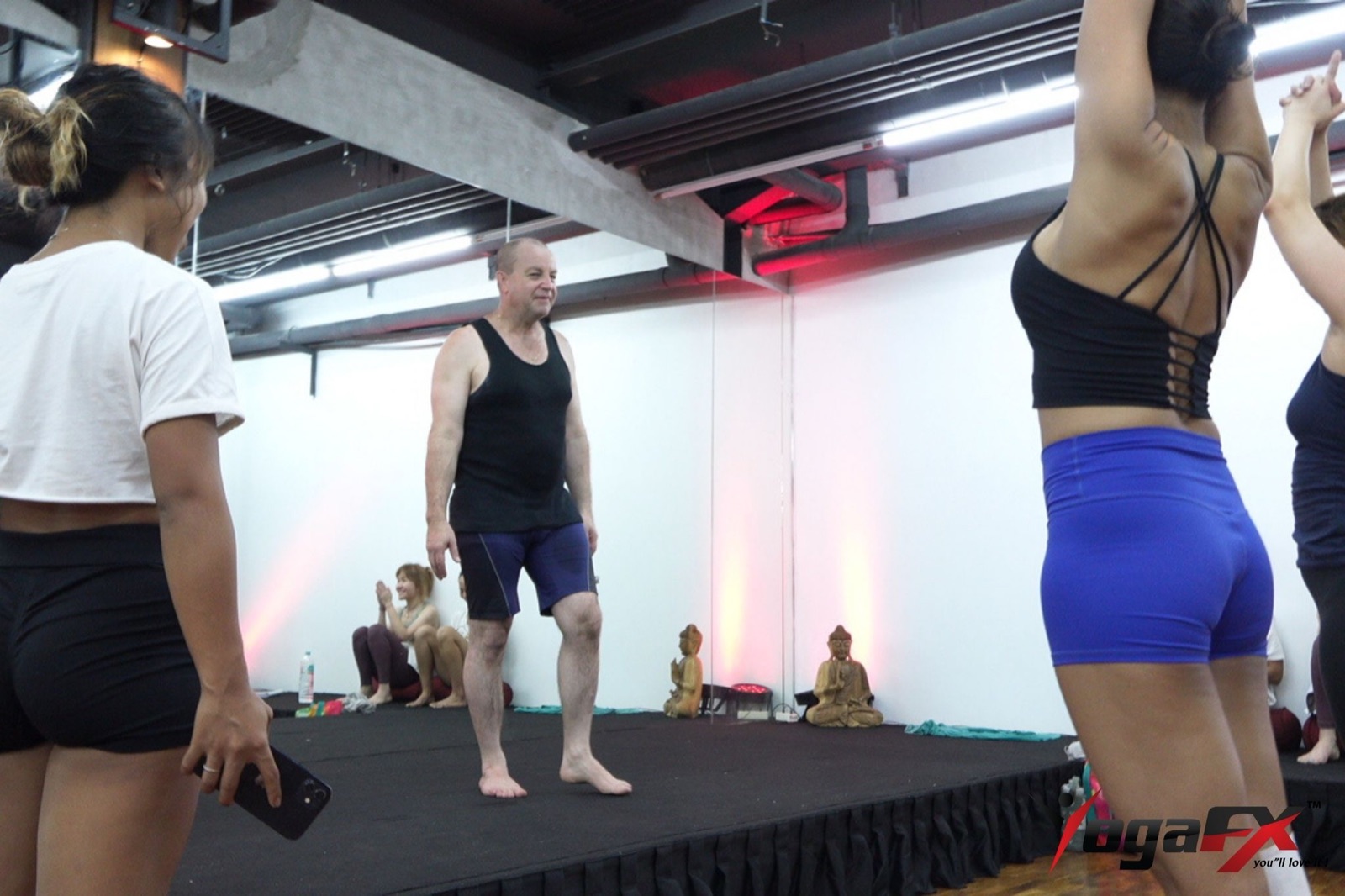
A live practical block: the trainer watches, corrects and lets trainees try again.
Mr. Ian Terry is E-RYT 500 with 12,000+ teaching hours, and he leads the Bali block himself. Trainees get feedback from a person who has taught the same dialogue for years, not from a recording. That's why the feedback loop is the main reason to travel.
6 days
Live block in Bali
One short intensive, after the online pre-course is done.
1,500+
Graduates
Trained at YogaFX, from more than 80 countries.
59.3%
Halved symptoms
Heated yoga group in the Nyer 2023 trial, against 6.3% on the waitlist.
g = 0.74
Spacing effect
Benefit of spaced over massed retrieval practice in 29 studies.
Preparation changes how much you take from six days. The most useful home work is small and regular. You don't need a hot room to do most of it, so you can start today.
Say the words aloud. Read your teaching script out loud, standing up, for 10 to 15 minutes. Silent reading fools you into thinking you know it.
Record yourself. Use your phone. Listen back for filler words, rushed endings and a flat voice.
Learn the postures from the inside. Practise the sequence regularly in a class you trust, so your body understands what you will describe.
Study the anatomy in short blocks. Twenty minutes on four days beats one long weekend.
Ask for a friend's eyes. Teach a short section to a friend or family member and ask what was unclear.
If hot classes are new to you, build up slowly, and start your hybrid yoga teacher training online study first. Our guides to heat acclimatization and how safe hot yoga is explain the warning signs and a gradual way in. Hydrate, stop if you feel unwell, and check with a doctor first if you have a heart, blood pressure or other health condition.
Timing matters too, because spaced study only works if you start early. Here is a simple plan for the weeks before your flight. It's a suggestion, not a requirement, so adjust it to your own schedule.
Week before travel
Online study focus
Speaking practice
Body practice
Weeks 4 to 3
Anatomy basics and class structure
Read the script aloud, one section a day
Two or three classes a week, building up gently
Weeks 2 to 1
Teaching ethics and student safety
Record yourself and listen back
Keep the same weekly rhythm
Final week
Revise your weakest topics
Teach a friend one full section
Rest well, hydrate and travel calmly
A sample preparation plan for a blended yoga teacher training with an online pre-course and a live block.
Between blocks, trainees can ask questions and try a section again.
The science, study by study
Research cannot tell you whether one school's hybrid programme is better than another's. It can tell you whether the ideas behind the format are sound. Two bodies of evidence matter here: how people learn a script, and how heated yoga affects the people you will teach.
Spacing your study helps you remember
A 2021 meta-analysis in Educational Psychology Review pooled 29 studies on retrieval practice. Latimier, Peyre and Ramus found a strong benefit when practice was spaced out rather than massed together, with an effect size of g = 0.74. You can read the full paper on Springer.
This was not a yoga study, so treat it as a learning principle, not proof about any course. It does support the logic of a pre-course. Weeks of short, repeated practice at home should hold a dialogue better than one cram session in the live week.
Heated yoga and the students you will teach
A randomised trial from Massachusetts General Hospital tested eight weeks of community-delivered heated hatha yoga in adults with moderate to severe depression. Nyer and colleagues randomised 80 people and analysed 65. Symptoms fell by half or more in 59.3% of the yoga group against 6.3% of the waitlist, published in the Journal of Clinical Psychiatry in 2023. Read the record on Europe PMC.
The authors describe it as preliminary and call for further research with active control groups. Our walk-through of the Harvard hot yoga depression study shows how it was run. For a teacher, the lesson is humility: students may come to class carrying a lot, and your job is to teach safely, not to promise outcomes.
A 2025 systematic review by Willmott and colleagues, covering 43 studies and 942 participants, also looked at Bikram-style practice and reported benefits for flexibility and well-being. This article is general information and not medical advice. Consult a healthcare professional before starting hot yoga.
What students say about hybrid yoga teacher training online and live
Reviews cannot replace research, but they show how the format feels to people who finished it. These come from YogaFX graduates and were left on Google and YouTube.
"He is a great teacher, truly an authentic, genuine person. The course was intense and required discipline, I loved it!"
Stacy, Google review, 2024
"If I wanna do another YTT, I will definitely do it with YogaFX."
Atika, Google review, 2019
Shannon, who finished the 200-hour training in 2024, put it simply in a short video message: she can highly recommend it and felt privileged to train with Mr. Ian.
Shannon, YouTube review, 2024: a 32-second graduation message after the 200-hour training.
Notice what the reviewers mention: the teacher, the discipline and the team. None of them praise the video platform, so the online part clearly isn't what stuck. That fits the idea that the online part is the quiet groundwork, and the live part is what people remember.
Common mistakes in hybrid yoga teacher training
Most problems come from how people use the format, not from the format itself. Here are the ones I'd watch for, whichever school you pick.
Treating the online part as optional
Some students leave the online work until the last week. Then they spend the live days reading instead of teaching. Finish the online pre-course early, so the live block is for practice.
Expecting the live block to fix everything
Six days is a short time. You'll leave with real teaching experience and honest feedback, but you won't leave a finished teacher. Keep teaching after you get home, for example to friends or in a small community class.
Choosing on price alone
A cheap course that never puts you in front of a live audience may leave you unable to teach. Ask any school how many times each trainee will teach in person, who gives the feedback, and what the certificate actually allows. Our guide on how to choose a yoga teacher training lists seven claims worth testing.
Skipping the health conversation
A hot room is demanding. If you have a health condition, speak to a doctor first and tell the trainers before you start. That's part of being a responsible future teacher, because you'll be asking the same of your own students.
Is hybrid yoga teacher training right for you?
Hybrid yoga teacher training suits some people far better than others. Ask yourself these questions honestly.
Can you study alone? The online part of a hybrid yoga teacher training needs self-discipline. If you need a class to keep you on track, say so when you enquire.
Can you take about a week away? Six days in Bali is far easier to arrange than several weeks.
Do you want to teach, not just deepen your practice? The live block is built around teaching reps.
Are you comfortable in a hot room? If not, start with classes and the safety guides above.
If you answered no to most of these, a longer in-person course or a fully online one may suit you better. A good school will tell you that before taking your deposit.
Trainees after the Bali intensive, together after six days of teaching practice.
The YogaFX hybrid programme in Bali
YogaFX has trained 1,500+ graduates from 80+ countries since 2017. The hybrid yoga teacher training programme is the Bikram Hot 26&2 Yoga Teacher Training MasterClass: an online pre-course, then a 6-day practical intensive in Bali led by Mr. Ian Terry.
Next batch: check-in Sunday 24 January 2027, check-out Friday 29 January 2027.
Venue: Soham Wellness Center, Seminyak.
Price: US$1,899 Early Bird, against a normal price of US$1,999.
Certification: Yoga Alliance RYT 200-Hour plus the Bikram Hot 26&2 200-Hour International Yoga Certification.
Ask the team how many spots remain for the next batch. If you would like to start the learning side today, the YogaFX Online Course costs USD 329, or 4 payments of USD 82.
Hybrid yoga teacher training splits one course into two parts. You study theory, anatomy and the teaching script online at your own pace, then practise teaching in person with a trainer. The online part builds knowledge at home, and the live part builds the skill of teaching real people.
How long is the in-person part of a hybrid yoga teacher training in Bali?
At our school the in-person part is a 6-day intensive in Bali, with check-in on a Sunday and check-out on the Friday. The next batch runs from Sunday 24 January 2027 to Friday 29 January 2027. You complete the online pre-course first, so you arrive ready to teach.
Can I join a hybrid yoga teacher training if I have never tried hot yoga?
Yes, but build up first. Take a few classes, learn the warning signs of overheating, and talk to a doctor if you have any health condition. Message the team on WhatsApp and we will help you plan your preparation before you travel to Bali.
Which certificates does the hybrid programme lead to?
The programme leads to Yoga Alliance RYT 200-Hour certification and the Bikram Hot 26&2 200-Hour International Yoga Certification. Teachers who already hold a certificate can ask about the YACEP option. Always check the current requirements on the official Yoga Alliance website before you enrol anywhere.
How much does the hybrid yoga teacher training cost?
The Bali programme has an Early Bird price of US$1,899, against a normal price of US$1,999. The standalone Online Course costs USD 329, or 4 payments of USD 82. Message the team on WhatsApp for the current room options and available spots before you decide.
If you feel hot yoga dizzy, stop moving and lie down in Savasana. Stay in the room, sip water slowly and tell the teacher. At home, tell someone nearby. Most spells ease with rest, but fainting, chest pain or confusion need a doctor. This guide shows each step, why it works and when to rest longer.
This article is general information, not medical advice. If you have a heart condition, low blood pressure, diabetes or take regular medicines, consult a healthcare professional before you practise in the heat.
Hot Yoga Dizzy: Five Steps to Take on the Mat
YogaFX teachers, led by Mr. Ian Terry, E-RYT 500, with more than 12,000 teaching hours in heated rooms, give the same instructions for a hot yoga dizzy moment: stop, lie down, breathe, sip and speak up. Here is how each step works, in order.
1. Ease off at the first wobble
The first wobble is a message, not a test. Come out of the posture slowly and do not try to finish it. Pushing on to save face is how a small dizzy moment becomes a faint.
2. Lie down in Savasana
Lie flat on your back with your arms by your sides. Lying down takes the strain off your legs, so it is usually easier for blood to reach your brain. The US Centers for Disease Control and Prevention (CDC) gives the same first aid for heat-related fainting: sit or lie down in a cool place. Our guide to why Savasana matters after heat explains the pose itself.
3. Stay in the room, with one exception
For an ordinary light-headed moment, staying in the room works well. The teacher can see you and the dialogue keeps running, so you rest without feeling lost. The exception is a set of heat exhaustion signs: heavy sweating, nausea, headache and a pale, clammy look. In that case, move to a cooler place, because the NHS lists moving to a cool place as its first step.
4. Sip water slowly
Take small sips instead of big gulps, which are harder to manage when you feel unwell. The CDC says to slowly drink water or a sports drink. Keep the bottle close to your mat before class so you never have to hunt for it.
5. Tell the teacher or the person nearest to you
Speak up early. A quick word means the teacher can check on you, watch your colour and bring a towel or fan. At home, the "teacher" is whoever shares your house, so tell them before you start practising.
Why a Hot Yoga Dizzy Spell Happens
Dizziness is a loose word, and a hot yoga dizzy spell can mean different things. MedlinePlus, the US National Library of Medicine's health guide, says it usually describes two different feelings: lightheadedness and vertigo. Lightheadedness happens when the brain does not get enough blood. Vertigo is a sense that you or the room is spinning.
A heated room pushes you toward lightheadedness for three reasons:
You sweat. The CDC describes heat exhaustion as the body's response to losing too much water and salt, usually through sweating.
You stand still for too long. The CDC links this to heat syncope, a fainting episode or dizziness.
You change position fast. MedlinePlus lists getting up too quickly as a cause of lightheadedness.
The same page describes orthostatic hypotension, a drop in blood pressure when you stand up after sitting or lying down. Its most common symptom is lightheadedness or dizziness on standing. That is why the moment you rise from a floor posture is the classic time for a hot yoga dizzy spell, and it is why you shouldn't spring up.
Which kind of dizzy is it?
Use the table below as a quick map for any hot yoga dizzy moment. It does not diagnose anything. It shows the usual cause, the first step and the source behind each step.
What you notice
What may be behind it
First step on the mat
Source
Room tilts for a few seconds as you rise from the floor
A short drop in blood pressure on standing
Sit back down, hold something steady, rise slowly
Mayo Clinic; MedlinePlus
Faint or light-headed after standing still for a long time
Heat syncope, a fainting episode linked to heat and standing
Sit or lie down in a cool place, sip water slowly
CDC
Dizzy with heavy sweating, headache, nausea or cramps
Possible heat exhaustion
Stop, move somewhere cool, cool your skin, sip fluids
NHS; Mayo Clinic
Strong spinning, even when you keep still
Vertigo rather than lightheadedness
Keep still and rest, then ask a doctor if it returns
MedlinePlus
Four common dizzy moments in a heated room and the first step for each. Sources: Mayo Clinic (orthostatic hypotension, 2022); CDC NIOSH (heat-related illnesses, 2026); NHS (heat exhaustion and heatstroke, 2026); MedlinePlus (dizziness, 2025).
Notice how little of this depends on the poses. The heat and the standing do most of the work. That matches what our guide to hot yoga safety and heat risk found when it read the heat studies one by one.
Hot Yoga Dizzy at Home: What Changes With No Teacher
Studio students have a teacher scanning the room. Home students do not. So the five steps for hot yoga dizzy moments stay the same, but you need to set up the room before you start. Most guides leave this out, and it is where an online course earns its keep.
Tell someone you are practising. A housemate, a partner or a friend on a call. Say where your mat is and when you will finish.
Keep a phone within reach. If you faint, you want to be able to call for help, or the person nearby can.
Use a warm room, not a hot one. You do not need a 40°C (104°F) studio to learn the postures. Add warmth slowly, as our heat acclimatization guide explains.
Put a bottle, a towel and a chair or wall within one step. MedlinePlus advises having something to hold on to when you stand.
Choose a mat spot you can lie down on safely. Clear the floor around you so a rest or a slip does not turn into a bump.
If you practise alone and often feel faint, the safest answer is not a cleverer technique. Instead, talk to a doctor, and avoid practising in the heat with nobody around until you know why.
Your Hot Yoga Dizzy Decision Card
Screenshot this card before your next session. It turns the hot yoga dizzy steps above into a short timeline, so you do not need to think when your head is swimming.
0 min
Wobble
Ease out of the posture. Do not push on.
1 min
Lie down
Savasana on your back, slow breaths.
5 min
Sip
Small sips of water. Tell the teacher or someone near.
30 min
Check
The NHS says heat exhaustion should ease within 30 minutes of cooling down.
Now
Get help
Fainting, chest pain, confusion, a seizure or a very high temperature need emergency care.
Hot yoga dizzy decision card. Sources: NHS, heat exhaustion and heatstroke (2026); MedlinePlus, dizziness (2025); CDC NIOSH, heat-related illnesses (2026). The minute marks are a teaching guide, not medical rules.
The minute marks on the first three cards are a YogaFX teaching guide. The 30-minute card comes from the NHS. The Mayo Clinic is more cautious and says to contact a healthcare professional if symptoms get worse or do not improve within one hour. So treat 30 minutes as the point to reassess, not a promise.
When to Rest Longer and When to Get Help
Most dizzy spells ease with rest, but some don't, and you should know which is which before you practise. The NHS separates heat exhaustion from heatstroke, and the difference decides what you do next.
Heat exhaustion: tiredness, dizziness, headache, feeling sick, heavy sweating, cramps and a high temperature. Move somewhere cool, remove extra clothing, drink water and cool your skin.
Heatstroke: a very high temperature, hot skin that is not sweating, fast heartbeat, confusion, a seizure or loss of consciousness. This is an emergency. Call for help.
Also get urgent help if you are dizzy with chest pain, shortness of breath, or fainting with a loss of alertness for more than a few minutes, as MedlinePlus lists.
The NHS says heat exhaustion does not usually need emergency care if you cool down within 30 minutes. If you are still unwell after that, it points to further help. So watch the clock, and do not talk yourself out of calling someone.
One more point. A hot yoga dizzy spell that keeps coming back is a reason to see a doctor before your next class. Repeated spells can have causes that rest on a mat will never fix, such as low blood pressure or a medicine side effect.
Coming Back After a Hot Yoga Dizzy Spell
Once a hot yoga dizzy spell has passed and you feel steady, you can often return. Go back gently. Wait until your breathing is slow, then sit up first and stand only when the room stays still. Choose lower variations for the rest of the session, with your knees down or your body seated, so your head stays near the mat.
Then look at what built up to it. A few habits lower the odds of a repeat:
Drink through the day. Spread fluid across the hours before class. Our hot yoga hydration guide shows how to measure your own sweat rate.
Eat light. A small meal a few hours before practice sits better than a heavy one close to it.
Rise in two stages. Sit, then stand. Hold something if you need it.
Build up slowly. Heat tolerance takes time. A short, warm session is better than a long hot one when you are new.
What the Research Says, and What It Does Not
Honesty matters here. We read the evidence the same way across this site, and we grade it. For a hot yoga dizzy spell, the evidence looks like this:
Claim
Evidence grade
What backs it
Lying down helps heat-related fainting
Strong guidance
CDC first aid for heat syncope
Rising slowly cuts dizziness on standing
Strong guidance
MedlinePlus and Mayo Clinic
Heat exhaustion should ease within 30 minutes of cooling
Strong guidance
NHS (Mayo Clinic says one hour)
How often dizziness happens in hot yoga classes
Not measured
No trial we found counted dizzy spells
Heated rooms push heart rate far above room-temperature yoga
Weak
One 2020 study of 16 practitioners found 113 against 109 beats a minute, no significant gap
Evidence grades for hot yoga dizzy advice. Grades are YogaFX's reading of the sources named; they are not a medical classification.
The last row deserves a closer look. In a 2020 study from Houston Methodist Hospital (Lambert et al., International Journal of Exercise Science), 16 experienced practitioners did the same one-hour sequence in a heated room and at room temperature. Average heart rate was 113 beats a minute in the heat and 109 at room temperature, and the authors reported no significant difference.
That result is reassuring for healthy, experienced people. However, it says nothing about dizziness, and the study did not measure core temperature. So we can't use it to say how common a hot yoga dizzy spell is. For that, you need a dedicated trial, and we have not found one. Our hot yoga heart rate guide covers what the numbers mean.
What Students Say About Being Looked After
Reviews cannot prove medical safety, and these were written about teacher training, not dizziness. Even so, they show what it feels like to learn from a teacher who watches the room for a hot yoga dizzy student. These are word for word from public YogaFX reviews.
Mr. Ian is both tough on us when necessary, and loving when called for. His love for all of us was quite obvious. He could 'see' us, read into our souls and call out who we are and what we needed.
Liz, Google review, 2025
I have practised for over 10 years and this was truly one of the highlights of my journey thus far.
Pete, Google review, 2026
The way that he taught us in the lectures spoke to the depths of my soul.
You can hear Weslyn in her own words in the video below.
Learn to Read the Room With the YogaFX Online Course
Spotting a hot yoga dizzy student is a teaching skill, and you can learn it from home. The YogaFX online course covers the postures, the dialogue and the heat safety a teacher needs, on your own schedule. Mr. Ian Terry, E-RYT 500, who trained for five years, from 2014 to 2019, with the founder of the method, leads it.
The course costs USD 329, or 4 payments of USD 82. Have a look at the online course page for the details. If you want a studio view of the same moment, see how a Bali studio handles a dizzy student, and read our full heat safety guide before you add real heat to your practice.
Start warm, not hot. Learn the sequence first, then add heat slowly.
Set up your exit. Mat spot, bottle, towel, phone and a person who knows.
Ask before you book. If you have a health condition, talk to your doctor first, then plan your hot yoga dizzy exit.
FAQ
Why am I dizzy after hot yoga?
Heat makes you sweat, so you lose water and salt, and less blood may reach your brain when you stand up fast. MedlinePlus lists dehydration and getting up too quickly as causes of lightheadedness. Rise slowly, sip water and rest first. If it keeps happening, see a doctor before your next class.
What should I do if I feel faint in hot yoga?
Stop and lie down in Savasana. The CDC advises sitting or lying down in a cool place and slowly drinking water. Tell the teacher. If you also have heavy sweating, nausea or a headache, move somewhere cool. Get urgent help if you faint, feel chest pain or become confused.
Is feeling lightheaded in hot yoga normal?
A brief light-headed moment can happen when you stand up fast, and it often passes quickly if you sit and rise slowly. It is still a signal, not a badge. If it lasts, returns often or comes with other symptoms, stop practising in the heat and ask a healthcare professional.
What if I feel dizzy and nauseous in hot yoga?
Dizziness with nausea, heavy sweating or a headache can point to heat exhaustion. The NHS says to move somewhere cool, remove extra clothing, drink water and cool your skin. Stay with someone. If you are not better within 30 minutes, or you feel confused, get medical help.
Can I practise hot yoga at home if I get dizzy easily?
Ask your doctor first. If they agree, practise in a warm room, not a hot one, with water, a towel and a steady object within reach. Tell someone you are practising. Stop at the first wobble and lie down. Avoid heat sessions alone until you know the cause.
Still have questions? Message Mr. Ian and the YogaFX team on WhatsApp and we will answer them personally. Message us at +62 811 388 8330. It is quick, friendly and free to ask.
Medical disclaimer: this article is general information, not medical advice. If you have a heart condition, low or high blood pressure, diabetes, take regular medicines or are pregnant, consult a healthcare professional before you practise in the heat.
Is hot yoga safe? For most healthy adults who warm up slowly, drink well and leave the room when something feels wrong, the one study that tracked core temperature in a full class reported no signs of heat intolerance. The trials are small, though, and a 90-minute class can push core temperature close to 40°C (104°F). So some people should talk to a doctor first.
Is Hot Yoga Safe? What the Evidence Can and Cannot Promise
I am Mr. Ian Terry, E-RYT 500, and I have more than 12,000 teaching hours in heated rooms. Students ask me "is hot yoga safe?" more than any other question, and I give them the answer I would give a friend: it depends on your health, and the research is thinner than the marketing suggests.
This guide reads the main studies on hot yoga risks one by one, so you can see where the evidence is firm and where it is not.
What the Research Supports
We grade every claim the same way on this site. A study that measured something counts. A study that did not measure it does not. That matters here, because no trial has ever tested whether hot yoga is safe for everyone. Here is the short version of what the research supports:
Healthy adults in studies coped. In the University of Wisconsin-La Crosse study, no participant showed signs or symptoms of heat intolerance across a 90-minute class.
Core temperature does rise a lot. Seven of 20 regular practitioners passed 103°F (about 39.4°C) in that same study.
The risk sits in the heat, not the poses. The NHS and the CDC describe heat illness and who is more exposed to it. They do not blame the postures.
Nobody has studied the high-risk groups well. Hot yoga risks for these people remain unmeasured. The trials below mostly took healthy adults and screened out people with heart, kidney or heat-illness histories.
This article is general information, not medical advice.
If you have a heart condition, diabetes, a history of heat illness or any worry about your health, consult a healthcare professional before you start. Our companion piece for UK readers on whether hot yoga is safe, a plain-English look at hot yoga safety for UK practitioners, covers the same question from a studio angle. This one is written for people learning at home.
Five Studies on Hot Yoga Safety, Side by Side
The table below sets out what each study measured, who took part and what it can tell you about risk. Read the last column first. It shows the limit of each result.
Study
Who took part
Heat used
What it found
What it cannot tell you
University of Wisconsin-La Crosse (Quandt et al., 2015)
20 regular practitioners of the 26&2 sequence, aged 28 to 67
90-minute class, core temperature sensor
Average peak core temperature 103.2°F (39.6°C) for men and 102.0°F (38.9°C) for women; no signs of heat intolerance
Nothing about beginners or people with health conditions
Houston Methodist and Rice University (Lambert et al., 2020)
16 experienced practitioners, average age 40
40.5°C (104.9°F) against 23.3°C (73.9°F), 40% humidity, 1 hour
Average heart rate 113 beats a minute in the heat and 109 at room temperature, not a significant gap
Core temperature was not measured
International Journal of Yoga trial (Bourbeau et al., 2021)
22 healthy adults aged 19 to 39
Heated chamber, 12 sessions over 4 weeks
No evidence of classic heat acclimation after 12 sessions
People with heart, kidney or heat-illness histories were excluded
Central Washington University (Campbell et al., 2017)
21 participants, average age 33
38.7°C (101.7°F), 36% humidity, 1 hour
Sweat rate about 0.9 litres (30 fl oz) an hour; fluid intake about 0.2; 33% drank nothing
One class only, and no health outcomes
Massachusetts General Hospital (Nyer et al., 2023)
Adults with depression
Heated yoga, 8 weeks
59% of the yoga group had symptoms fall by half or more, against 6% on the waitlist
It was a mood trial, not a heat-safety trial
Five hot yoga studies and their limits. Sources: Quandt et al. (University of Wisconsin-La Crosse, 2015); Lambert et al. (Int J Exerc Sci, 2020); Bourbeau et al. (Int J Yoga, 2021); Campbell et al. (Int J Exerc Sci, 2017); Nyer et al. (Massachusetts General Hospital, 2023).
Is Hot Yoga Safe at 40°C (104°F)? How Hot the Body Gets in a 90-Minute Class
The most direct answer comes from the University of Wisconsin-La Crosse study. Twenty volunteers who already practised the Original Hot 26&2 Yoga sequence swallowed a temperature sensor, and the team logged their core temperature every ten minutes. Core temperature rose steadily through the class.
The average highest reading was 103.2°F (39.6°C) for men and 102.0°F (38.9°C) for women. One man reached 104.1°F (40.1°C), and seven of the 20 went above 103°F. The team also noted that the risk of heat-related illness increases at 104°F (40°C). Nobody showed signs or symptoms of heat intolerance, yet that is a small, experienced group.
So is hot yoga safe for a newcomer? The study cannot say, but it does show what to expect. Your core temperature will climb, and a class is not a sauna sit. Because you are moving, your body makes heat as well as absorbing it. As a result, pacing in your first weeks matters more than any posture.
Is Hot Yoga Safe for Your Heart? What Heart Rate Data Shows
You might expect a hot room to send your pulse up. In the 2020 study from Houston Methodist Hospital and Rice University, 16 experienced practitioners did the same one-hour Original Hot 26&2 Yoga sequence on two days. One room was 40.5°C (104.9°F) and the other was 23.3°C (73.9°F), both at 40% humidity.
Average heart rate was 113 beats a minute in the heat and 109 at room temperature. The authors reported no significant difference between the two.
That is reassuring for healthy, experienced people, and it suggests the hot yoga dangers are not about the pulse. However, it says little about someone with a heart condition, and the study did not measure core temperature, so it cannot show how close anyone came to a limit.
Is Hot Yoga Safe to Start Fast? Why Adaptation Takes Time
Many students assume they will simply get used to the heat. The 2021 trial in the International Journal of Yoga tested that. Twenty-two healthy adults aged 19 to 39 did 12 sessions over four weeks, either in the heat or at normal temperature.
The authors reported no evidence of heat acclimation after 12 sessions. Heat-tolerance tests were also set up with a safety rule: the test ended if anyone reached a core temperature of 40°C (104°F). The trial excluded people with a history of heat illness, known cardiovascular, kidney or liver disease, and anyone taking antidepressants. So those exclusions tell you who the evidence does not cover.
Is Hot Yoga Safe if You Barely Drink? Sweat and Fluid Data
Fluid is the part of safety you control most. In the 2017 study from Central Washington University, 21 people took one 60-minute class at 38.7°C (101.7°F). They sweated about 0.9 litres (30 fl oz) an hour and drank about 0.2, even with water freely available. A third drank nothing at all. These hot yoga dangers are easy to prevent.
For example, most started the class well hydrated (76%), and average body-mass loss was 0.9%. About half lost 1% or more, though, and people underestimated how much they had sweated. The authors called for personalised hydration advice. Our hot yoga hydration guide shows how to measure your own sweat rate at home.
Is Hot Yoga Safe for Mood Treatment? What the Trial Says
A 2023 randomized trial from Massachusetts General Hospital (Nyer et al.) tested heated yoga for depression over eight weeks. In that trial 59% of the yoga group had their depressive symptoms fall by half or more, against 6% of the waitlist group. That is a strong result for mood.
Even so, it is not a safety guarantee. The trial asked whether yoga helped depression, not whether a hot room suits every body. We could not open the full paper for this article, so we cite only its headline result and nothing about adverse events. Treat it as evidence of benefit, and use the heat studies above for risk.
Hot Yoga Safety in Five Numbers
The graphic below pulls the figures that matter most into one place. Screenshot it before your first heated class.
39.6°C
Average peak core temperature
Men in a 90-minute class, 103.2°F.
7 of 20
Passed 103°F
Regular practitioners who went above about 39.4°C (102.9°F).
0.9 L
Sweat per hour
Average in a one-hour hot class.
33%
Drank no fluid
One in three students took nothing in class.
30 min
The NHS cooling window
Heat exhaustion usually settles within it; if not, call 999.
Hot yoga safety in five numbers. Sources: University of Wisconsin-La Crosse (2015); Central Washington University, Int J Exerc Sci (2017); NHS (2026).
Is Hot Yoga Safe? Heat Exhaustion and Heatstroke Signs to Know
The NHS guidance on heat exhaustion and heatstroke separates two conditions, and the difference decides what you do next. Heat exhaustion is unpleasant and fairly common. Heatstroke is an emergency. Learn both lists before your first class, because you will not want to read them mid-posture.
Heat exhaustion: tiredness, dizziness, headache, feeling sick, heavy sweating with pale and clammy skin, cramps, a high temperature and strong thirst.
Heatstroke: a very high temperature, hot skin that is not sweating, fast breathing and heartbeat, confusion, a seizure or loss of consciousness.
The NHS says heat exhaustion does not usually need emergency help if you can cool down within 30 minutes. Its four steps are to move somewhere cool, remove unnecessary clothing, drink water or an isotonic sports drink, and cool your skin with cool water or a fan. If you are still unwell after 30 minutes, or you see signs of heatstroke, call 999, and do not drive yourself to A&E.
What does that mean on a studio floor? Lie down, stay with someone and tell the teacher at the first sign. Pushing through a spinning room does not prove anything. Instead, a good teacher would rather pause the class than watch a student keep going.
Who Should Avoid Hot Yoga Until a Doctor Says Yes?
Heat is hard on some bodies, so who should avoid hot yoga at first is a real question. The CDC page on heat and chronic conditions says hot days can be especially dangerous for people with chronic conditions. It names heart disease, mental illness, poor blood circulation and obesity as risk factors. It also says some people take medications that can make the effect of heat worse.
Group
Why heat can matter
What to do first
Source
Heart or circulation problems
CDC lists heart disease and poor circulation as heat-illness risk factors
Ask your doctor whether a heated class suits you
CDC
Regular medicines
Some medications can make the effect of heat worse
Bring a full list to your appointment
CDC
Diabetes or other long-term conditions
The NHS says these groups are more at risk of heat exhaustion and heatstroke
Get advice before the first class
NHS
Children and older people
More at risk of heat exhaustion and heatstroke
Check with a doctor and choose a gentler setting
NHS
Past heat illness
Screened out of the 2021 trial
Tell your doctor and your teacher
International Journal of Yoga
Pregnancy
NHS says to keep cool and stop if you feel too hot
Ask your midwife or doctor before any heated class
NHS
Groups who should seek medical advice first. Sources: CDC (heat and chronic conditions); NHS (heat exhaustion and heatstroke; exercise in pregnancy); Bourbeau et al., Int J Yoga (2021).
A doctor cannot make a hot class risk-free. So is hot yoga safe for you? Because a doctor knows your history, they can tell you whether your health and medicines suit it. For example, the CDC warns that heavy sweating removes salt and minerals, and it advises talking to your doctor about how to replace them safely. Our hot yoga and blood pressure guide covers what vascular studies report.
Is Hot Yoga Safe in Pregnancy?
The NHS guidance on exercise in pregnancy tells pregnant women to drink water, try to keep cool and stop if they feel uncomfortable, too hot or unwell. It also says to tell your instructor you are pregnant. That page does not name hot yoga, so we cannot quote a ruling on it. The sensible step is to ask your midwife or doctor before you book any heated class.
Hot Yoga Risks and Five Checks That Make a Class Safer
Is hot yoga safe once you know the limits? Mostly, yes, for healthy adults. Evidence tells you where those limits are. Habits keep you inside them. These five checks come from the studies above and from years of watching students in the room. They are YogaFX teaching guidance, not medical rules.
See your doctor if you are in a risk group. Use the table above as your checklist.
Arrive hydrated. Drink through the day, then sip in the last hour. Do not chug.
Start small. Take one class, rest, and build up. Twelve sessions did not bring classic heat adaptation in the trial.
Eat light. Have a small meal a few hours before class, as in our guide on what to eat before hot yoga.
Know your exit. Agree with the teacher that you can lie down or leave at any moment.
What a Real Class Looks Like
A real class at YogaFX runs 90 minutes in a room at about 40°C (104°F) and 40% humidity, heated naturally by the tropical climate. The teacher talks through every posture, and there is no music, so the teacher can hear and watch the room. That matters more than it sounds. Because the room is quiet, a teacher who sees a student go quiet or flush can step in early.
What Students Say About Feeling Safe in the Room
Reviews cannot prove medical safety. Instead, they show how a learning space feels. These comments come word for word from public YogaFX reviews, and they describe the training room rather than heat tolerance.
"Thank you so much for creating this space for us to grow the safe space."
You can watch Samantha's graduation message below.
Is Hot Yoga Safe at Home? Study First, Add Heat Later
If you study online, your body gets time that a weekend workshop never gives it. You can learn the 26 postures and the two breathing exercises in a warm room, not a hot one. So you can find your own limits at your own pace, with a bottle, a towel and an exit within reach.
Here is how we suggest home students build up. It is teaching guidance, so adjust it with your doctor if you are in a risk group.
Learn each posture at room temperature first, with the dialogue, until the sequence feels familiar.
Add warmth gradually. A warm room is enough for early weeks, and you do not need to copy a 40°C (104°F) studio at home.
Weigh yourself before and after practice to learn your sweat rate, then drink to match it.
Rest for 10 to 15 minutes after practice before a cold shower.
Stop at once if you feel dizzy, sick or confused, and lie down in a cool place.
Heat safety is also part of becoming a teacher. Our guide to hot yoga certification and heat safety shows what teachers must know. You will not find a claim here that hot yoga cleanses the body either. If you want the evidence on sweat, our guide on whether hot yoga sweats out toxins explains it.
Learn Heat Safety and the Full Dialogue Online With YogaFX
The YogaFX online academy lets you study the postures, the dialogue and the physiology from home, on your own schedule, and it is Yoga Alliance certified. Ask the team for the full details. The course costs USD 329, or 4 payments of USD 82.
Who Leads the Course
It is led by Mr. Ian Terry, E-RYT 500, who trained for five years, from 2014 to 2019, with the founder of the method. Since 2017, YogaFX has trained more than 1,500 graduates from 80+ countries, and we hold more than 550 reviews across Google, Yoga Alliance and YouTube. For a week-by-week view, ask the team for the 8-week course outline.
Learn the science with its limits. Read each study the way we did above.
Practise at home first. Learn your own numbers before you add real heat.
Ask before you book. Message the team about your health situation, then check with your doctor.
FAQ
Is hot yoga safe, or can it be dangerous?
It can be dangerous, mainly through heat illness and dehydration. In one study, seven of 20 regular practitioners passed 103°F core temperature, though none showed signs of heat intolerance. Risk is higher for people with chronic conditions. Learn the NHS signs of heat exhaustion, and leave the room if you feel unwell.
Is hot yoga safe with high blood pressure or a heart condition?
Check with your doctor first. The CDC lists heart disease and poor circulation as risk factors for heat-related illness, and says some medications can make the effect of heat worse. No trial we found tested hot yoga in people with these conditions, so take advice before booking.
Is hot yoga safe during pregnancy?
Ask your midwife or doctor first. The NHS advises pregnant women exercising to try to keep cool and to stop if they feel uncomfortable, too hot or unwell. Its exercise page does not name hot yoga, so we cannot quote a ruling. A heated room is a reason to check before booking.
Is it safe to do hot yoga every day?
No trial we found sets a safe number of classes per week. In a 2021 trial, 12 sessions over four weeks did not produce classic heat adaptation, so a body may not simply get used to it. Start with one class, rest, and build slowly with your doctor's advice.
Who should not do hot yoga?
Some people need medical advice first: those with heart disease, diabetes, a history of heat illness, regular medicines, older adults, children and anyone pregnant. The NHS says several of these groups are more at risk of heat exhaustion and heatstroke. A doctor can say whether a heated class suits your health.
Medical disclaimer: this article is general information, not medical advice. If you have a heart condition, diabetes, a history of heat illness, take regular medicines or are pregnant, consult a healthcare professional before starting hot yoga.